FREE
DOWNLOAD
The Salience Index benchmarks the brands in each UK sector on organic search, reviews, and social. Download this report to see how your brand compares with the competition on search visibility and growth.
100+ Brands Featured
Biggest brand gain
Foil shaver growth
Biggest brand loss
The Salience Index benchmarks the brands in each UK sector on organic search, reviews, and social. Download this report to see how your brand compares with the competition on search visibility and growth.
I was extremely impressed with the insight and depth of analysis in the Salience Report... The data-driven analysis tracking visibility, authority, links, page speed, search volume, keywords, and more paints a detailed picture of brand performance and emerging trends. The team was delighted to be featured.
The free UK Male Grooming Industry Report
The salience-voice-pass skill is built for full controlled-ramble restructuring (tangents, inventory lists, meeting-line close). Your instructions explicitly ban most of that and this is analytical report prose, so I’m following your spec directly: a surgical pass that strips the one contrastive/“looks like X, but really Y” construction (paragraph 1) and leaves the clean declarative paragraphs untouched, with every tag, number, brand and date preserved.
Between March 2025 and March 2026, total organic visibility across the UK male grooming sector fell 3.4%, from 1,043,315 to 1,008,235 monthly visits across the brands we track. That is a contraction. The 3.4% is a sector average, and the brands underneath it moved a very long way apart over those twelve months.
The English Shaving Company grew its organic visibility 91.6%. Pall Mall Barbers grew 101.6% and climbed 11 ranking positions. Kent Brushes grew 71.7%. Over the same twelve months Salt Grooming lost 68.3% and fell 18 places, and Mankind.co.uk lost 46.8% and fell 11 places. The traditional wet shaving specialists grew by close to 100 percentage points while several brands built around the beard era declined by similar margins.
For a senior marketer inside this sector, the 3.4% headline is the least useful number on the page. Demand has shifted between brands and between product categories. The brands catching that shift are growing in a market that is shrinking overall, which means their gains are coming directly from the brands standing still. The brands missing it face two problems at the same time: their own organic visibility is falling, and the product categories they rank for are getting smaller. The rest of this report covers where that demand has gone and which search terms now carry it.
Curious which of those search terms your grooming brand could pick up? Have a chat with our ecommerce SEO agency.
Of the 9,670 male grooming product keywords we tracked, 51.3% are declining in search volume year-on-year. The decline is concentrated in the terms that defined the last decade of the category. Beard trimmers, at 33,100 average monthly searches, are down 18.2%. Beard styler, at 22,200 searches, is down 18.5%. Hair buzzer, at 18,100 searches, is down 18.2%. The core beard oil term, at 14,800 monthly searches, is down 7.8%, and across 520 tracked beard trimmer keywords the average growth is zero.
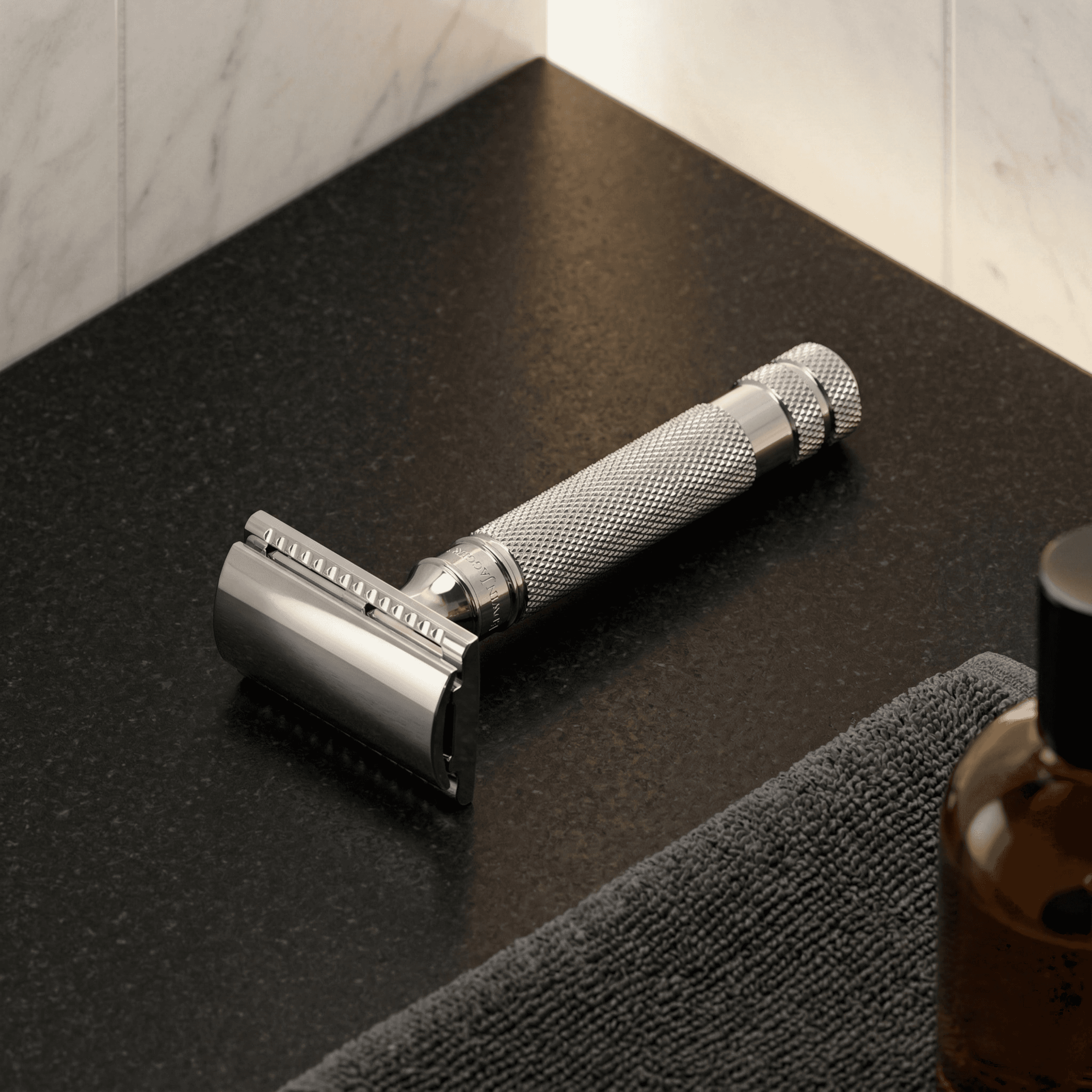
The terms that are growing are specific, traditional and high-intent. Single blade razor searches are up 86%, at 3,600 monthly searches. Men’s foil shaver is up 117%, off a smaller base of 720 searches. Safety razor keywords average 19.5% growth across 72 tracked terms, and double edge razor terms are up 18% across 46 tracked terms. Head shaver keywords average 17.2% growth at a competitiveness score of 3, which means high search demand with very few brands optimising for it properly.
For anyone planning content and category pages, this is the finding that should change next quarter’s priorities. The keywords that carried beard-era traffic are declining across hundreds of terms at the same time, and the wet shaving terms replacing them have risen consistently quarter on quarter. The brands that build genuine content depth around close, traditional shaving now will rank for demand that is still growing.
The brands losing organic visibility are the ones most associated with the beard era and with mass-market electric grooming. Salt Grooming, one of the fastest growing brands in our 2024 data, lost 68.3% of its organic visibility in a single year and fell from 7th to 25th, a drop of 18 places. Mankind.co.uk lost 46.8% and fell 11 places. Braun lost 23% of its organic visibility, while its dedicated retail site Braunshop.co.uk grew 54.6% over the same period, which suggests the product-focused store is now ranking for the searches Braun has lost. Manscaped saw its branded search volume fall 33% year-on-year.
The brands gaining visibility tell a consistent story. The English Shaving Company grew 91.6% and climbed 9 places. Pall Mall Barbers grew 101.6% and climbed 11 places. Kent Brushes grew 71.7% and climbed 9 places. Taylor of Old Bond Street grew 20.1% and climbed 4 places. Every one of these brands sells traditional, craft and wet shaving products, and every one of them gained ground in a market that shrank 3.4% overall.
For a marketing team, this is worth taking literally. Catalogue depth in brushes, soaps, blades, razors and aftershave balm is what separates the brands climbing the rankings from the brands that built their authority on beard content and electric trimmers. The search terms that are still rising favour the first group, and the second group has kept losing ground despite their brand awareness.
If your product range skews heavily toward beard maintenance or mass-market electric grooming, you are currently optimising for the shrinking part of the market. Beard trimmers, at 33,100 monthly searches, are down 18.2%. Hair buzzer, at 18,100 searches, is down 18.2%. Beard styler, at 22,200 searches, is down 18.5%. These terms were the building blocks of most grooming brands’ content and SEO strategy. Men’s foil shaver, at 720 searches, is up 117% and sits in genuine opportunity territory. Single blade razor, at 3,600 searches, is up 86%. Safety razor keywords average 19.5% growth and double edge razor keywords average 18%.
There are four practical moves here. First, your category pages should lead with proper, traditional, close shaving as a primary category with real depth, instead of relegating it to a subcategory under beard care. Second, content should build genuine authority around the specific, technical, high-intent questions men are now searching, such as the best foil shaver for sensitive skin or how to choose double edge razor blades. Third, product range depth matters, because the brands gaining visibility in traditional shaving carry real catalogue breadth across brushes, soaps, blades, razors and aftershave balm. Fourth, the wet shaving revival is a legitimate cultural story that national press will cover, and the brands that earned their growth this year did so partly through that kind of editorial coverage.
Taken together, these four moves point a brand toward the product categories and search terms that are still growing while the beard-era terms continue to decline.
Still scrolling? Here's the full 69-page report.
Download the free reportDigital performance reports covering 60+ industries within retail, finance and B2B.