 by Jack
Most of the Google Marketing Live 2026 coverage frames the announcements as Google handing advertisers more power. Smarter bidding. Better AI tools. Richer commerce surfaces. For us, GML 2026 is the year Google finished moving every meaningful control point into its own ecosystem.
Keywords. The daily budget. The attribution model. The checkout.
There’s a reason for that…
What changed?
Google is phasing out the keyword as the thing you target. In its place comes AI Brief, where instead of building lists of keywords you write a prompt for Gemini describing your brand and the audience you want to reach. The model then decides for itself which search queries are a good match for your ads, rather than you specifying them directly.
There are a few practical changes to be aware of. From September 2026, any campaigns that rely only on broad match, as well as Dynamic Search Ads, will be moved across to AI Max automatically, so this isn’t something you opt into. You should also know that pinned assets in your Responsive Search Ads will no longer be respected once you switch on URL Expansion or URL Inclusions. In other words, the moment you enable those features, Google is free to generate and serve content that overrides the assets you’d deliberately pinned in place.
The bigger point is that the part of the system you used to control directly, choosing which queries trigger your ads, is now handled by Google’s model instead. You’re describing intent and letting the model interpret it, rather than setting the targeting yourself.
Daily budget changes
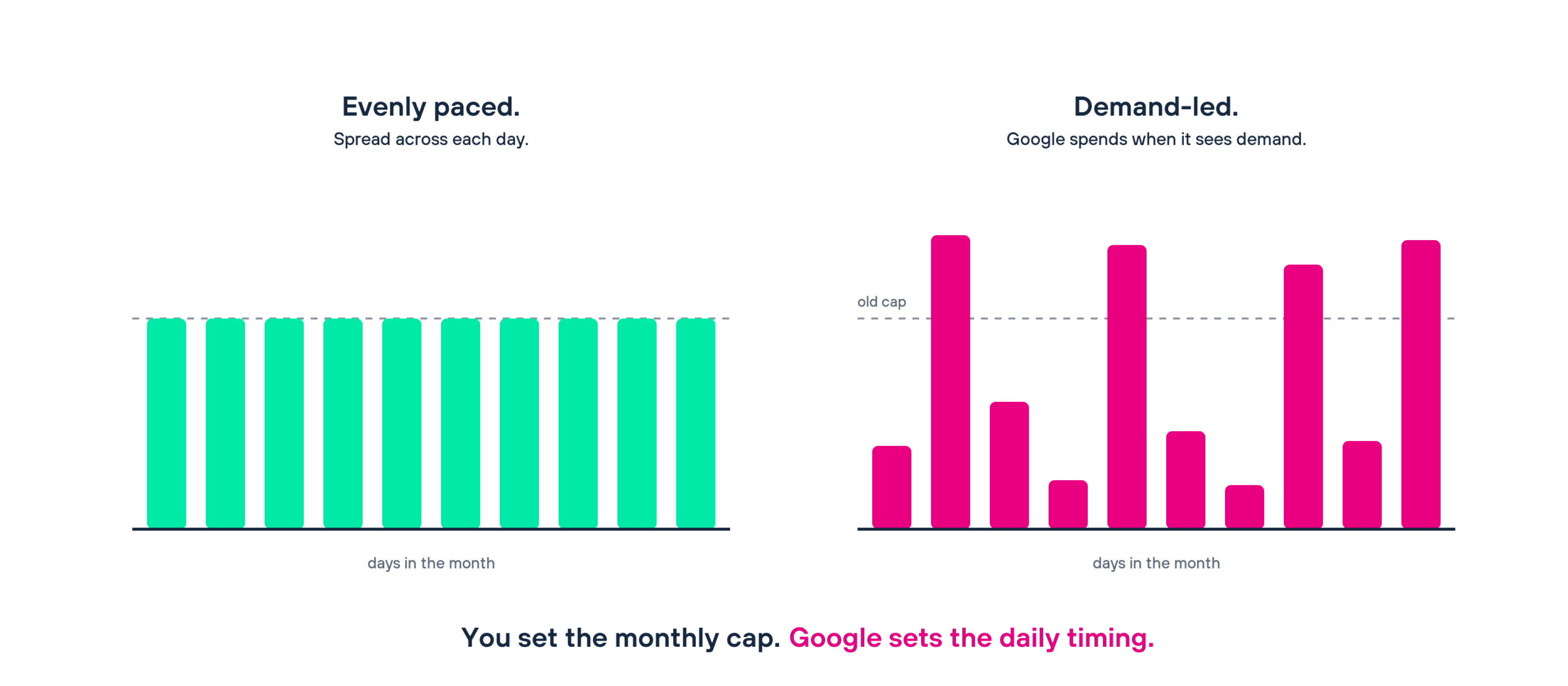
Demand-Led Budget Pacing removes the linear daily cap. Josh Braverman, Group Product Manager at Google Ads, explained the mechanic in a Google blog post on 20 May 2026: with demand-led pacing, Google AI optimises spend to follow consumer demand. It captures more on peak days and reduces spend on slower days, while staying inside monthly budgets and daily caps.
The practitioner response was immediate. Brooke Osmundson at Search Engine Journal flagged the operational pain: budget management challenges for anyone running scripts or third-party platforms, because those systems typically rely on predictable daily spending patterns. If your finance team enforces linear pacing through a script, the script now fights the platform.
Google’s compensating offer is the Campaign Total Budget. Set a fixed total alongside start and end dates, and the system paces inside the window. Anu Adegbola at Search Engine Land, writing on 7 May 2026, noted Google’s own reported impact: advertisers using total budgets have seen a 66% reduction in manual budget adjustments. That number is the one Google chooses to lead with. The trade is real. You give up daily cadence, you get back a third of your manual work.
Changes to attribution…
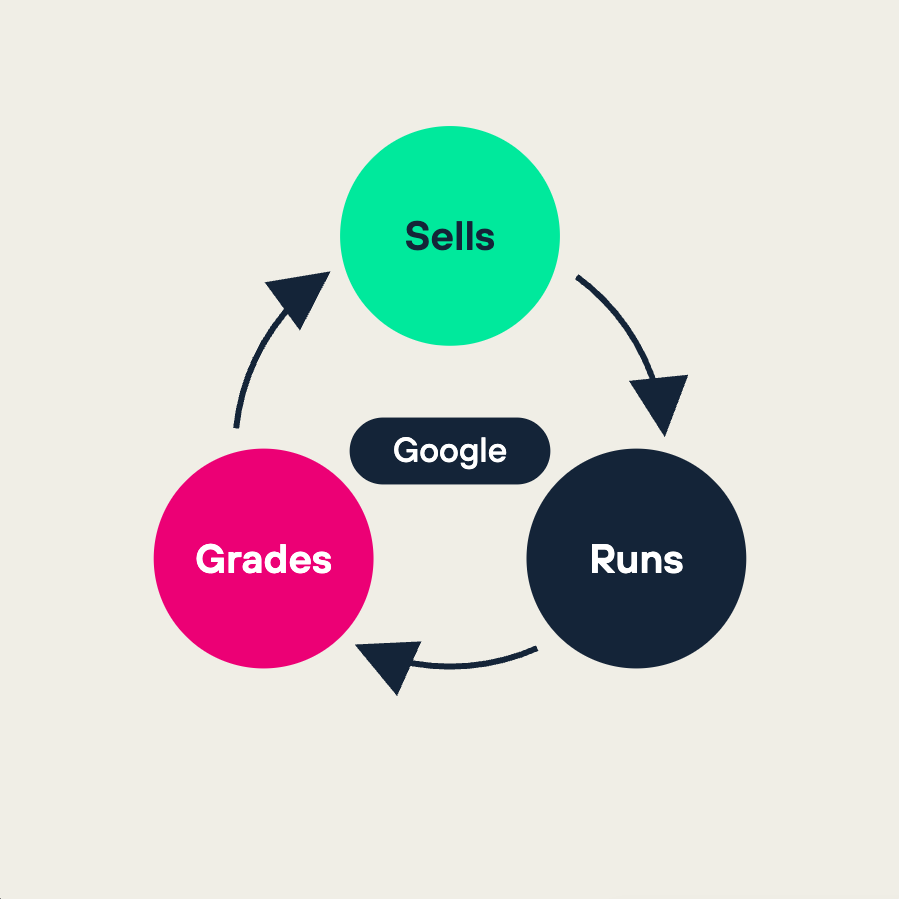
Qualified Future Conversions is the part of the announcement set where the closed-loop pattern is hardest to miss. Gemini predicts the long-term revenue value of upper-funnel exposure by linking ad impressions to leading user actions that happen afterwards. Google sells Demand Gen as a top-of-funnel product. Google’s AI predicts the future revenue Demand Gen will produce. Google reports that future revenue back to you as proof Demand Gen worked.
The supplier sells the product, predicts the outcome, and grades the result.
Anu Adegbola positioned QFCs alongside Journey-Aware Bidding and Meridian, the new MMM suite, as Google’s wider attempt to move advertisers “from constant optimisation toward providing strategic inputs and trusting AI systems.” That’s accurate as a description of Google’s direction. It’s also a description of where the grading authority is moving.
Checkout is the most operationally disruptive one
Universal Cart and the Universal Commerce Protocol pull the transaction off your site and into Google’s interface. Vidhya Srinivasan, VP and GM of Ads and Commerce, described the shape in a Google blog post on 19 May 2026: Universal Cart works across merchants and across services, so you can add things to your cart while browsing Search, chatting with Gemini, watching YouTube or reading Gmail.
The retailer becomes a feed and an order receiver. On-site CRO bypassed. Post-purchase upsells bypassed. Frictionless checkout is rolling into the US this summer, with YouTube and Gmail next, then expanding to the UK in the coming months. No firm UK date yet.
Ashish Gupta, Google’s VP and GM of Merchant Shopping, was careful in a Digiday interview on 25 May 2026: “We are not a retailer, we are not a marketplace, and that approach continues to guide us in this agentic era as well.” Maybe. The architecture says something different. Molly Schonthal, Managing Director of Agentic Commerce at VML, gave Digiday the wider read: “Google’s roadmap is likely the beginning of a broader restructuring of commerce around AI agents and assistant-driven decisioning.”
Nicole Olbe, Managing Director at Adyen, told Startups.co.uk on 27 May 2026 what UK retailers need to plan for: “This shift will fundamentally change the checkout experience, and retailers must prioritise the underlying payment infrastructure.” Payment infrastructure isn’t usually a marketing problem. Under UCP, it is.
The numbers on AI Overviews
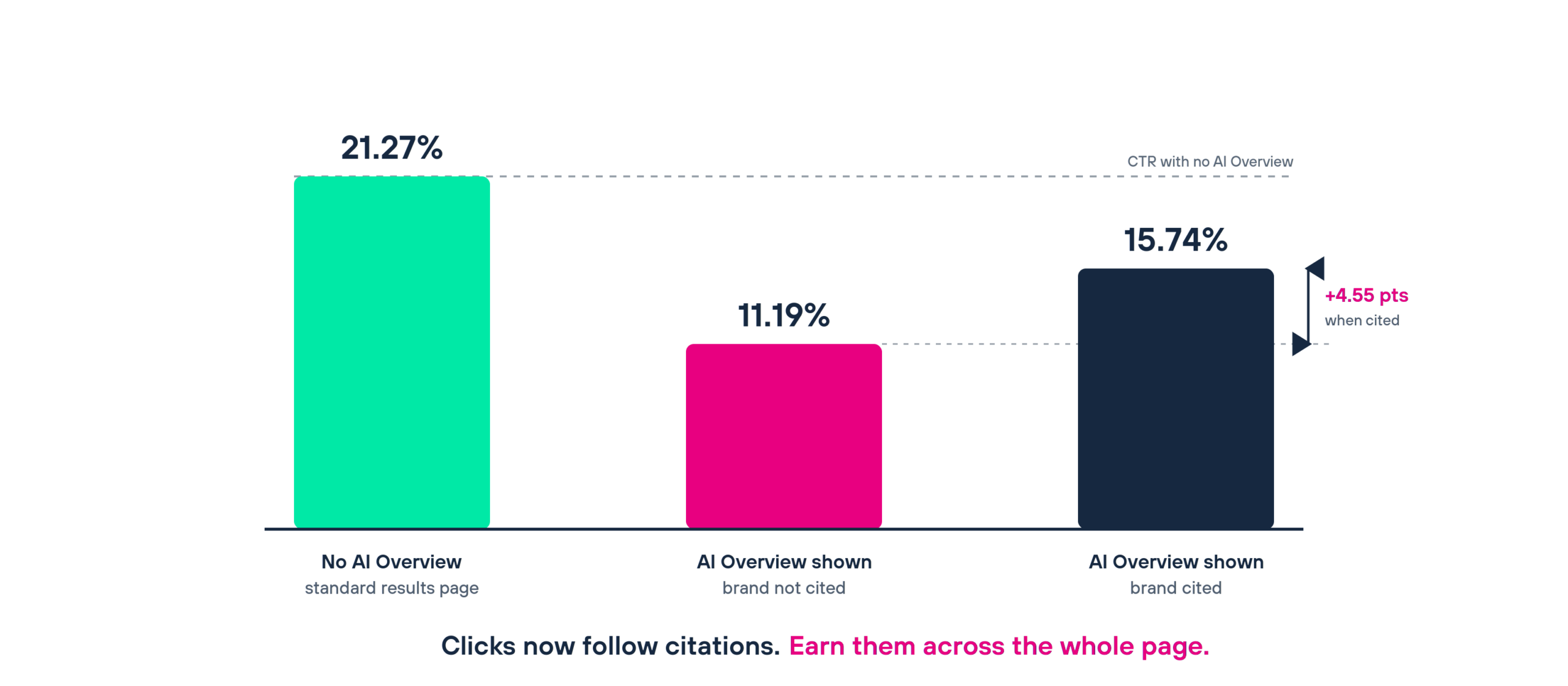
The hardest data in the GML run-up came from Seer Interactive’s 2026 update on AI Overview impact: 53 brands, 5.47 million tracked queries, 296.9 million paid impressions, January 2025 through February 2026. The number that gets quoted everywhere is the comparison: informational queries with a cited brand averaged 15.74% paid CTR; without citation, 11.19%.
The nuance most coverage strips out: the gap is narrowing. Seer’s April 2026 update tracks paid CTR when an AI Overview is shown across 2025. It started the year at 14.6% and rose to 16.2%. Non-AIO CTR fell from 26% to 21.8% over the same period. So the headline “AI Overviews kill CTR” is broadly accurate at the moment-in-time level. It’s also a story that’s already changing. The platform is recovering some of the click loss, and the gap between cited and non-cited brands is closing.
Either way, whether your ad gets a click is now substantially decided by whether Google’s own AI cites your brand in its own summary.
None of this is new behaviour.
Every Google Ads product release since broad match has arrived with the same pitch. Better efficiency. Better automation. Less manual work.
Smart Bidding moved the bid lever inside the platform. Performance Max moved the channel allocation lever inside the platform. AI Overviews moved the SERP layout lever inside the platform. Each one shipped on a slightly different efficiency story. Each one consolidated control.
GML 2026 is the most aggressive version of the same fifteen-year playbook. The novelty in 2026 is the scope. The last few external levers are being taken at once.