by Sean
How Britain’s most loved online travel agent became an organic powerhouse
Ever clicked on a travel guide only to read bland copy that could have been written by a robot, or by a content exec who’s never been to the place they’re writing about? I feel your pain.
Luckily for holiday hunters, not every online travel agency chases keywords over humans. Most brands churn out thin, programmatic, location content. Loveholidays does the opposite.
They’ve been publishing rich destination guides with everything you’d need to plan a holiday there:
- Weather
- Key attractions
- Best resorts to stay
- Best hotels
- Best packages
- Things to do
- Beach information
- Food & Drink
- Nightlight
- Planning advice
- A ‘Prices last checked at 13:41 12 August 2025’, which is updated by the day
- TrustPilot Reviews
- Payment options
The online travel agent industry
The online travel market is exploding. Global gross travel bookings are forecast to hit $1.72 trillion in 2025. And online bookings will account for nearly 65 % of all travel purchases by 2026. Travellers rely on search engines and review sites more than traditional agents. Plus, 75 % of leisure travellers are inspired by social‑media posts. Salience’s dataset of more than 100 travel booking engines shows a familiar pattern within our rankings.
Giants like TUI dominate with 9,237,381 organic traffic, but growth has stagnated, with organic traffic shrinking 1% year over year. Loveholidays, a relatively young online travel agent launched in 2012, has been gaining share of voice by investing in evergreen, human‑written content. Instead of flooding Google with millions of templated pages, Loveholidays commissions travel journalists to produce detailed guides such as “Ibiza for Families” and “A history lover’s guide to Morocco.”
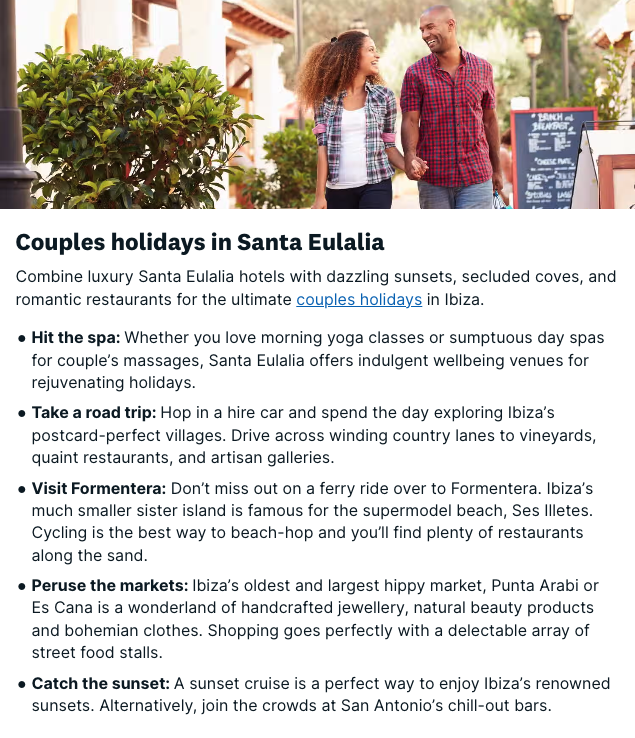
These guides are structured with chapters (introduction, what to do, what to eat, where to stay) and offer clear facts like travel time, currency and best time to visit. They even cite UNESCO and airport traffic statistics, building authority and trust. The result? Rather than breathless “paradise found” prose, the copy acknowledges downsides (peak crowding, cost) and offers alternatives. This honesty resonates with readers and search engines. Guides link to relevant holiday packages and blog posts, gently nudging users further down the booking funnel without interrupting the narrative.
Conclusion
You don’t need millions of pages to compete; a portfolio of well‑researched guides can build authority and links. Depth wins over breadth. In an industry addicted to scale and automation, Loveholidays stands out by treating travellers like people, not clicks. Their guides mix hard data with vivid stories and make it easy to plan a trip. The numbers speak for themselves: 20% organic growth, 1,220,000 average monthly brand searches and a rapidly increasing share of voice.
What Next?
- Want more insight into the travel booking industry? Read our 2025 travel booking industry analysis piece.
- Need hands‑on support? Learn more about our eCommerce SEO service and see how we build “search for humans, not algorithms.”
- Want some more data on the travel booking industry? Get our free 69-page travel booking industry data report.
- Want more content like this delivered daily? Connect with Michael or myself on LinkedIn, where we share regular insights, practical tips, and industry analysis to help you stay ahead of the curve.