by Sean
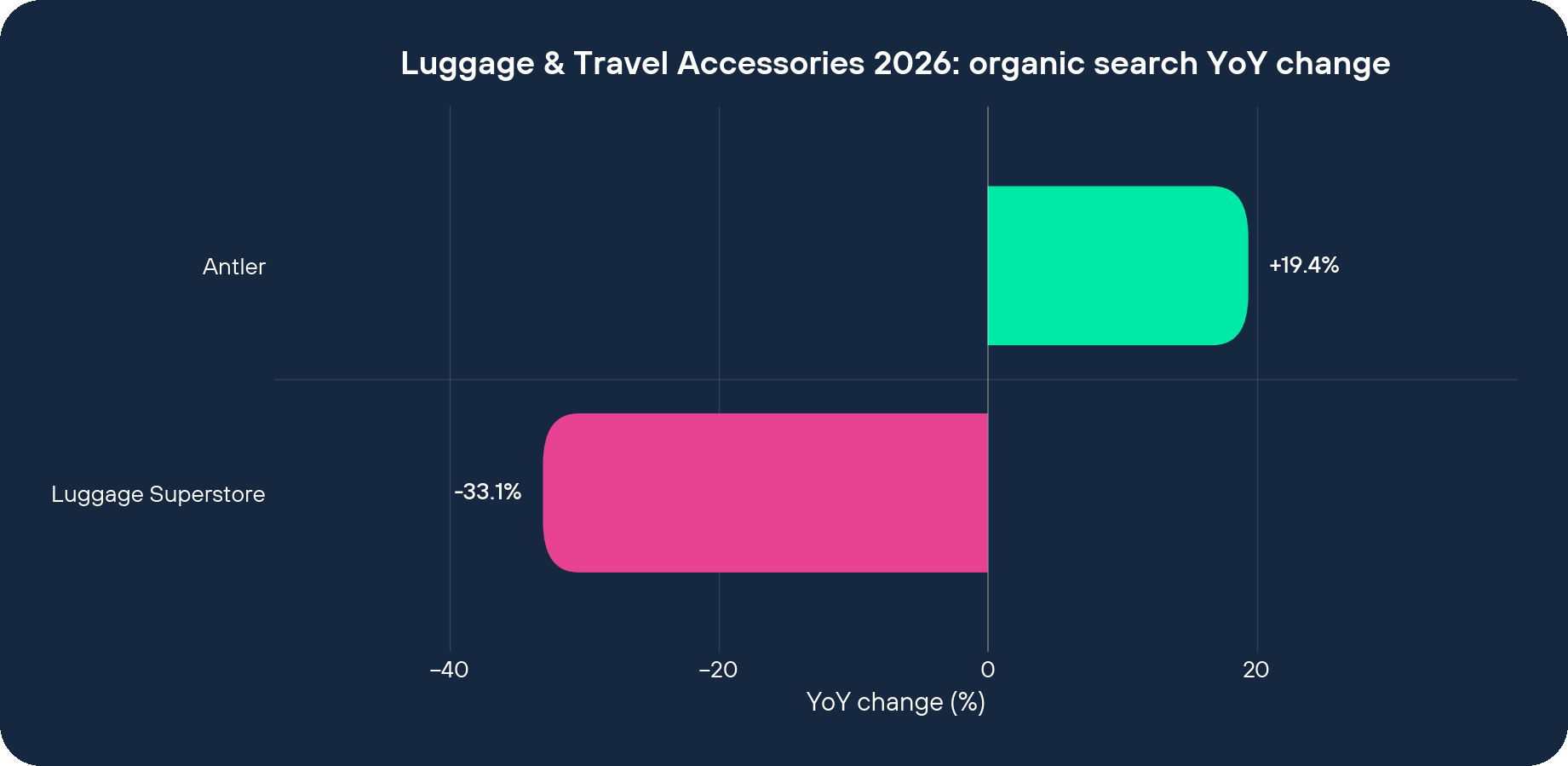
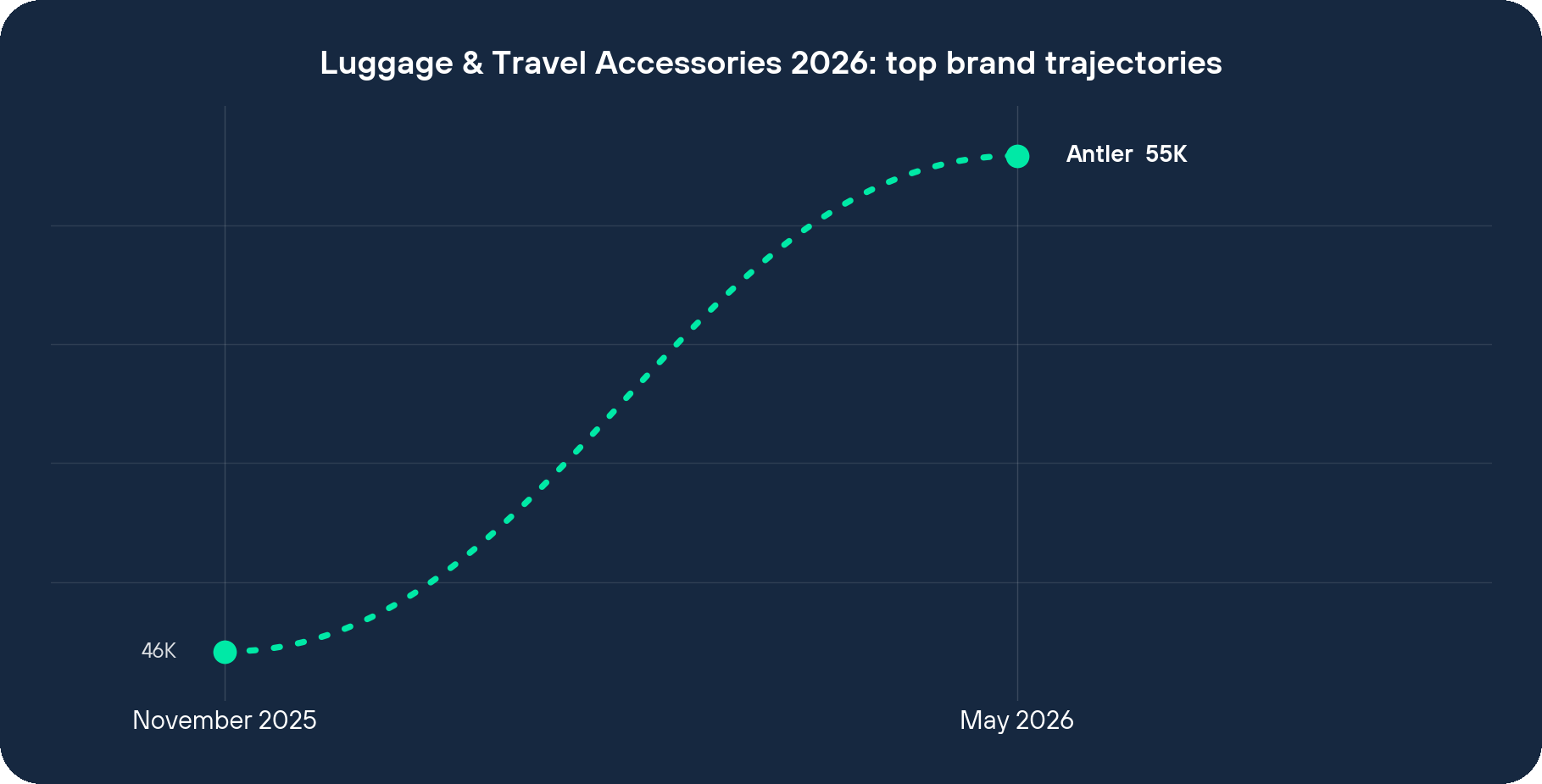
Across the UK luggage sector, nine of twelve multi-brand retailers lost between 22% and 71% of their organic visibility in the six months between November 2025 and May 2026. In the same window, Antler, a brand-direct site selling its own luggage from antler.co.uk, added 9,000 organic visits and posted a +19.38% rise that put it 29.28 percentage points ahead of the wider luggage market.
6-month data refresh. Mid-cycle update of Salience Index Luggage & Travel Accessories data, not the full report. Request the latest refresh data.
That movement isn’t extraordinary in isolation. What makes it worth profiling is where the growth came from and which sites, specifically, lost it.
The data picture
Antler’s organic visibility went from 46,443 monthly visits in November 2025 to 55,443 in May 2026, a +9,000 swing, +19.38% in six months, against a luggage market index that contracted 9.9% over the same period. Antler holds rank 5 in the dataset of 111 brands.
The brand-direct cohort all moved in the same direction. Tripp +13,649. Eastpak +16,639. Osprey +10,477. Briggs & Riley +6,905. Globe-Trotter +2,426. Tusting +2,446. Add Antler and you have roughly 61,500 organic visits gained by brand-owned sites in six months.
The multi-brand retailer side: Luggage Superstore -13,219. Travel Luggage Cabin Bags -10,880. Wardow -14,674. Caseluggage -3,330. Swiss Store -2,401. Skyflite -1,289. Roughly 45,800 visits lost across that cohort alone. The numbers don’t sit quite at parity, but the direction of travel, gains concentrated on brand-owned domains, losses concentrated on the retailers that aggregate them, is hard to read any other way.
What’s on Antler’s actual site
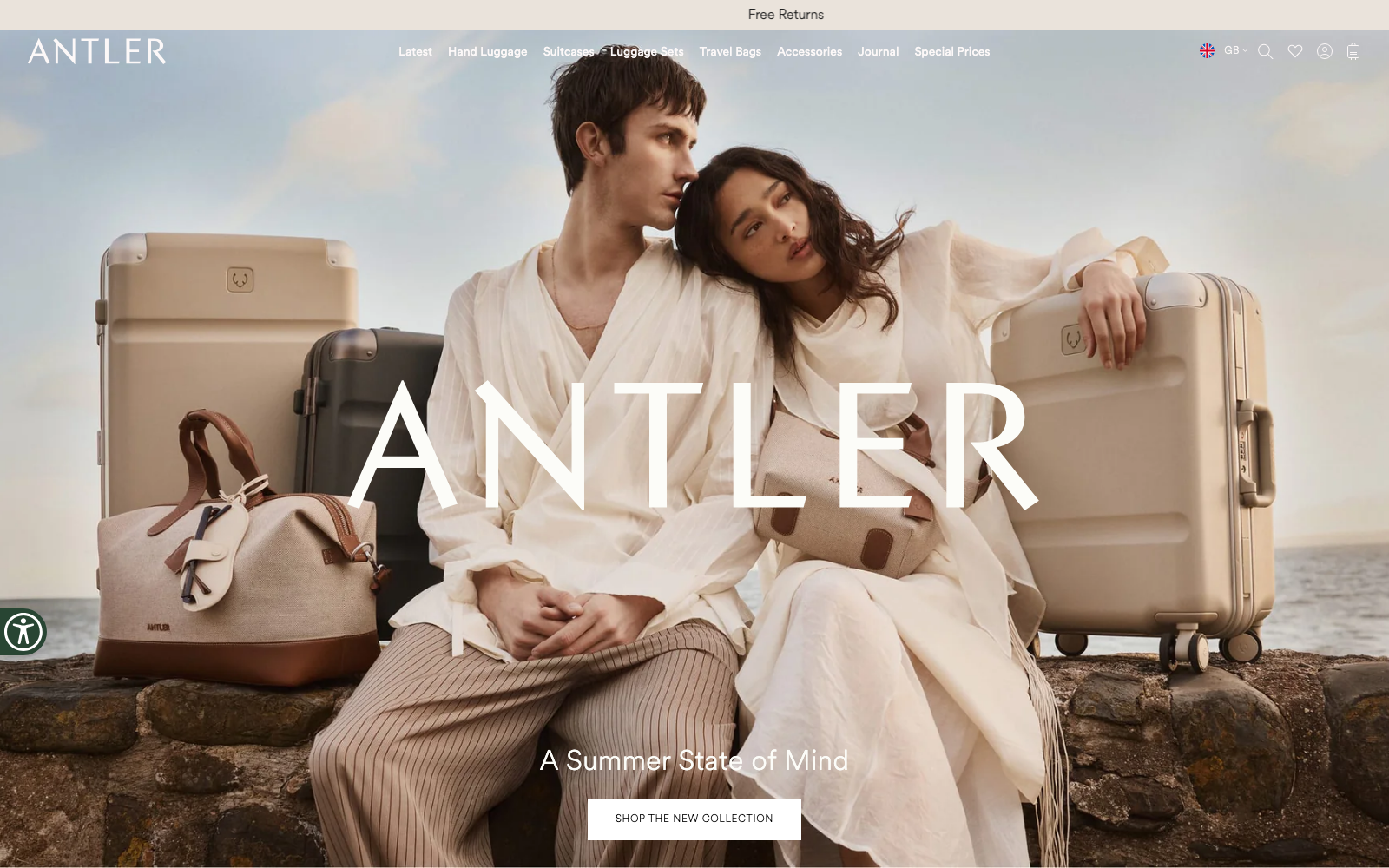
The trust band at the top of antler.co.uk, the strip of icons most ecommerce sites use for delivery promises and returns guarantees, is doing something different. There are five items in it, and only two are conventional ecommerce table stakes. The full list: Free Delivery on Luggage, Free Returns, New Regent Street Store Now Open, Lifetime Warranty on Luggage, Over 110 Years of Expertise.
A heritage statement, a physical retail flag, a product guarantee that implies confidence in build quality, and two delivery/returns lines. The 110-year claim and the lifetime warranty are exactly the kind of declarative, dated proof points an AI Overview reproduces near-verbatim when summarising a brand recommendation. They are quotable as written.
The collection naming follows the same logic. Heritage Collection, Discovery Collection, Soft Stripe 2.0, these are proper-noun product lines with their own URLs, their own editorial framing, and their own SERP footprint. When an AI Overview names “the Antler Discovery Collection” as a recommendation, the destination is a brand-controlled landing page on antler.co.uk. When it names “best cabin suitcase for hand luggage,” the destination used to be a comparison page on a multi-brand retailer. That distinction is the whole story.
Antler’s ‘Our Stories’ editorial section, heritage features, design notes, travel content, is the kind of brand-owned long-form content AI Overviews cite when the user asks anything that orbits the brand. It is also the kind of content a multi-brand retailer structurally can’t produce, because they don’t own any of the brands and can only describe them from a sales-floor perspective.
What’s on Luggage Superstore’s site
Luggage Superstore is the cleanest contrast in the dataset. -33.06% / -13,219 organic visits, rank 13, the single largest absolute loser on the retailer side.
Their homepage opens with FREE 60 Day Returns, Rated Excellent 4.8 on Reviews.io, Buy Now Pay Later, Next Day & Same Day Delivery. The navigation runs Hard Luggage, Soft Luggage, Cabin Luggage, Business Bags, View All Brands. The brand page is an A, Z list, American Tourister, Brics, Caribee, Delsey, Eastpak, Jansport, Joules, Kipling, Pierre Cardin, Porsche Design, Samsonite, Travelpro, Victorinox.
Those are good signals for a transactional shopper who has already decided which brand they want. They are weak signals for a discovery query, because every brand on that A, Z list has its own .com or .co.uk with its own heritage story, its own product imagery and its own collection naming. When an AI Overview is choosing what to summarise for “best cabin suitcase UK 2026,” it has a choice between a brand-owned page that says “Since 1914, designing and manufacturing quality luggage” and a retailer category page that says “Cabin Luggage.” It picks the brand.
The Luggage Superstore proposition is sharp on conversion. Their PLPs are well-merchandised, their reviews are real, their fulfilment terms are competitive. The visibility loss is happening upstream of conversion, at the point where a user is still working out which brand to buy. Once the AI Overview names Antler, Samsonite and Tripp directly, the user clicks the brand. The middleman has no remaining function in that journey.
Things that probably also matter
Antler’s +19.38% has more than one driver, and any honest read on the data needs to name them.
The Regent Street store opening, flagged on the homepage as a recent event, is a brand-marketing investment that drives brand-name search regardless of any AI Overview dynamic. People walk past a London flagship and Google the brand later that evening. Antler has been actively visible in trade and consumer press through the comparison period, and any sustained PR programme lifts brand-name organic queries on its own.
The November 2025 → May 2026 comparison also flatters travel-category brands modestly. November sits in the back half of a soft buying cycle and May sits inside the spring/summer travel build. Some of the +9,000 is seasonality being read as growth.
The honest read on Antler is that several tailwinds landed at once. AI Overview routing is one of them, and the data fits the pattern unusually cleanly, the retailer cohort lost ground at roughly four times the market average rate in the same period, which is the signature you’d expect if upstream comparison-page demand was being absorbed at the SERP. Pricing, distribution, the Regent Street opening, and the underlying lift of the spring travel cycle are all in the mix too. Pulling apart how much of the +9,000 belongs to which driver isn’t possible from this dataset alone.
What the example shows
Antler is in this position because it owns its product story end-to-end. The named collections, the lifetime warranty, the dated heritage claim, the editorial section, the flagship store, these aren’t tactical SEO assets put in place to chase AI Overview citations. They were built up over years for brand-equity reasons, and they happen to be exactly the artefacts an AI Overview cites because they’re declarative, brand-controlled and rich in proper nouns.
A multi-brand luggage retailer in 2026 doesn’t have an obvious counter. They can’t write a “Since 1914” story for a brand they don’t own. They can compete on price, on delivery terms, on returns windows, on customer service, Luggage Superstore is competing on all four, but those are conversion-stage strengths. The visibility loss is happening earlier.
What Antler illustrates is that the brands which built proper editorial and heritage infrastructure pre-AI-Overview are now the ones being cited inside the AI Overview. That’s a benefit of having already done the work for a different reason, over a long enough period that the work has texture and detail to it.
A brand starting that work now has the harder problem, not because the playbook is unknown, but because authenticity and dated provenance are exactly the things that can’t be retrofitted at speed.