 by Michael
This week Google added a property type to Search Console called platform properties. You can now verify your brand’s Instagram, TikTok, X and YouTube accounts and see how that content performs in Google Search and Discover, down to the individual post and the individual query. It’s rolling out over the coming weeks.
TL;DR
Google’s new platform properties report only measures how your social content performs on the slice of discovery that flows through Google, not on social itself, and it inflates impressions while letting clicks resolve inside Google’s own walls. There are now two systems competing to claim credit for the same TikTok, and whichever number you trust decides where your budget flows next. Adopt the tool, but don’t adopt its worldview.
The industry reaction has been near-unanimous and near-identical: social is a search surface now, here’s the dashboard, go and measure it. Every SEO publication ran the explainer. The social agencies did a victory lap. Even the sharper strategists landed on “search is fragmented, optimise everywhere,” which is true, and which is now the consensus take.
We want to make the opposite case. Not because the update doesn’t matter. Because it matters for a reason almost nobody is naming.
What the report actually measures
Read the small print, not the announcement. Platform properties show you clicks and impressions for your social content on Google Search and Discover. Google’s own help documentation is explicit that it does not count when someone sees your content inside TikTok or Instagram itself.
So the number you’re about to get isn’t “how my social content performs.” It’s “how my social content performs on the slice of discovery that flows through Google.” Those are very different things, and the gap between them is where the trouble starts.
Two features of that slice matter. It leans heavily on Discover, a feed where impressions routinely dwarf clicks. And it sits on surfaces where Google has spent three years getting better at keeping the user inside the result.
Then read Google’s own footnote, because it sharpens the point. When your video appears and someone taps it, that counts as a click even if it opens inside Google’s own viewer rather than on your TikTok. So the click here doesn’t reliably mean a visit to your property either.
Impressions inflated by a feed you don’t control, and clicks that can resolve inside Google’s walls rather than yours. Neither metric is quite the thing it appears to be.

If that pattern sounds familiar, it should. It’s the exact mechanism that hollowed out website click-through while rankings held steady. We’ve tracked it across the entire client book in the Salience Index: brands holding position one and losing clicks anyway, because position one became position zero.
Google has now pointed that same mechanism at your Reels and handed you a dashboard to admire it on.
The vanity metric nobody’s warning you about
Here’s what’s going to happen over the next quarter. Data starts flowing. A CMO opens Search Console and sees their brand’s TikToks pulling tens of thousands of impressions from Google. It looks like reach they’re capturing. Someone puts it in a board deck.
Most of it is reach Google is capturing, with your content as the raw material. Same trap as celebrating a top ranking while the click never comes. Visibility is not traffic. You already know this about your website. This is the identical argument, one surface across, and right now you’d be one of the only people making it about social instead of cheering the impressions.
That’s the takeaway to protect your team from: a new number that goes up is not the same as a new number that means something. Before anyone reshapes strategy around this data, they need to know what it counts and what it leaves out.
Here’s what makes this genuinely significant, and why the industry is right to pay attention, even if they’re naming it wrong. For the first time, a single dashboard is attempting to connect your brand’s footprint across multiple surfaces in the discovery loop; your TikToks, your YouTube content, your Instagram, all appearing alongside Google’s own surfaces in a single view. That’s the direction measurement needs to go. The problem is what it measures and whose interests that serves.
Why attribution fails your customers’ actual journey
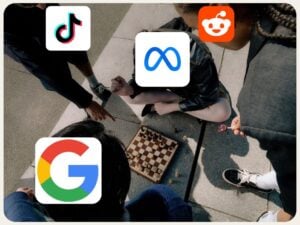
The problem runs deeper than platform competition. Buyers in 2026 don’t move linearly. They discover a brand on a TikTok, see it resurface in Google Discover, search it on Google, find a Reddit thread, and come back three weeks later via a branded search. That loop – the messy middle – plays out across multiple major surfaces. No attribution model has ever been able to see all of it. Google’s new tool doesn’t solve that. It just gives Google’s slice of the loop the most credible-looking data
There are now two systems competing to claim credit for the same TikTok. The platform’s native analytics say the post drove reach and engagement inside the app. Google’s new report says it drove impressions and clicks in Search and Discover. Both are measuring the same piece of content. Neither sees the whole picture. And whichever number your brand decides to trust decides where your budget flows next.
Google just made the first move in that war. By giving you clean, first-party, query-level data, it makes its version of social performance feel the most credible, the most measurable, the most real. And its version conveniently draws your attention toward the part of social discovery Google can see and monetise, at the exact moment the actual behaviour, especially among younger buyers, is moving toward search that happens natively inside TikTok and Instagram.
Reshaping your social strategy around Google’s view of social is therefore a live risk, not a hypothetical. The tool is genuinely useful. It’s also not neutral.
It’s a well-built instrument for measuring the world the way its maker would prefer you measured it.
The quieter trade
One more thing worth a line in any board conversation. To get the dashboard, you verify the link between your social accounts and your brand. That’s the first time Google has let you claim properties on domains you don’t own, and it’s being reported as a gift.
It runs both ways. You hand Google a confirmed, first-party map of your brand across the web, which is precisely the entity data that feeds its AI surfaces and its understanding of who you are. You get a reporting view. Google gets a cleaner model of your entire digital footprint, straight from the source. The reporting is the carrot. The entity graph is what Google is buying. Worth knowing who’s paying.
What we’d actually do
Not “ignore it.” The data is real and you should have it. But treat the rollout as a diagnostic, not a scoreboard.
✓ Define your commercial outcome first – revenue, pipeline, incremental sessions and work backwards from that when interpreting any platform-reported metric. If a number doesn’t connect to a commercial outcome, it’s useful context at best.
✓ Claim your platform properties the moment they appear and baseline immediately, so you own a clean “before.”
✓ The moment data lands, separate impressions from clicks and watch the ratio, because on these surfaces that ratio is the whole story.
✓ Cross-check Google’s numbers against your native platform analytics rather than picking a winner, and treat the two as answering different questions.
✓ Put SEO and social in the same room to read this together, before anyone builds a target around a number they don’t yet understand.
The bottom line
Social as a search surface stopped being a prediction some time ago. That part is settled, and everyone’s saying it. The unsettled part is whether ‘performing’ gets defined by attribution logic, who claims the credit – or by measurement: what actually moved a commercial outcome. And Google has just cast the first vote in its own favour.
The brands that win from here are the ones that adopt the tool without adopting its worldview. They’ll measure their whole search presence across every surface, they’ll know which numbers are traffic and which are just theatre, and they won’t let one platform’s dashboard rewrite their strategy.
That’s the work we do at Salience: building a view of your search visibility that answers to your commercial goals, not to whichever platform happens to be handing out the prettiest report this quarter.
Want a read on what your brand’s full search footprint is actually worth, across every surface and net of the vanity metrics?