by Sean
The single biggest move in the table
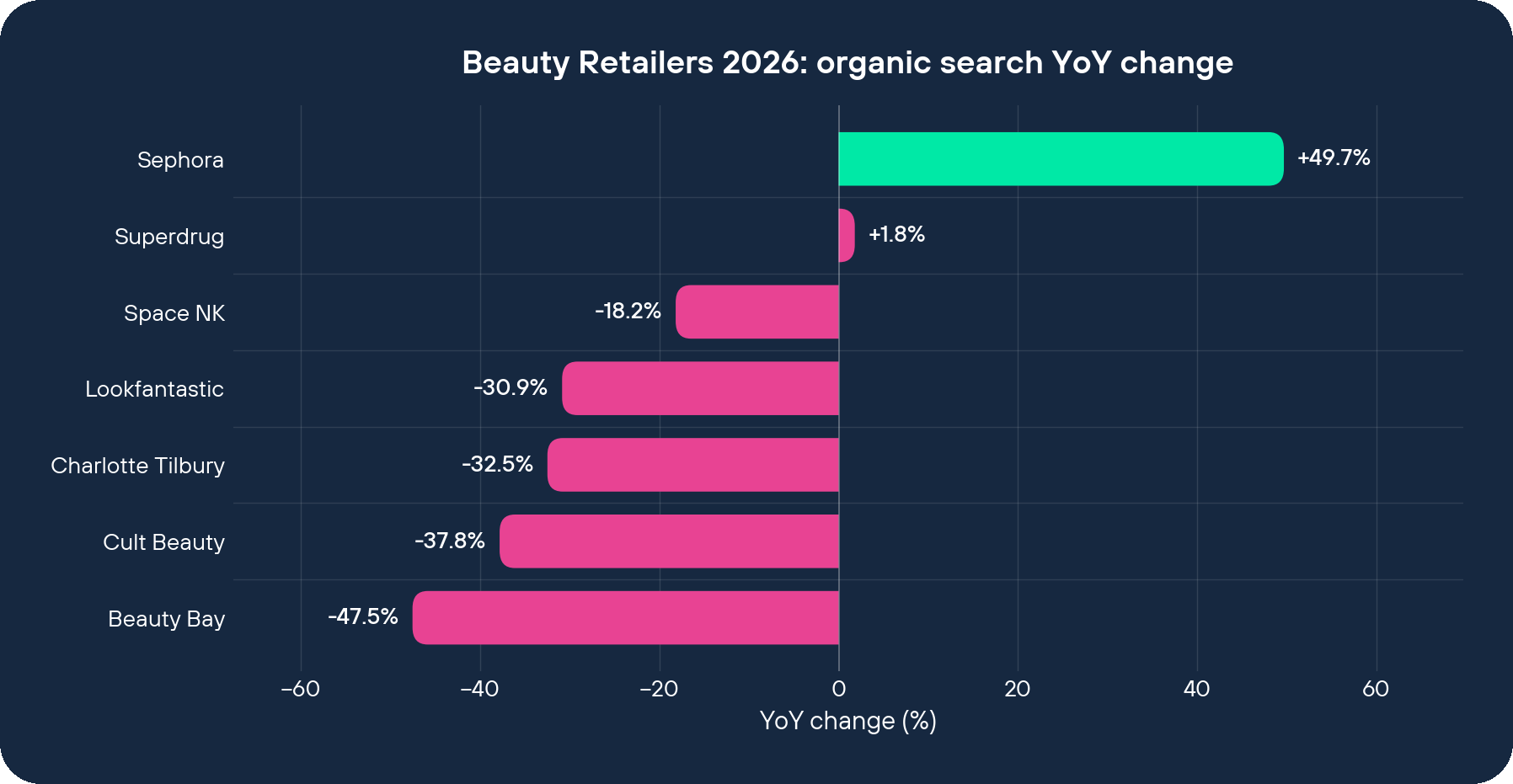
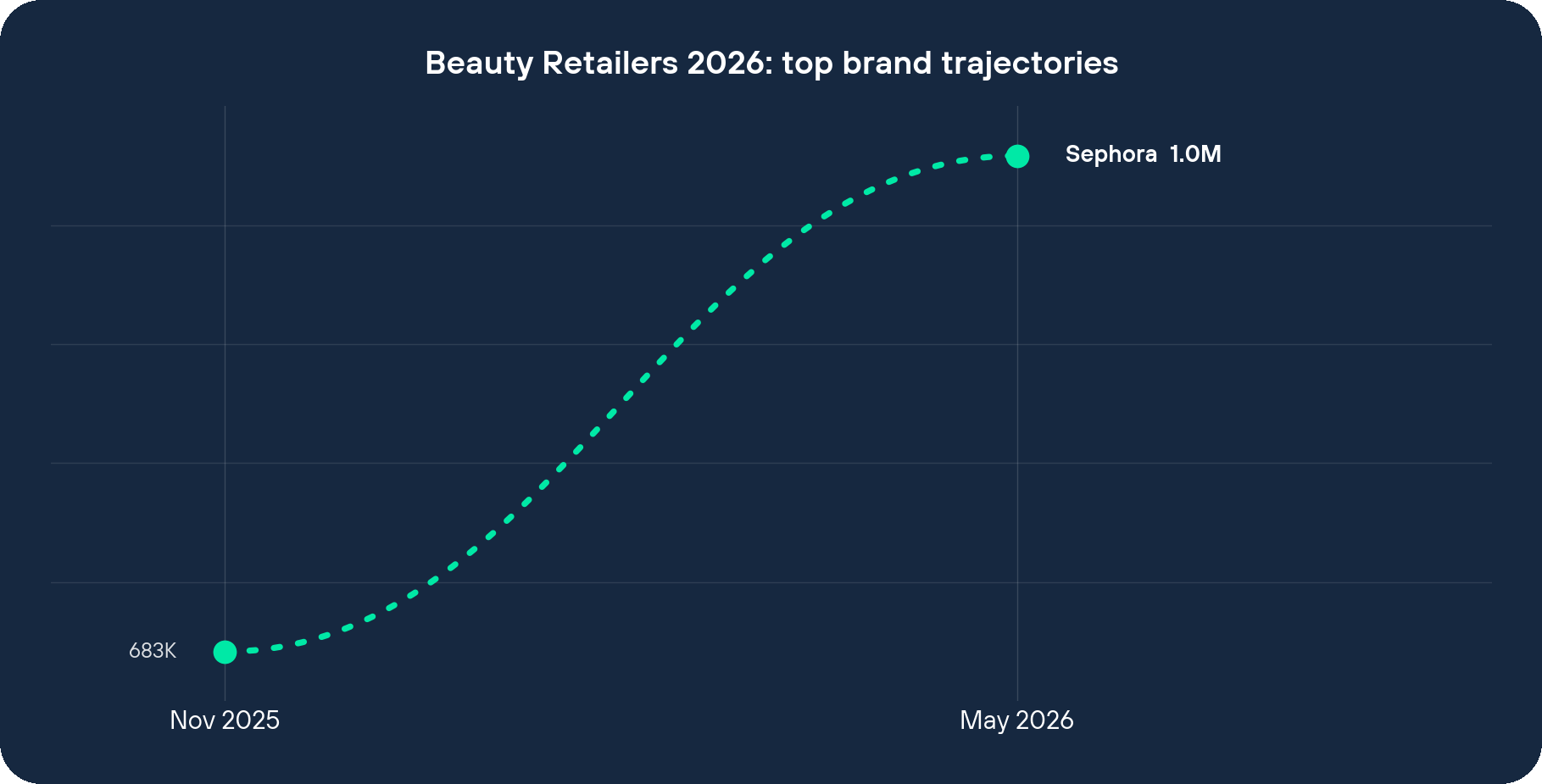
Sephora’s UK site rose from 682,873 organic visits to 1,022,088 between November 2025 and May 2026, a gain of 339,215 visits, or +49.67%, which the dataset records as +61.40% against a market that fell 11.72% over the same six months. That moved it to rank 2 of the 335 brands measured, behind only Superdrug. It is the largest absolute gain anywhere in the table. Click below to access the latest Beauty Retailers market report.
The number is worth a second look because of the company it keeps. Every other prestige multi-brand retailer near the top fell over the same period. Lookfantastic lost 292,386 visits (−30.85%) and sits at rank 5. Space NK fell 18.18% to rank 4. Cult Beauty fell 37.82% to rank 8. Beauty Bay, much further down at rank 38, fell 47.54%. On the brand-owned side, Charlotte Tilbury’s own site lost 243,454 visits (−32.49%). One retailer gained while its direct competitors declined together.
The concentration figures sharpen that. Take Superdrug (+1.80%) and Sephora out of the top ten and the remaining eight fell 19.99%, close to double the headline −11.72%. The top two retailers’ share of the top-ten pool climbed from 48.85% to 56.47%, a gain of 7.62 points, and Sephora is now one of those two.
Most of this is a brand still arriving in the UK
The dull explanation has to come first, because it accounts for a lot of the gain. Sephora is a young business in this market. It left the UK in 2005, bought the British e-tailer Feelunique in 2021, relaunched it as sephora.co.uk in late 2022, and opened its first UK store at Westfield White City in March 2023. It has been opening stores steadily since, across London, Manchester, Edinburgh and Gateshead among others.
A retailer in that phase grows organic visibility quickly almost regardless of how good its SEO is. It laps comparison periods from when fewer people knew it had returned. Every store opening produces a wave of local and branded searches, “sephora trafford”, “sephora near me”, “sephora white city”, and the LVMH marketing budget behind brand campaigns lifts branded search that also surfaces in organic results. None of that is visible in this dataset, and all of it inflates a +49.67% figure that sits on lower starting traffic than Space NK or Lookfantastic carry.
A young brand with that kind of money can buy awareness quickly. Whether it keeps the resulting traffic depends on whether its pages answer the searches that awareness generates, and that is where the site itself starts to matter, which kinds of query Sephora is built to catch, and whether those are the queries that are actually moving in this sector.
What the homepage is set up to capture
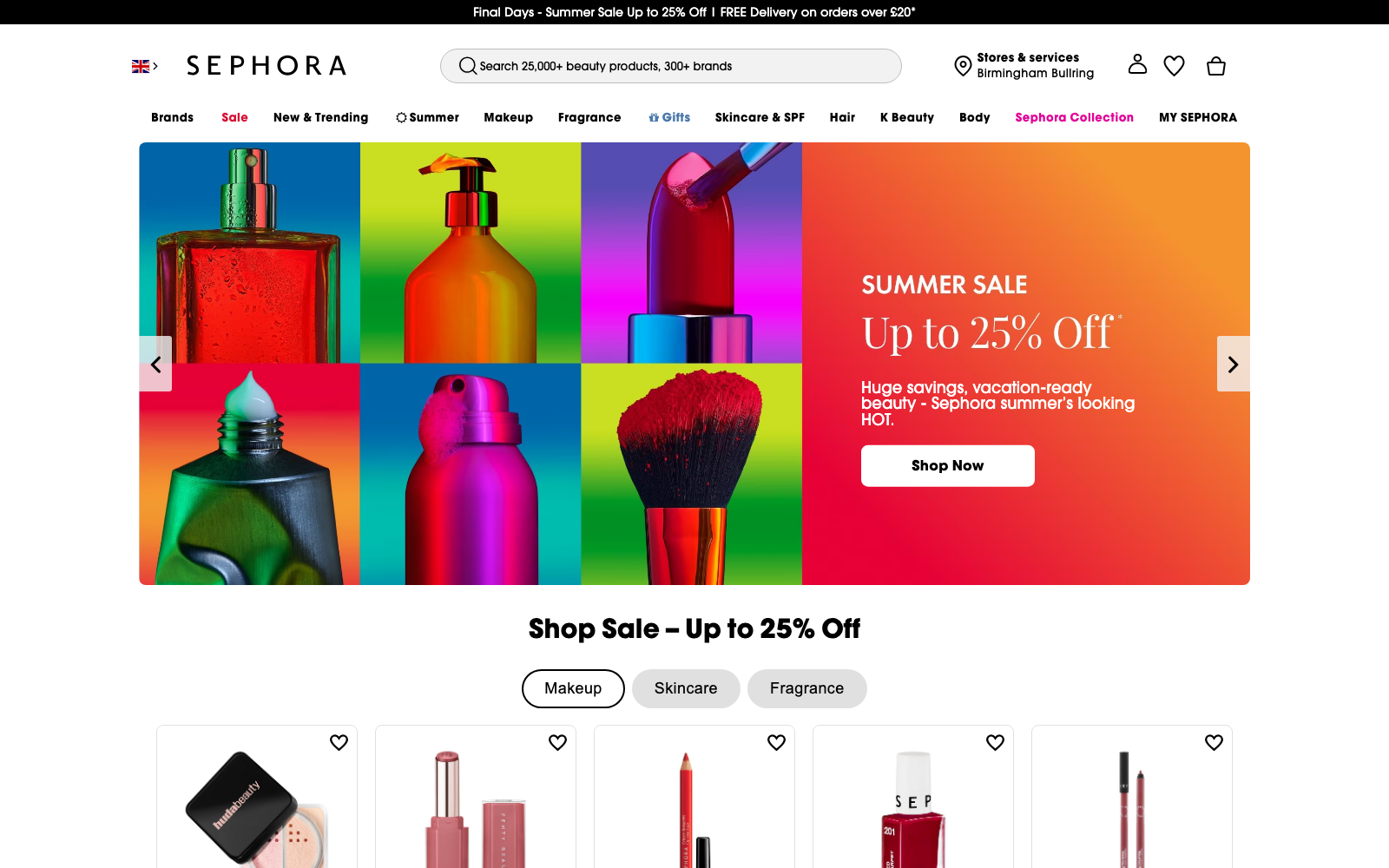
The Sephora UK homepage is organised around helping someone decide what to buy, with discovery tools sitting alongside the catalogue rather than behind it. It runs a Gift Finder, a Fragrance Finder and a Brush Finder, guided journeys that target the long, undecided queries people type before they have landed on a product, the “best fragrance for…” and “which foundation brush” searches that a transactional product page rarely ranks for. It runs an “Explore Our Blog” hub and a “Makeup Trend Predictions” feature, both aimed at informational intent. And it runs themed edits, “K-Beauty”, “Your Best Rated”, “Hot on Social”, that gather browse-intent traffic around a topic instead of a single SKU.
Each of those is a page that can rank for a non-branded research query and then move the visitor into the catalogue, which is what content marketing for organic visibility is built to do. That category of search, somebody investigating before they have a brand or product in mind, is exactly the traffic the prestige e-tailers used to win and are now losing. I can’t isolate how many of Sephora’s 339,215 added visits came through these pages specifically; the dataset doesn’t break down by query. What I can say is that the site is structured to answer the kind of search that is shifting, while several rivals have thinned their editorial and finder content over the same window.
The exclusive brands are where branded demand routes
The clearer line between a Sephora decision and the search data runs through its brand list. “Only at Sephora”, the “Latest Brands” section (PHLUR, ANUA, rhode, Medicube, Biodance) and “Hot Launches” put viral, hard-to-find-elsewhere names front and centre. rhode is Hailey Bieber’s skincare and lip line, acquired by e.l.f. Beauty in 2025 and one of the most-searched new beauty brands of the last two years. ANUA, Biodance and Medicube are K-beauty brands that broke through on TikTok, the same social-led demand traced in Revolution Beauty’s TikTok-driven growth, Biodance’s Bio-Collagen overnight mask in particular generated enormous branded search demand off the back of a single viral product.
When a brand trends and the place to buy it in the UK is Sephora, or Sephora first, the branded searches that trend produces, “biodance mask uk”, “anua toner”, “rhode lip tint where to buy”, have one obvious retailer to land on, provided its ecommerce SEO for category and product pages puts the right page in front of those searches. That demand routes to sephora.co.uk instead of the brand’s own site or a rival e-tailer that either doesn’t stock it or got it later. This is the most direct connection I can draw to the data: securing distribution of viral exclusives generates branded query volume, and Sephora positioned itself as the UK answer to those queries. It is inference from the brand list and what those brands’ search demand looked like, not a measured attribution, but it is a far more specific claim than crediting the gain to general “good SEO”.
Cult Beauty shows the alternative a rival took
Cult Beauty earned its name on curation, being the place to find the cult favourites before the high street caught up. It ranked 8th here after losing 167,575 visits (−37.82%). Its live homepage now leads with discount mechanics: a FIRST15 code for 15% off a first order, an EXTRA10 sale code, a free gift worth £125 over a £75 spend, “our summer sale just got hotter”, 20% off SPF. The hero space that once introduced shoppers to brands they hadn’t heard of now defends order volume on price. There is a confound worth naming honestly: Cult Beauty and Lookfantastic are both owned by THG, and both fell by more than 30% across this period, which points at a parent-group story, investment levels, restructuring, the group’s wider financial pressure, as much as any head-to-head loss to Sephora.
What this tells the rest of the sector
The 49.67% on its own is not the lesson; a good share of it is simply a well-funded brand arriving in a market and building awareness, and that growth rate will normalise as the comparison periods stop being soft. The lesson is which searches Sephora is positioned to catch, guided research and browse queries through its finders and edits, and branded demand for viral exclusives it stocks first, because those are precisely the searches the prestige e-tailers and brand.com sites are losing as their numbers fall 30 to 47%. A new entrant can buy awareness. Holding the traffic that awareness creates is a separate job, and on the evidence of its own pages, that is the job Sephora has built its UK site to do while several of its rivals spent the same six months discounting.
Further reading
- our full beauty sector analysis, it gives a fuller picture of the beauty sector across 100-plus brands, which sets useful context around the single brand this article focuses on.
- our 2026 Male Grooming report, grooming sits next to beauty in most retailers’ ranges, so this report shows whether the same search shifts are playing out in an adjacent category.
- our online pharmacy sector report, Superdrug leads this table and trades as a pharmacy as much as a beauty retailer, so the online pharmacy report covers a closely related set of competitors.