by Sean
Where DrinkSupermarket sits in the category
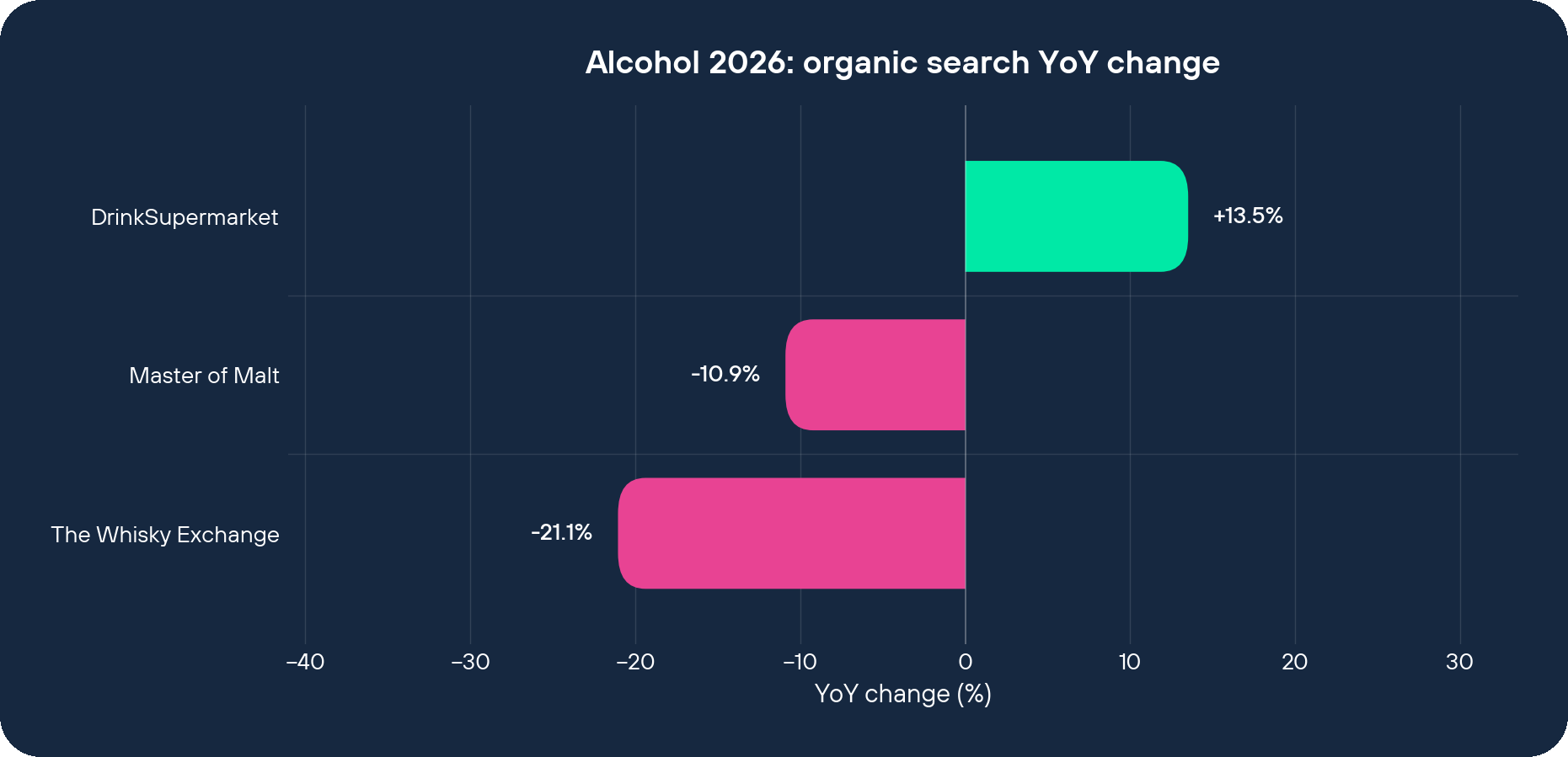
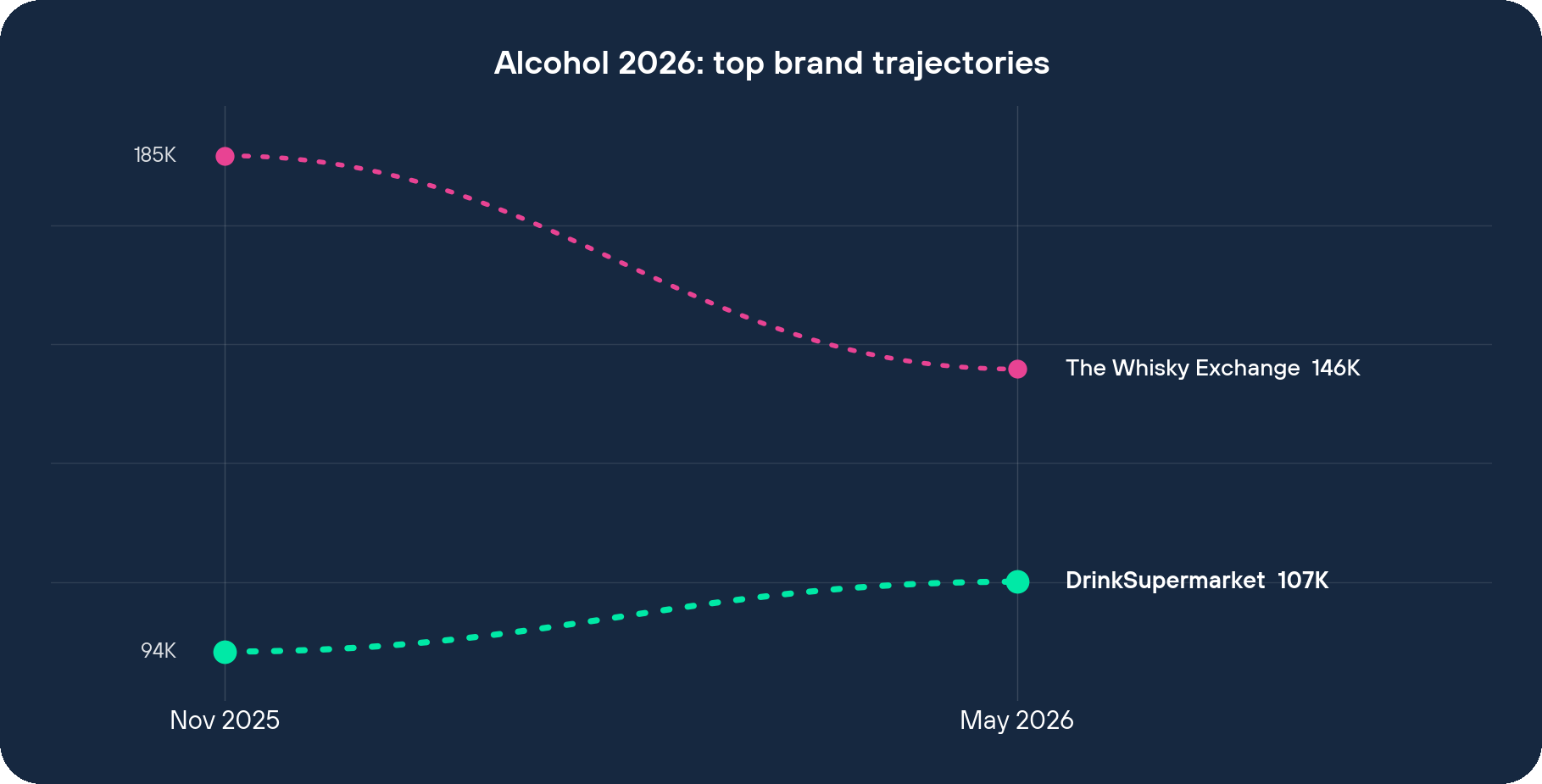
DrinkSupermarket is a broad-range online drinks retailer, beers, wines, spirits, mixers and gifting sold under one roof, and over the six months from November 2025 to May 2026 its estimated organic visibility rose 13.51%, from 94,269 to 107,003, a gain of 12,734. In a dataset of 284 alcohol brands where the market moved just −2.1%, that put it 15.60% ahead of the market and held it at rank 6 by current visibility. For a generalist sitting among deep category specialists, that is a strong six months, and the reason becomes clear the moment you look at what the site is built to do. Click below to access the latest Alcohol market report.
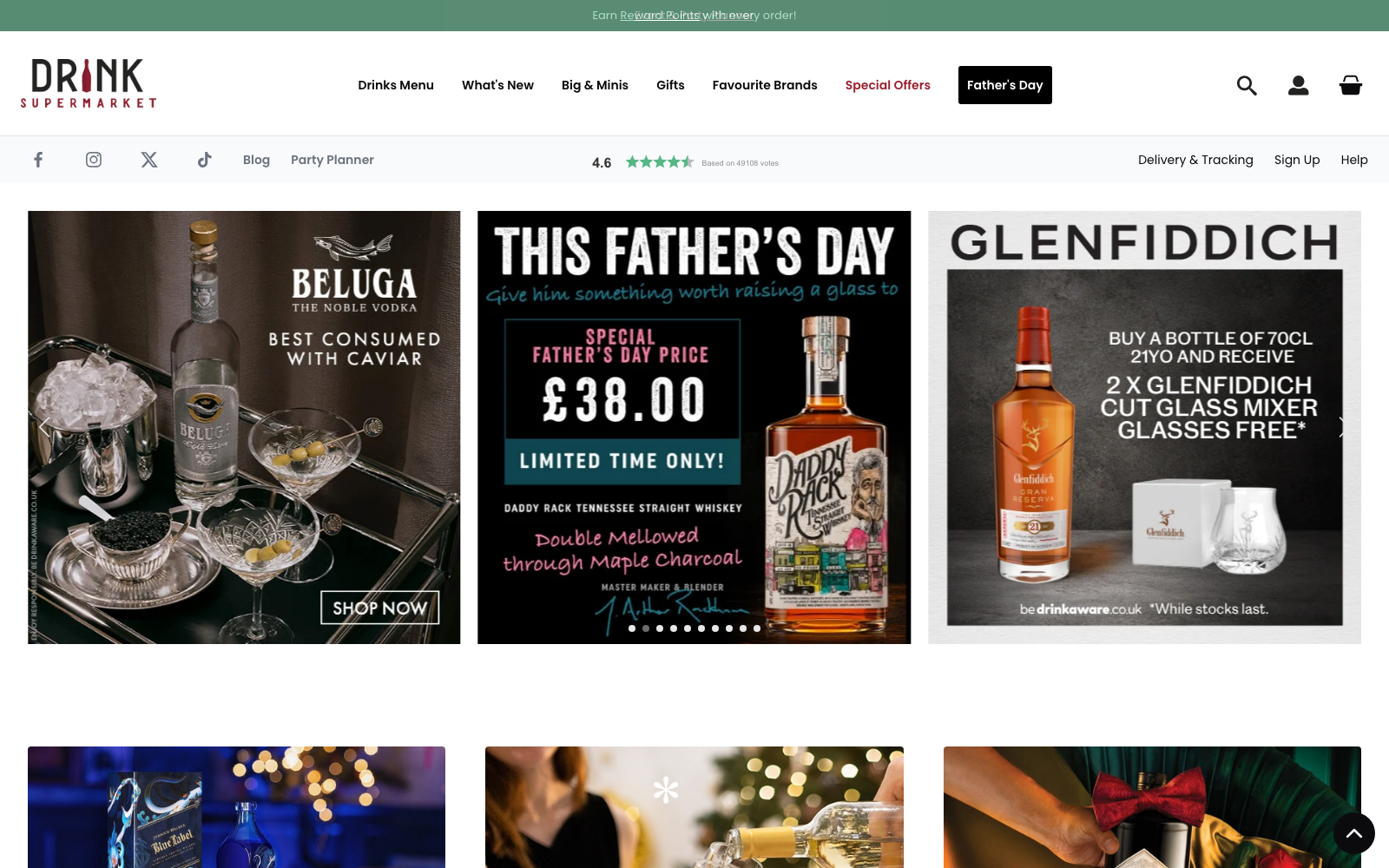
The scraped homepage is almost entirely commercial. The headline proposition is “Buy Drinks Online.” The primary navigation is a large “Shop by Brands” directory, Glenfiddich, Aperol, Havana Club, Grey Goose, Bombay Sapphire and on down the list, sitting alongside gift packs, bottle engraving and a Party Planner. There is no blog, no guides section, no tasting-notes hub, no distillery profiles. The pages that earn DrinkSupermarket its rankings are product listing pages and product detail pages for named brands and specific bottles, plus gifting and occasion pages. The queries it ranks for carry buying intent, “buy Glenfiddich 12”, “Grey Goose 70cl”, “Aperol gift set”, rather than the informational questions a specialist publishes guides to capture.
The pages that grew are the ones AI Overviews don’t replace
In a market where AI Overviews and zero-click results are removing upper-funnel clicks, the type of query a page ranks for now decides whether it keeps its traffic. When someone searches “how is whisky made” or “best whisky for beginners”, Google can compose an answer at the top of the results and the searcher often never clicks through, the question has been resolved in place. When someone searches “buy Bombay Sapphire 1 litre”, there is nothing for an overview to resolve: the searcher wants a shop with the bottle in stock at a price, and the result that wins is a product page. DrinkSupermarket’s rankings sit overwhelmingly on the second kind of query, so very little of its visibility is exposed to the summarising that has pulled clicks away from research content.
DrinkSupermarket has also put its development effort into converting that intent on-site. The homepage carries “Ask DAISY”, an AI shopping assistant that answers product questions and steers customers to bottles inside the session. To be clear, DAISY is a conversion tool rather than a ranking factor, so it is not what lifted the organic numbers. What it tells you is where this business has decided to compete: the spend is going into closing the visit on-site, and there is no editorial library here for an overview to read and summarise without sending a click back. That decision lines up with the pages that actually grew.
What changed for the whisky specialists
The Whisky Exchange shows the other side of the same six months. It built its visibility on editorial discovery content, whisky guides, tasting notes, distillery profiles, the Whisky Exchange blog, advent and festival pieces, which ranked for upper-funnel queries such as “what is single malt”, “how is whisky made” and “best whisky for beginners”. Those are exactly the questions an AI Overview can now answer without a click. Over the same window its estimated organic visibility fell 21.05%, from 184,626 to 145,755, a loss of 38,871, dropping it to rank 5 and leaving it 18.96% behind the market. Master of Malt, which runs a similarly deep editorial operation, fell 10.90% (−11,697) to rank 7. The Whisky Exchange has been owned by Pernod Ricard since 2021, so this is a well-funded specialist whose visibility is still concentrated in precisely the content type AI Overviews have started to absorb.
Be honest about what’s driving the numbers
It would be too neat to credit all of this to AI Overviews, so take the drivers one at a time.
The clearest one is seasonal. The comparison runs from November to May, and November is the peak of whisky gifting and whisky-research search, “best whisky gift”, “whisky for Christmas”, “how to choose a whisky”, while May is not. A premium whisky specialist will always look weaker measured from its November high to a spring low, and a broad everyday-drinks retailer with a flatter annual demand curve will look relatively stronger across the same two points, before AI Overviews enter the picture at all. Some of the 21.05% gap at The Whisky Exchange is that seasonal swing in search volume rather than lost clicks. A drinks retailer can plan around that curve, and how Majestic turns seasonal spikes into year-round growth works through one way of doing it.
The second is range. A generalist that keeps adding products grows its transactional long-tail almost automatically, every new brand and bottle is another product page that can rank for another “buy” query. If DrinkSupermarket expanded its range over the period, that is the most common way a generalist adds transactional rankings, and it is a plausible contributor to the 12,734 gain. This dataset does not confirm a range expansion, so I’d hold it as a hypothesis rather than a finding.
Third, what this data cannot see at all: paid search, actual sales, and any brand marketing that lifts branded organic demand. If DrinkSupermarket ran heavy paid or brand campaigns in the period, the branded-search uplift could sit inside this organic number and none of it would be visible here. And the gain is measured from a November base, one of the strongest months for drinks retail, so it comes from a high starting point rather than a soft one.
What survives all of that is the within-category comparison, and it is the strongest part of the evidence precisely because it controls for the category. DrinkSupermarket, The Whisky Exchange and Master of Malt all sell the same spirits into the same UK market over the same six months. The two with deep editorial libraries fell together while the transaction-led generalist rose. Seasonality explains some of the size of the gap; it does not explain why the divergence lines up so cleanly with the type of pages each business ranks for. The alcohol category did not soften by 21%. It moved −2.1%.
What this means if your visibility sits in content
For anyone running an editorial-heavy drinks site, the practical question is which of your pages still earn a click. Informational content continues to do real work, it builds authority, it earns AI Overview citations, it supports the brand, but the share of those queries ending in a visit is falling wherever Google can answer in place, and that shows up as declining organic traffic even when your rankings have not moved. Making that content keep earning its place is the job of content strategy for AI Overview citations. The pages holding their visibility are the transactional ones: well-structured PLPs and PDPs for named brands and specific products, gifting and occasion pages, clear stock and pricing, the result a buying query has to click to satisfy. Building and maintaining those pages well is the core of ecommerce SEO for category and product pages. DrinkSupermarket carries most of its visibility there and has spent its development budget on converting the visit once it arrives.
If your site sits closer to the specialists, the work is to measure your informational and transactional pages as two separate populations, to stop reading a guide’s falling traffic as an SEO failure when it is partly AI Overviews answering the query, and to make sure the commercial pages that still convert are built and maintained as carefully as the editorial that used to bring people in.
If you want the full picture behind this comparison, you can download the full alcohol report and see where all 284 brands in the category sit. And if you want to check whether the same split between transactional and editorial visibility is showing up elsewhere, every Salience Index sector report tracks it across the other retail categories we cover.