by Sean
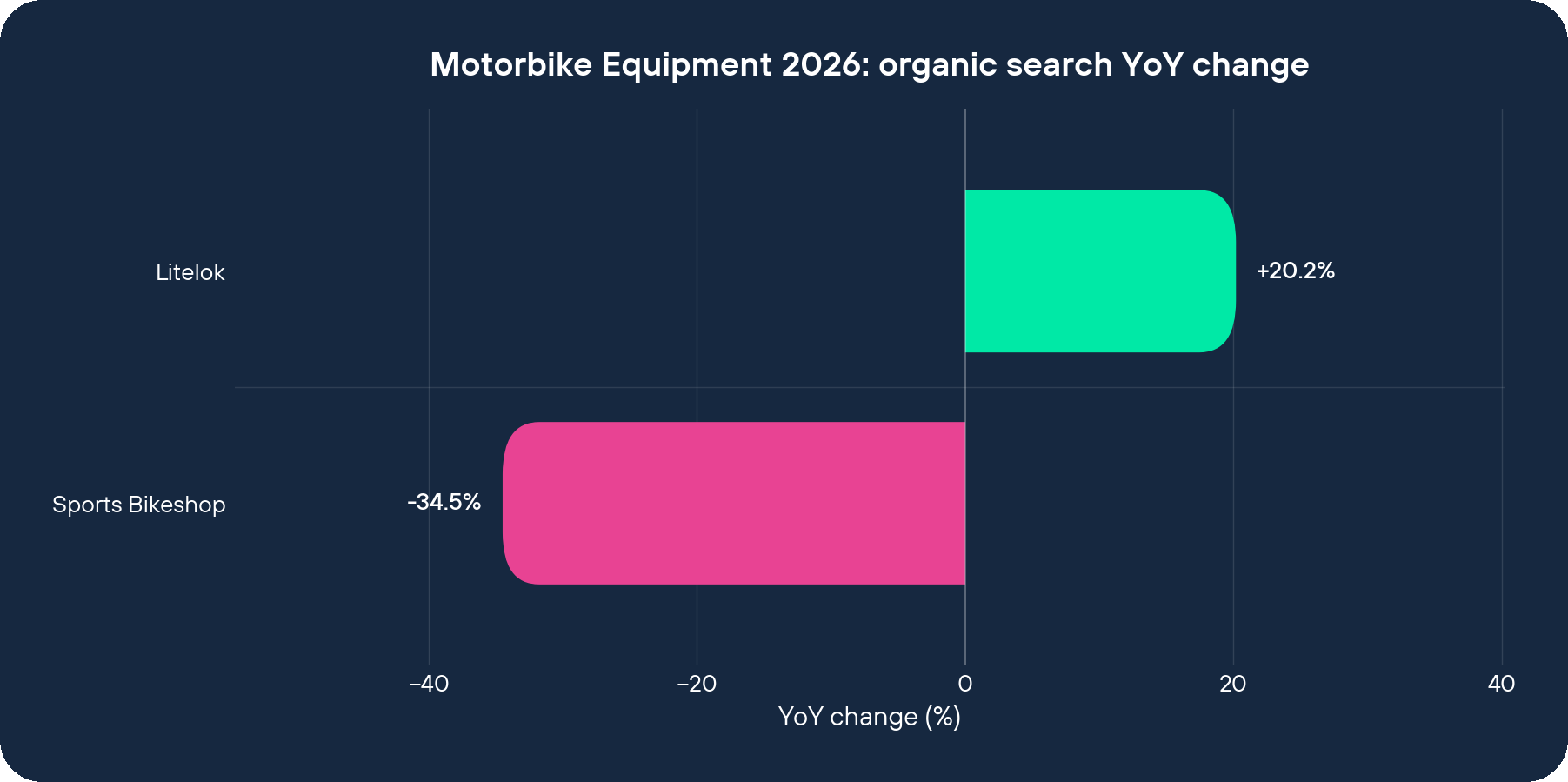
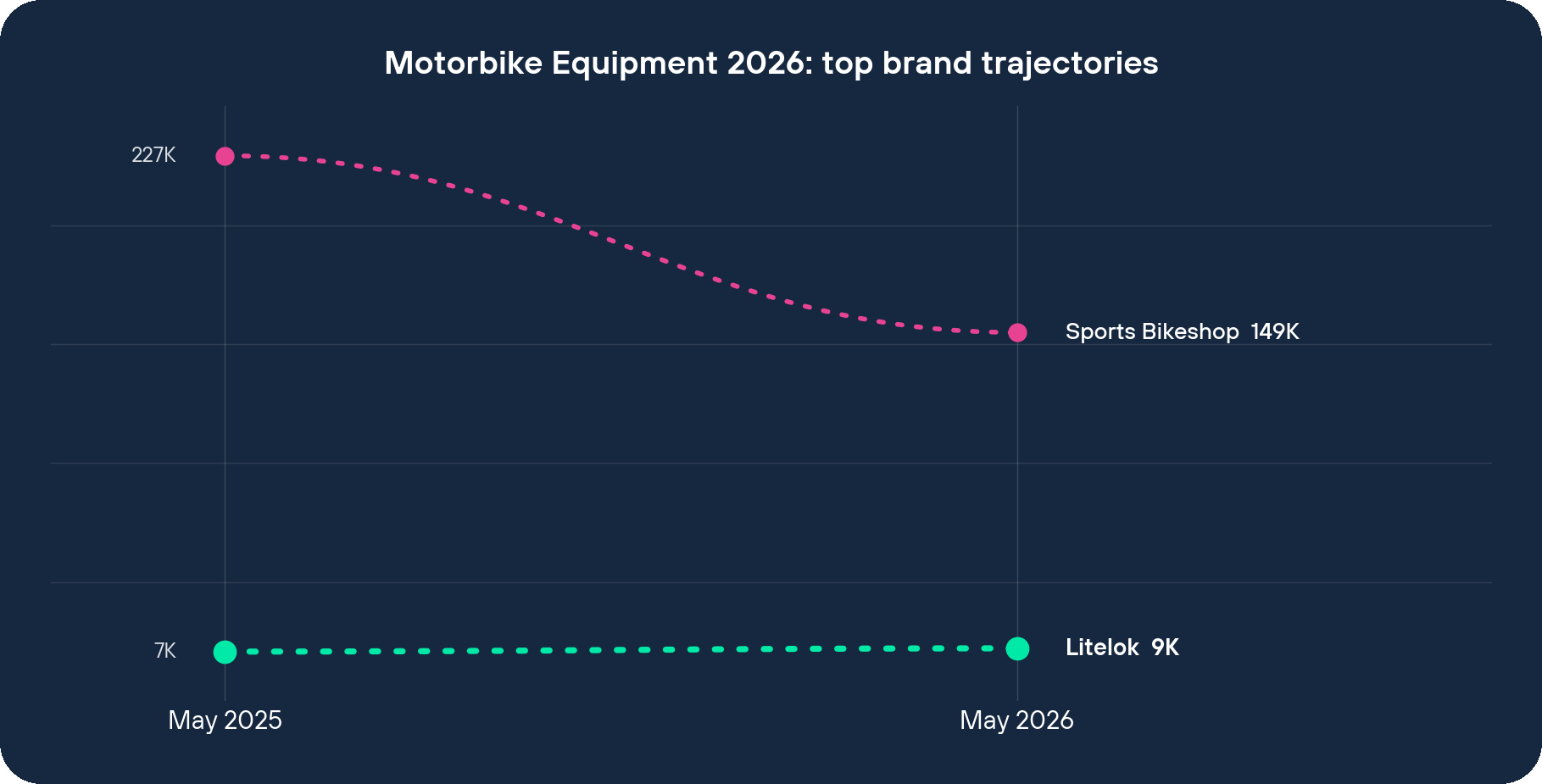
Between May 2025 and May 2026 the UK motorbike-gear market lost 13.00% of its organic visibility, and most of the names you would expect to hold up did not. Litelok went the other way. Its organic visibility rose from 7,170 to 8,618, up 20.20% year on year, which puts it 33.20 percentage points ahead of the market. For a brand that spends heavily to keep its name in front of buyers, that would be a decent year and not much of a story. Litelok does not do that. It attracts 70 branded searches a month, which places it 47th of the 50 brands in the reach table, with only Sea Star Superbikes below it on 20. Sports Bikeshop, at the top of that table, pulls 90,500. So Litelok grew its discovery in a falling market while, in round terms, more than a thousand times fewer people were typing its name into Google than were typing the category leader’s. Click below to access the latest Motorbike Equipment market report.
That gap between brand demand and search performance is the whole reason this brand is worth a closer look. It is the punchline of this quarter’s narrative made literal: the trusted, followed, five-star names are losing organic ground, and a lock specialist almost nobody searches for by name is gaining it.
A brand with almost no name recognition grew anyway
Take Litelok’s reach numbers on their own terms first. It sits 47th of 50 on the combined brand reach score, its social score of 57.619 ranks 35th, and its 70 monthly branded searches are the equal-second lowest in the set. There is no meaningful pool of people going looking for “Litelok” as a company. Whatever pulled its organic visibility up 20.20%, it was not people already sold on the brand searching their way back to it.
That leaves non-brand discovery: people searching for a problem or a product type rather than a company, and landing on Litelok because Litelok ranks for those queries. When a brand with 70 name-searches a month grows organic visibility by 1,448 visits, almost all of that growth has to be coming from queries that never mention the brand. That is the interesting bit, because it is the exact thing brand equity and a big review base are supposed to make unnecessary, and it is the thing that is quietly moving this market.
What the site actually sells
The clearest thing about Litelok is how little it tries to do. The site sells locks and nothing else. There are no helmets, no jackets, no luggage, no maintenance range padding out the catalogue. Compared with a general motorcycle retailer whose top navigation runs Helmets, Clothing, Gloves, Boots, Accessories, Parts, Brands, Clearance and Motocross, Litelok covers one topic and covers it in depth. For a search engine trying to work out which sites are authoritative on bike and motorcycle security, a domain where every page, every product and every guide is about locking a bike reads as a specialist. That concentration is doing real work for its rankings on security-related queries, and it is a clear case of how topical authority wins motorbike search.
The product range itself is narrow and clearly laddered, from the X1 Mini at £139.99 up to an X3 bundle at £539.98, and the site pushes buyers into it with a “Lock Finder” tool that asks a few questions and routes you to a specific SKU rather than dropping you into a category page to browse. The proof cues are heavy and specific: the X range is marketed on angle-grinder resistance and carries Sold Secure Diamond-level security ratings, the site states the locks are made in Britain at a solar-powered South Wales factory, and it quotes third-party press directly on the page, “The Litelok X1 is the best overall bike lock we tested,” attributed to Josh Patterson at The Guardian. Litelok’s own pages lean hard on customer proof and advertise thousands of five-star reviews; in this report’s review index it registers 1,337 reviews at 4.8 stars, which is a strong rating on a modest volume rather than the enormous review counts the big retailers carry.
None of that individually is unusual. Put together, it describes a brand that has decided its credibility has to come from what the product is and who has vouched for it, because it cannot come from name recognition it does not have.
The angle-grinder problem is doing a lot of the work
Here is where honesty about causation matters, because it would be easy to credit Litelok’s whole year to its site strategy and stop there. The bigger factor is almost certainly outside anything in this dataset: the way bikes and motorcycles are actually being stolen in the UK has changed. Angle-grinder attacks have become the dominant method, and that has created a large and growing pool of problem-led searches, people looking for an “angle grinder proof bike lock” or an “angle grinder resistant motorcycle lock”, that mention no brand at all.
Litelok’s entire X range is built and marketed as the answer to exactly that query. So a real category tailwind and a site that answers one urgent question line up neatly. The angle-grinder theft wave is not something Litelok created, and it would be lifting search demand for any credible angle-grinder-resistant lock regardless of who made it. What Litelok has done is make sure that when someone searches the problem, its narrow, deep, security-only site is one of the pages best placed to rank for it, the same work that goes into building topic authority through content depth. That is a defensible read: the growth is coming from non-brand queries, the brand has almost no name demand to explain it any other way, and the category it has concentrated on happens to be the one with the strongest theft-driven pull right now.
What these numbers can and cannot show
The percentage flatters the size of what happened, and it is worth saying so plainly. Litelok added 1,448 organic visits. That ranks 32nd by absolute change in this dataset. Sports Bikeshop, at the other end, lost 78,470. Growing 20.20% on a base of 7,170 is a far easier move than holding position on 227,423, and part of Litelok’s headline figure is simply where it sits on that curve, small brands swing by large percentages on small numbers. A specialist climbing off a low base is a different event from the market leader falling off a high one, even when both are real.
There are also drivers this dataset cannot separate. Press coverage like the Guardian recommendation feeds both referral traffic and “best lock” buyer-guide rankings, and I cannot isolate how much of the 1,448 came from that, and earning press coverage and citations like it is deliberate work. Product launches within the X range, seasonal patterns, and the possibility that May 2025 was a soft comparison period all sit behind the year-on-year figure and none are visible here. Paid campaigns can lift organic-adjacent numbers too, though with only 70 branded searches a month it is clear paid spend is not building name demand for Litelok whatever else it might be doing. The honest position is that several things moved this number and most of them are not in the table. The one claim the data does support cleanly is a negative one: this growth did not come from brand equity, because Litelok has almost none to draw on.
Sports Bikeshop from the other end
The contrast that makes Litelok’s position legible is Sports Bikeshop, because it holds exactly the assets that are supposed to guarantee discovery. It has the sector’s largest branded demand at 90,500 searches a month and its biggest review base at 140,424 reviews averaging 4.9 stars, more than a hundred times Litelok’s review count, at a near-identical rating. And it was the single largest faller in the dataset, down 34.50% from 227,423 to 148,953, a loss of 78,470 visits. Its lead over the number-two site, jsaccessories.co.uk, narrowed from 102,800 to 32,654, a 68.24% collapse in one year. Sports Bikeshop is a broad-catalogue retailer covering the whole gear category, and the branded demand and trust signals it has accumulated did not stop non-brand discovery moving away from it. That is the same market Litelok is growing in, seen from the position everyone assumes is the safe one.
What is worth watching
Read across the two, the signal for anyone working in this sector is that branded demand and review volume are no longer protecting organic visibility on their own. The largest name and the largest review base in the category both lost ground, while a specialist with neither grew, helped substantially by a real theft-driven category tailwind that this dataset cannot measure, and flattered somewhat by a small base. What Litelok demonstrates is narrow: a security-only site, laddered products, independent security ratings and third-party proof are enough to catch problem-led, non-brand search in a category with strong underlying demand. Whether that holds as the angle-grinder story matures, or as bigger players decide to compete harder on the same queries, is a question the next reading period will answer, not this one.
If you want to see whether the same thing is happening beyond motorbike gear, the biggest names losing organic ground while specialists without brand demand gain it, you can benchmark this sector against all Salience Index sector reports, and read the full motorbike-gear market report for the figures behind this piece.
Further reading
- 2025 motorcycle accessories industry analysis, the wider sector picture behind this year’s winners and fallers that frame Litelok’s result.
- 2025 Cycling Industry Report, cycling is the closest adjacent market, sharing the same bike-security buyers and problem-led searches Litelok serves.