by Sean
A short read on why bad outcomes are not bad decisions, and what that costs you if you cannot tell the difference.
The Australian Grand Prix earlier this year. Ferrari were leading. The fastest car, the best track position, everything going right. A virtual safety car came out, which slows the whole field and makes a pit stop far cheaper than usual, and Ferrari had a choice. Dive in now for fresh tyres, or stay out and gamble on a better window later. They had watched interruptions come and go all weekend, they did the maths, they bet on another stoppage arriving, and they stayed out.
The second stoppage never usefully came. Their main rivals, on fresh tyres, sailed past. Ferrari lost the lead and lost the race.
Half the paddock called it the worst call of the season. The call itself is still debated. But the reasoning behind the pit strategy did not change between “brilliant” and “worst.” Only the luck did.
Resulting, and the equation
Annie Duke, who played professional poker for twenty years, has a word for what happened to Ferrari that weekend. Resulting. Judging the quality of a decision purely by how it turned out. Her book Thinking in Bets (2018) is the whole argument, and it goes like this. Outcome equals decision quality plus luck.
Luck carries real weight and does not care how well you thought. A flawless decision on perfect information can still produce a terrible result because a random variable landed against you. A stupid bet can pay out and look like genius.
The reason we fall for it is that outcome is the only part of the equation we can see. The probabilities, the risk, the unknowns at the moment of the choice, all invisible in hindsight. So we read backwards from the loss to the thinking and assume the thinking was bad, because the thinking is the bit we cannot look at.
Which is a slightly terrifying thought if you manage a team, or you are just trying to get through your own career. You are being graded on things you could not control.
The defensible decision
Once a person works this out, once they realise they will be judged on outcomes that contain a big lump of luck, something predictable happens. They quietly stop trying to make the best decision and start making the one that is easiest to defend when it goes wrong. Rory Sutherland calls this the defensible decision, or the “Heathrow Option,” in Alchemy (2019). Same idea, older form: “nobody ever got fired for buying IBM.”
The question in the head shifts. What is the best choice here? becomes: what can I most easily justify if this all falls apart?
The PA and the two airports
Sutherland grounds it in a personal assistant booking a flight for their boss to New York. Two airports. The big obvious one everybody uses. And a smaller one, closer to the city, faster through the queues, objectively better on paper.
Play it four ways.
She books the clever, smaller airport and it goes perfectly. The boss breezes in early. She looks like a genius who found a hidden gem. She books the big obvious one and it also goes perfectly. Praise: precisely nothing.
Now the bad days. She books the big obvious one and it is a mess. Delays, chaos, boss misses half the meeting. Feedback is a shrug. These things happen, it is the busy one, everyone uses it, not her fault.
She books the smaller airport and that is the one that melts down. Power cut, strike, whatever. Same missed meeting. Feedback is brutal. Why did you send me somewhere odd? Why were you trying to be clever?
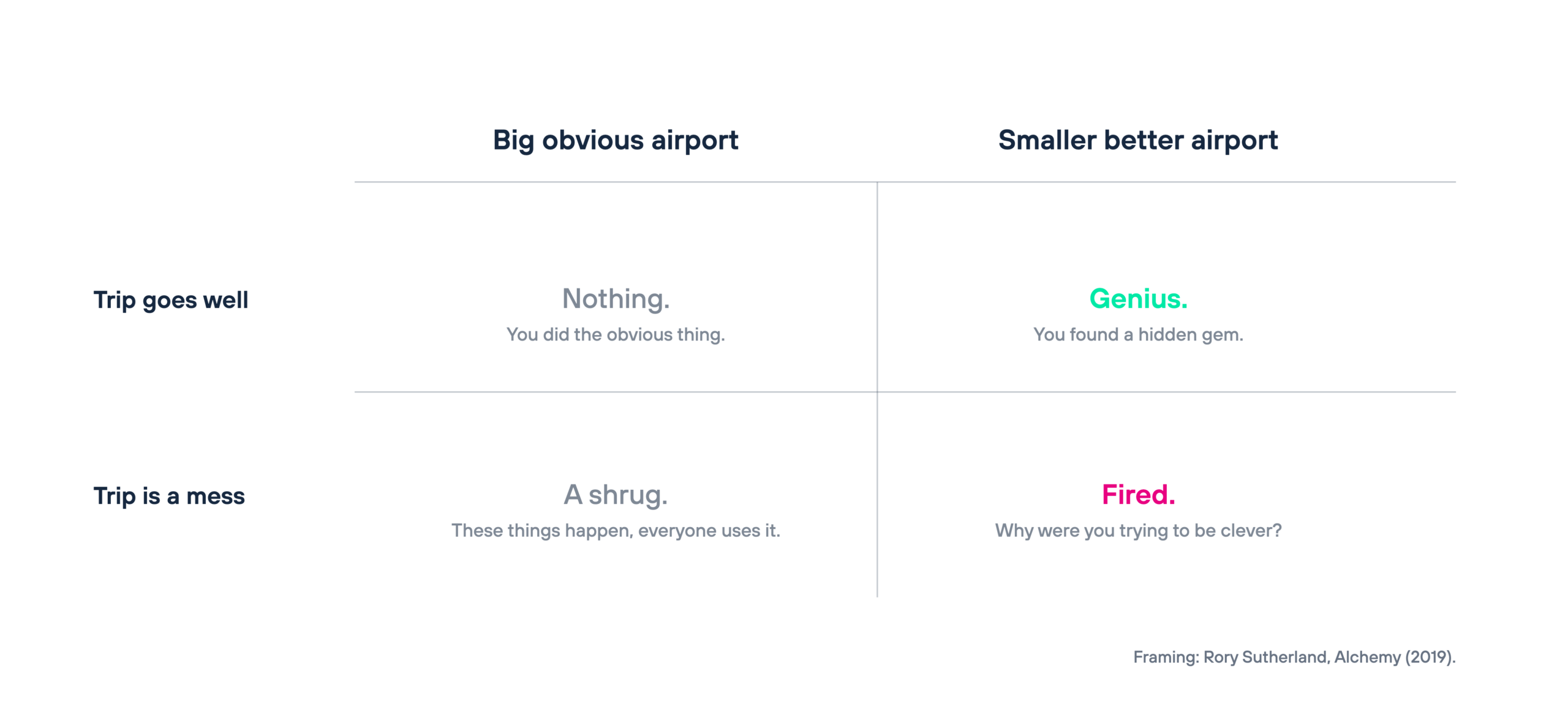
Same bad outcome. One gets a shrug. One gets you fired. The PA, being rational, learns the safe move. Always book the obvious airport. Not because it is better for the boss, but because it is insurance for her.
And this runs deeper than office politics. For most of human history, if you failed alongside the tribe on the same hunting ground, you shared the failure and stayed in the group. Break away, try a new hunting ground, fail, and you were exiled. We are wired to prefer failing with the crowd over risking a solo failure, even when the solo route was the smarter bet.
Investing
Scale that terror up from one nervous assistant to an entire industry and you get active stock picking.
A boring index fund buys a tiny sliver of the whole market. It takes no cleverness, it costs almost nothing, and over twenty years it quietly outperforms most highly paid stock pickers going. And yet billions keep flowing into people trying to beat it.
Run the same matrix. Market crashes. The index-fund holder loses thirty percent and everyone reads it as a blameless act of the economy. The stock picker who strayed from the crowd loses the same thirty percent and gets called reckless. Same loss, opposite verdict.
So what do the professionals do to protect themselves? They quietly build portfolios that look suspiciously like the index anyway. There is a name for it, closet indexing, and it exists so that when they lose money they can point at everyone else losing money too. They are optimising for keeping their job. Not for your returns.
There is an ego piece underneath as well. We reject the boring winning option partly because handing money to a faceless formula feels passive. We would rather feel like we are steering the ship. We would rather fail actively than win passively.
Penalties
The pattern shows up on a football pitch too. Bar-Eli and colleagues (Journal of Economic Psychology, 2007) analysed 286 elite penalty kicks and found something odd. Goalkeepers dive left or right roughly 94% of the time. The kicks themselves distribute more evenly than that, and on a career average, staying dead centre would often be the better move. In the underlying data, staying centre saves the shot 33.3% of the time, versus 14.2% diving left and 12.6% diving right.
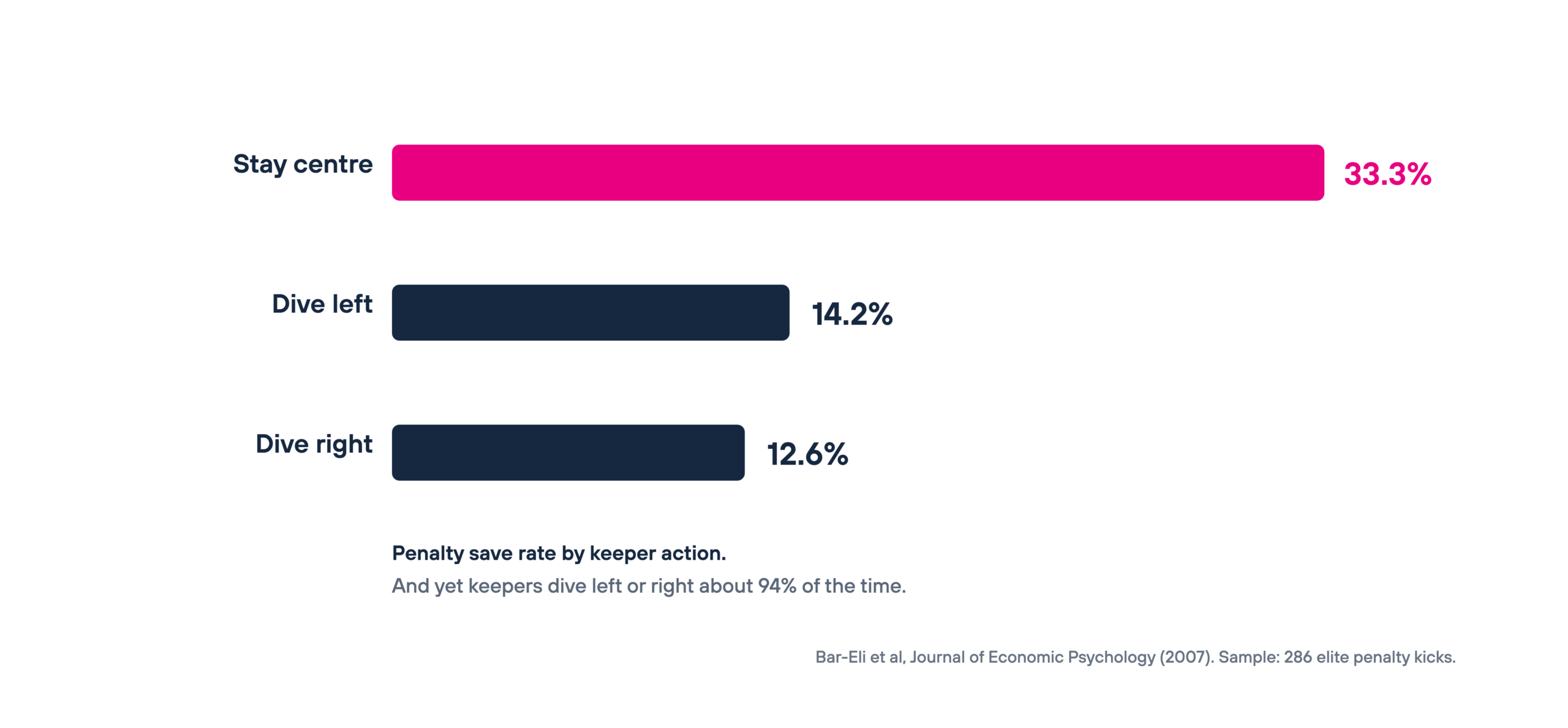
Why don’t keepers do it? The theatre of failure. Dive full length and the ball still goes in, everyone says: unstoppable, great effort. Stand still and the ball goes past, and you look like you froze. So the keeper picks the move that saves fewer goals over a career to avoid looking like a fool on the one that gets past him.
We all do this in quieter ways. The safe email over the better one, the expected recommendation over the braver one, the thing we can defend in the meeting over the thing that would actually work.
The lesson is not “always do the unconventional thing.” That is as lazy as always playing it safe. The default choice is often the default because it genuinely is the best one. The unconventional call is only the right call when you have actually done the work and the odds honestly favour it. Otherwise you are quietly increasing your own chance of failure to feel clever. The discipline is honest evaluation, not bravery.
You cannot get rid of the luck. Chaos gets a vote in every outcome and it always will. You do have full control over whether you grade yourself, and the people around you, on the quality of the thinking or the optics of the result.
The advantage of grading on quality is that it compounds. You start rewarding sound bets that got unlucky, you stop rewarding lucky punts that took the credit, and over enough loops the decisions actually improve. Grade on outcomes and you learn the wrong lesson from your own career, quietly, for years.
Stay human,