by Sean
What the headline number hides
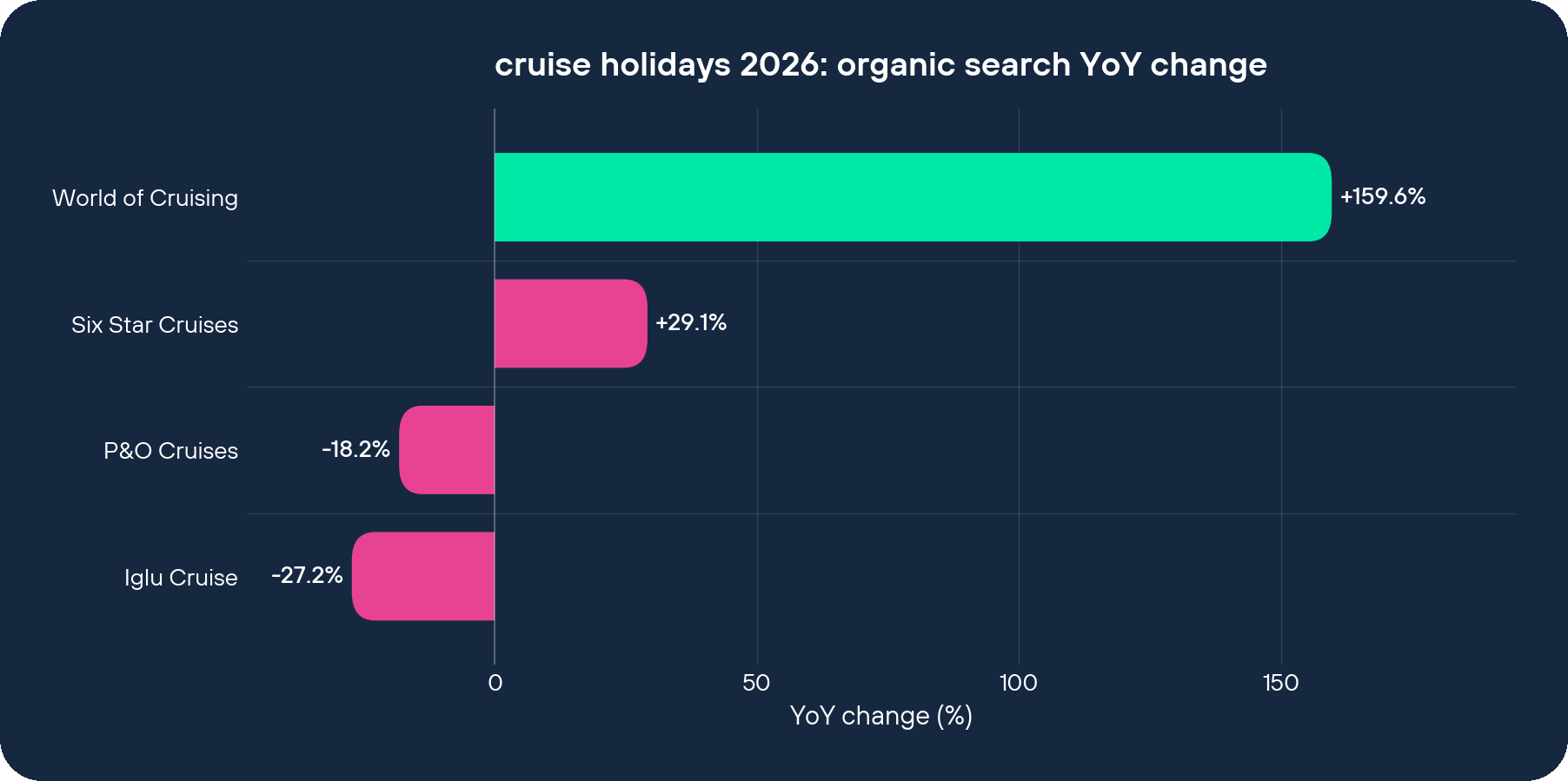
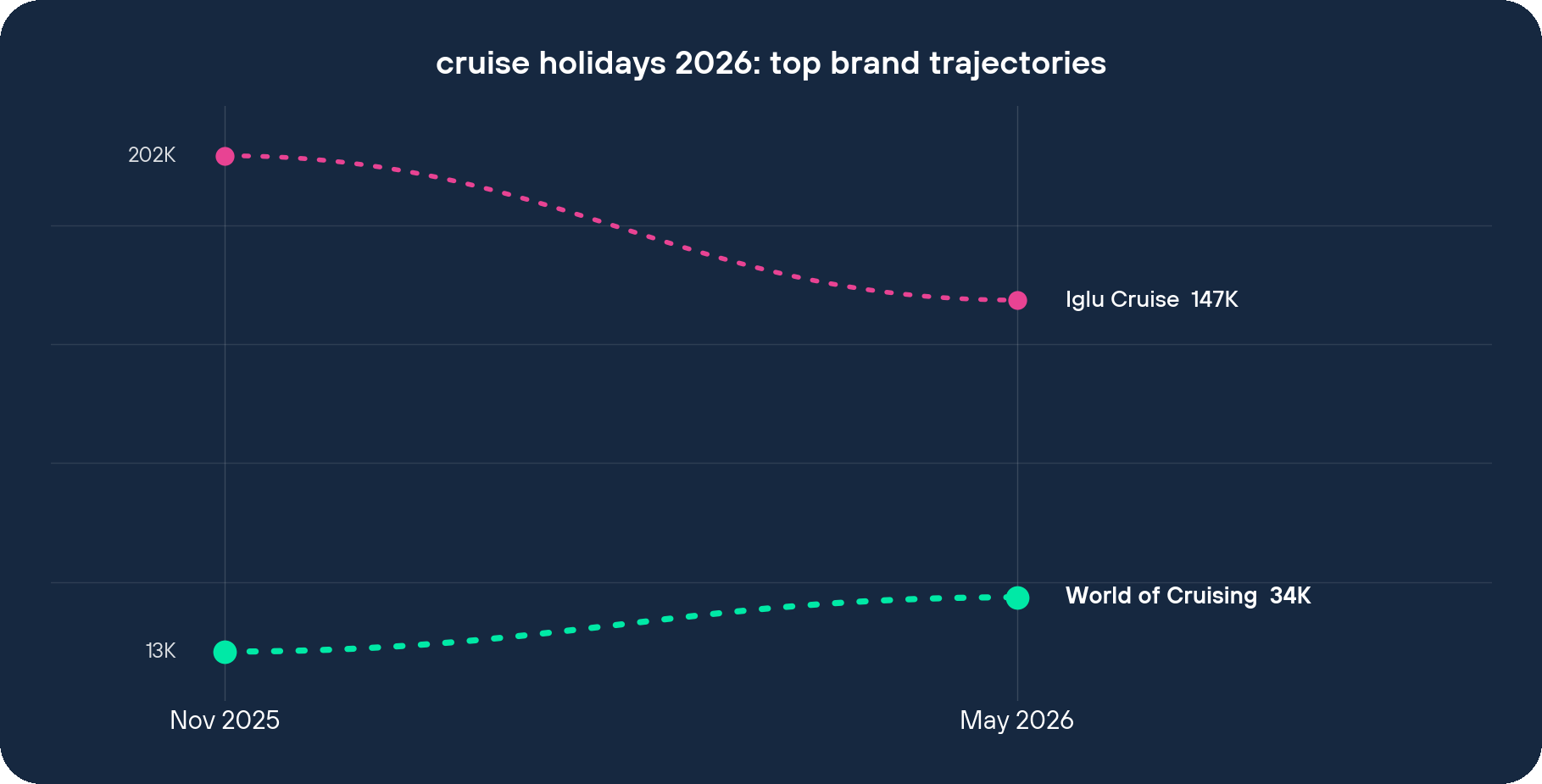
Search visibility across the 130 cruise brands in this index fell -12.65% between November 2025 and May 2026. World of Cruising did the opposite. Its visibility rose from 12,978 points to 33,696, a gain of +20,718, an increase of +159.64% over the period that puts it +172.27% ahead of the market average. It is the clearest single piece of evidence in the dataset that the -12.65% headline is averaging together two groups of brands moving in opposite directions, because no honest reading of “the market fell 13%” survives contact with a brand in that market that grew by triple digits. Click below to access the latest cruise holidays market report.
Climbing while bigger brands fell
The gain is more interesting than the raw percentage because of where it came from. World of Cruising climbed the visibility ranking from 54th to 29th, overtaking roughly twenty-five other cruise brands in six months and moving into the part of the search results that larger operators are giving up. P&O Cruises, still the biggest brand in the sector at 800,285 points, fell -18.21% over the same window. Iglu Cruise, the largest pure-play online cruise agent in the UK, fell -27.24%. World of Cruising moved up the table while the brands above it moved down, and that is a more durable signal than a brand-search spike that inflates one reading and disappears by the next.
Where the editorial comes first
What World of Cruising actually is explains how it did this. It began as a consumer cruise magazine and the website still works like one. The business earns its money by attaching cruise deals to editorial content, which is the reverse of how an online travel agent operates: an OTA builds its site around inventory and adds a thin layer of advice content on top, if it bothers at all. Because the editorial came first, the content depth is genuine, and that shows up in what the site publishes.
Winning the questions before booking
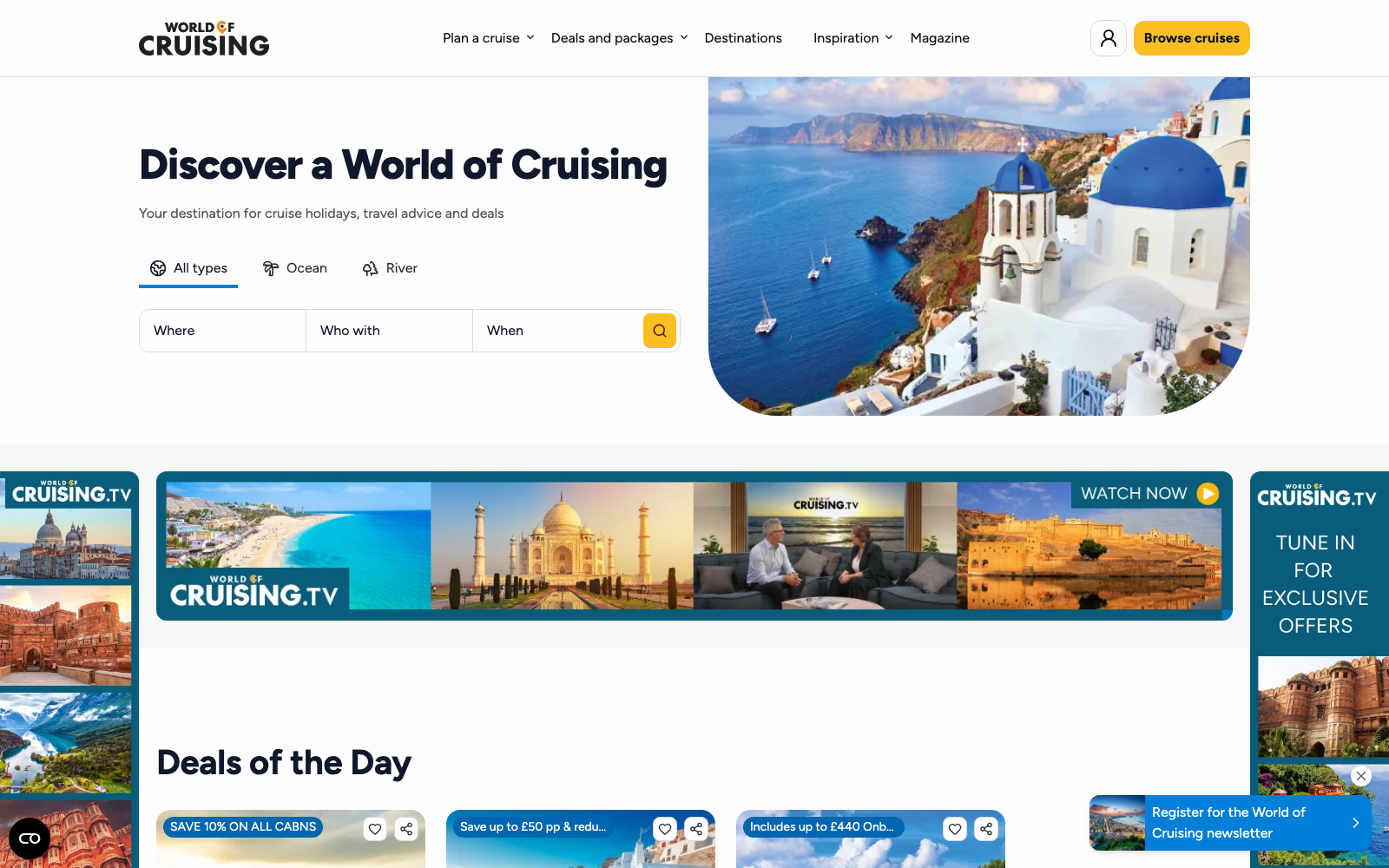
Look at the homepage and the priorities are obvious. The top of the page carries a section headed “Latest cruise advice and news,” followed by dated expert guides with read-times attached: “What are the best Mediterranean cruises? An expert guide,” along with equivalents for the best Greek Island cruises, the best Caribbean cruises and the best LGBTQ+ cruises. These guides sit at the top of the page, given the same visual weight as the curated “Deals of the Day” panel. Putting them first tells you what the brand expects to bring people in. Someone planning a cruise asks “what are the best Mediterranean cruises” long before they are ready to filter a list of sailings by price, and World of Cruising meets that question with a written guide. A deal-led site sends the same visitor straight to a filtered list of sailings and hopes the price does the work. The first of those is the informational query space, the questions people type before they are ready to book, and it is the space most large cruise sites treat as an afterthought.
This is also the part of search that has become more valuable, not less, over the period this report covers. Google’s results increasingly favour pages with real editorial provenance, and AI Overviews answering a query like “best Mediterranean cruises” pull from guide-style content that reads as though someone who knows the subject wrote it. A title that has been publishing cruise features for years is better placed to be the cited source for those queries than an agent whose strongest pages are filtered listings, and the same content-first advantage shows up in how Loveholidays built organic visibility. I want to be careful here, because the dataset does not show which queries or which features produced the visibility, so I cannot prove that AI Overview citations specifically drove the gain. What I can say is that climbing twenty-five ranking positions is consistent with a brand ranking for more and better informational queries, and that is precisely the territory its content is built to win.
What the percentage cannot prove
The +159.64% also needs the boring drivers named, because a single number rarely has a single cause. Some of the size of that percentage comes from the starting figure: 12,978 points is a relatively small position, and it is mathematically easier to post a triple-digit percentage gain from there than it is for P&O at nearly a million. Some of it is probably seasonal, May is when people plan summer and autumn cruises, so demand for “best Mediterranean cruises” content is naturally higher in the May reading than in the November one. And there may be changes I cannot see in this data, such as a redesign or a content push, that I am not going to credit without evidence. What survives those caveats is the comparison itself. A small starting figure and seasonal demand would lift the whole field, and the whole field fell -12.65%. World of Cruising rose while the market declined and climbed twenty-five places at the same time, and neither the starting figure nor the calendar explains a brand moving up the table while the brands around it move down.
The lesson for deal-led rivals
Iglu Cruise is the useful contrast because it chose the opposite arrangement and competes in the same sector. It is the largest pure-play online cruise agent in the UK, and it competes on volume: a deep catalogue of discounted sailings, organised so a visitor can filter by price, date, ship and departure port. Its homepage navigation is built entirely around inventory, “Cruise deals” broken into Last Minute, Mini Cruises, All Inclusive, Family, Luxury, Solo and a dozen more; cruises by line, by UK port, by ship, by destination; and a search-by-Cruise-ID box. There is a Help Centre, but nothing resembling World of Cruising’s advice section. Over the period Iglu fell -27.24%, losing 55,042 points from 202,096 down to 147,054, and giving up exactly the informational queries a content site captures. The detail that makes this look like a difference in approach rather than bad luck is internal to Iglu’s own group: its premium sibling Six Star Cruises, which leans on guides and destination content, rose +29.14% over the same window. It is the same parent company running both brands, and the one that reads more like a publisher grew while the one built around discounted inventory fell.
For anyone working in this sector, World of Cruising’s six months are worth sitting with, because they show where visibility is now being decided. The questions people ask before they book, which destination, which line, which time of year, are increasingly answered by editorial content, and by AI summaries that cite editorial content, and the brands that already publish that content are taking rankings that deal-led sites used to hold by default. World of Cruising did not invent this position in six months. It has been a cruise magazine for a long time, and the period simply rewarded what it already was. That is the harder problem for the operators it overtook, because editorial authority of that kind takes years to build and cannot be assembled quickly enough to defend a ranking once it has started to slip.
If your brand is losing the informational queries that now decide cruise and travel rankings, the fix is the editorial depth World of Cruising spent years building. Our content built to earn AI Overview citations is written to do exactly that: guides and destination content made to be the source Google and AI summaries cite when someone asks which cruise, which destination or which time of year. Get in touch if you would rather compete for those questions than leave them to the brands already publishing the answers.
Further reading
- strategies that won 2024’s Google core updates, It explains the recent Google core updates that reward editorial provenance, useful background to why content-led brands are gaining ground in search.
- our Travel Booking sector report, It benchmarks the wider online travel agent market, the closest adjacent sector to cruise and a useful comparison for how deal-led travel brands are performing.
- our Holiday Cottage sector report, It profiles another travel and leisure sector where a content-led brand is outperforming the field, a close parallel to read alongside this one.
- SEO services for organic rankings, Readers tracking ranking gains like World of Cruising’s often want help with the organic and technical work that sits behind a climb up the results.