by Sean
A short read on how brands are spending in 2026, and why “just do more of it” stopped being the answer.
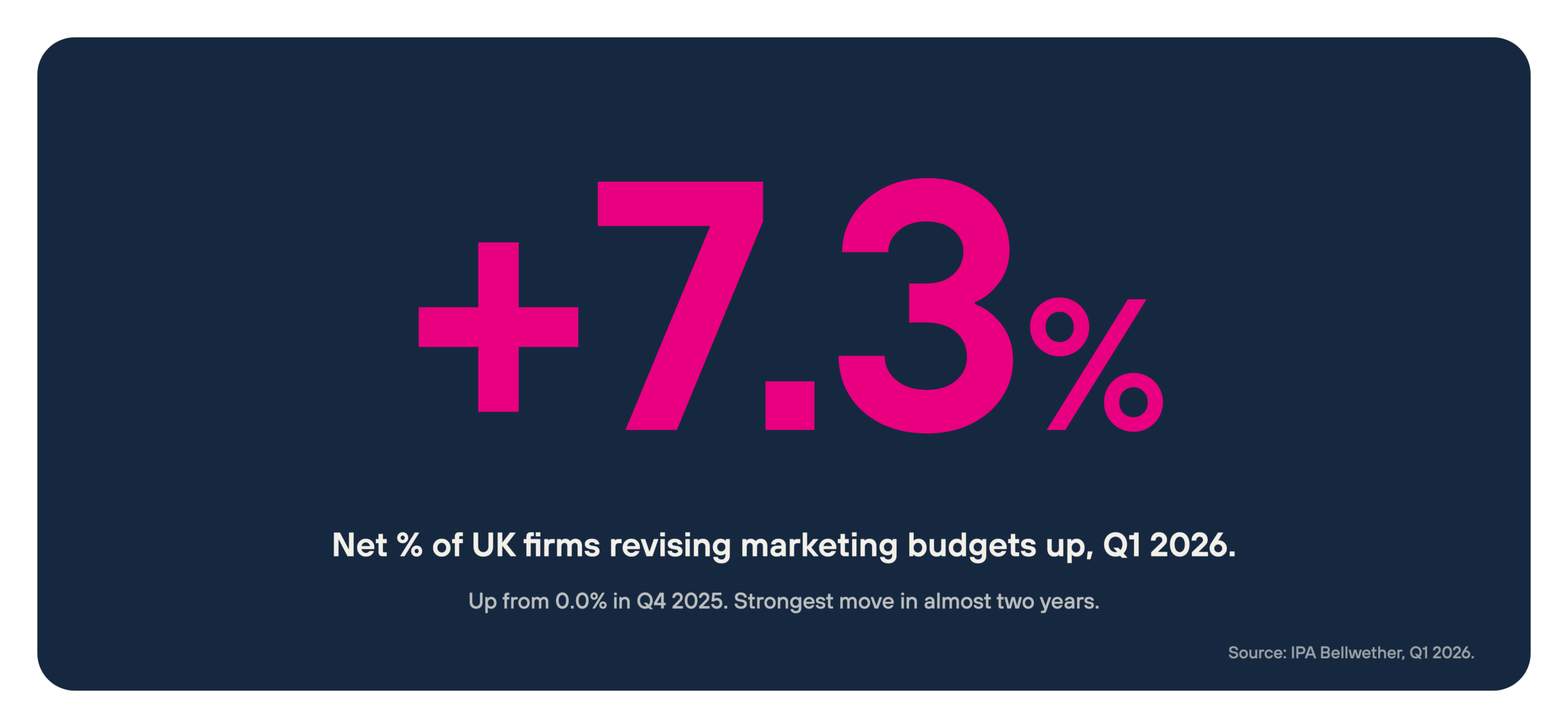
The financial year has turned, new budgets have landed, and for the first time in a while the mood has lifted. The IPA’s latest Bellwether report, published 16 April 2026, found UK marketing budgets revised up by a net +7.3% in the first quarter. That’s the strongest upward move in almost two years, after a flatline 0.0% reading in Q4 2025. Of the panellists surveyed, 26.8% raised spend and 19.5% cut it. The rest held steady.
S&P Global Market Intelligence, the team behind the Bellwether, has nudged its 2026 UK ad spend forecast up to 2.5%, from a previous 1.5%. That’s the conservative end of the range. WARC and the Advertising Association have UK ad investment forecast to grow 6.6% this year, putting the market on track to break £50bn for the first time. Magna’s global number sits at +6.3%.
After a long stretch of holding their nerve, brands are spending again.
But anyone expecting a return to business-as-usual is reading it wrong. The money’s back. The brief has changed.
What the categories tell you
The headline number is the +7.3%. The category breakdown underneath is the story.
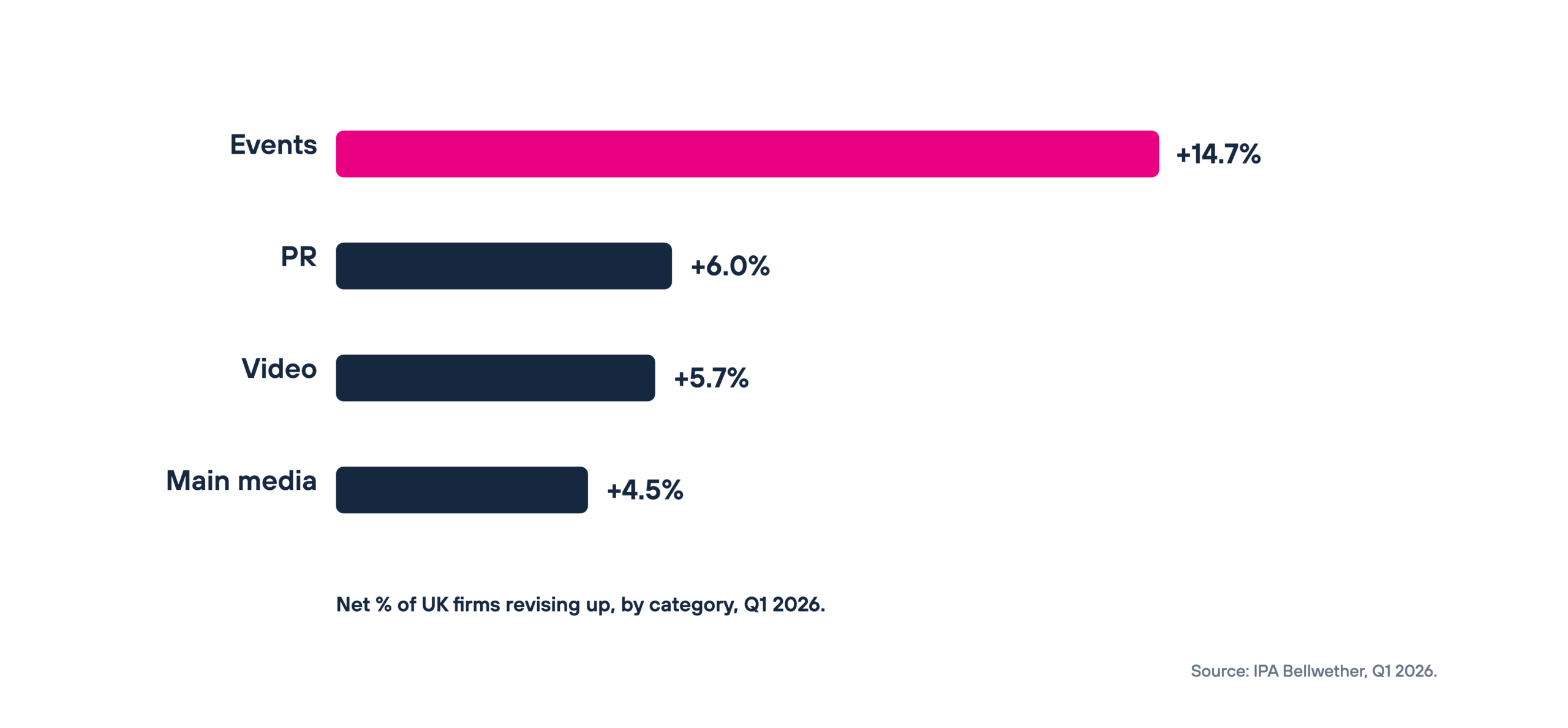
Events lead the pack at +14.7% net balance, up from +1.4% in Q4. Video has rebounded sharply to +5.7%, from a -5.0% contraction the previous quarter. PR is at +6.0%, its strongest revision in five quarters. Main media advertising is up +4.5%, the best reading since Q3 2023. Direct marketing and sales promotions also moved up.
Paul Bainsfair, IPA Director General, framed the read in the release: “These latest Bellwether results defy wider geopolitical uncertainty and signal a bullish start to the year for UK marketing investment.”
Events leading the pack at +14.7% tells you something specific about how buyers feel about the year. Events spend is the most committal line on the marketing P&L. You can’t soft-launch a venue booking and you can’t easily renegotiate a stand contract. Brands aren’t just dipping toes back in. They’re committing to fixed-date, real-world activity months in advance.
So the budget is back across multiple lines, not just one. The interesting question isn’t whether brands are spending. It’s what they’re spending it on, and why the conversation around that spend has shifted.
From inputs to outcomes
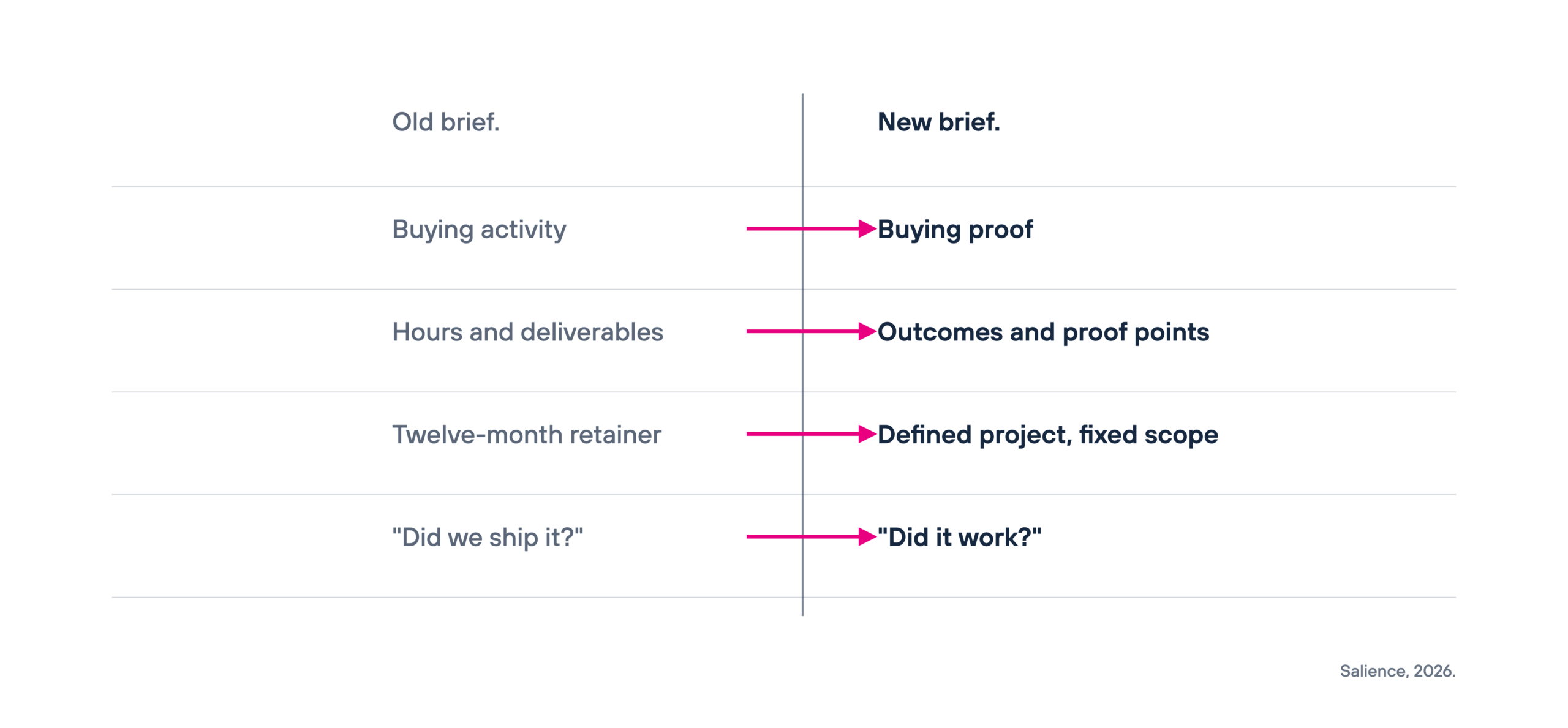
For years, the agency relationship ran on inputs. You bought a retainer, a number of hours, a content calendar, a set of deliverables, and you trusted that all that activity would turn into results somewhere down the line.
That bargain is quietly dying. Budget-holders want proof now, not more activity. Analysts have taken to calling 2026 the year outcome-based value becomes the pricing frontier. The conversation has reshaped around performance. Tighter scope. Cleaner outcomes. A straight answer to the only question that matters. Did it work?
It’s a healthier question. It’s also a harder one, because most brands genuinely can’t answer it about their current search spend. They can tell you what was produced. They can’t always tell you what it earned.
There’s a structural reason that gap exists. The old retainer covered effort. The new conversation needs to cover impact, and the measurement layer that proves impact wasn’t part of the original deal. So the brief has to change before the agency relationship can.
What Forrester actually said
The agency-side data point that anchors this is Forrester’s Predictions 2026, published 1 October 2025 by Jay Pattisall, VP and Principal Analyst.
Forrester forecasts a 15% reduction in agency headcount in 2026, following an 8% average cut in 2025. Pattisall’s framing is direct: companies are pulling work in-house, cutting retainers, and using AI tools to do in hours what used to require an agency relationship and a monthly invoice. He quotes an unnamed global holding-company CEO inside the prediction: “By 2028, we’ll double profits and halve the people.”
That sentence is the agency model on a single line. It tells you something about the supply side, but the more important read is on the demand side. If clients are getting the same output from fewer people, they’re not going to accept the same invoice for it. The whole input-billed model relied on the work being expensive to produce. AI flattens that cost. The buyer notices.
The cleanest summary of where this leaves the industry: “we’ll handle it for you” is a weak pitch in 2026. “Here’s the outcome, and here’s how we’ll prove it” is a strong one.
Why brands are starting with projects
This is where the model is visibly shifting. Rather than signing a twelve-month retainer on faith, more brands (retailers especially) are starting with a defined project. A specific outcome, a fixed scope, a clear before-and-after.
It makes sense. A project is how you de-risk a relationship.
You’re not betting the year on a partner you’ve known for three weeks. You’re handing them a real problem, a real deadline, and watching what they actually do with it. The buyer keeps optionality. The agency has to prove it can ship the named outcome before anyone signs up for the long version.
There’s a soft version of this that’s already industry standard. The “test phase” before a retainer. The “audit” before the strategy work. The “one-month pilot” before the rebuild. These are project shapes in a retainer-shaped wrapper.
The newer pattern is sharper. The project is the deliverable. There’s no retainer waiting at the other end of it. If a longer relationship comes out the back of a clean project, it comes because the work earned it, not because anyone agreed to it upfront.
The quiet irony is that the project usually isn’t the end of the story. The good ones are a front door. A well-run project that delivers a measurable win tends to become the start of something longer, not because anyone got locked in, but because the proof was sitting right there.
What this changes for in-house teams
Two things change.
First, the brief itself has to carry the measurement. “Get us more organic traffic” is an old brief. “Get us more organic revenue from these three priority intent clusters, measured against a control via geo-experiment, in the next 90 days” is a new one. The first version buys activity. The second buys an outcome.
Second, the team has to be ready to grade the work. The biggest reason agency reviews go poorly isn’t that the agency missed; it’s that the buyer never agreed up-front how the work would be judged. Outcome-based pricing puts that conversation at the start, where it belongs. Awkward, useful, faster.
If you’re a CMO with a Q2 plan and a fresh budget line, the question isn’t “who do we hire”. The question is “what’s the smallest piece of work that would prove the supplier can move our numbers, and can we structure that as a defined project, not a hire?”
How we think about it
We’ll be upfront about our bias. This is how we like to work, too.
At Salience we’d rather earn the relationship than assume it. A sharply scoped piece of work, an outcome we’ll measure honestly (awkward bits included), and a clear view of whether your search investment is actually moving revenue, not just rankings. We stay human-first about all of it. Real people, real judgement, plain answers.
We chase humans, not algorithms.
That isn’t a positioning line we invented. It’s a description of how the work has to be done now. The algorithm-first decade gave us tools that can scale activity to infinity. The next decade rewards teams that can scale judgement, and that’s still a human problem.
If there’s a fresh budget burning a hole and you’re tired of buying activity, that’s the conversation we enjoy most. No pressure, no leap of faith. Just a problem worth solving, and a chance to show our working.
Get in touch whenever it’s useful. We’ll keep these coming either way.
Stay human,