by Sean
Why brand recognition is invisible to condition-led search
Click here to access the latest Online Pharmacy market report.
When a patient types “ozempic alternatives for weight loss” or “what antibiotic for a UTI” into Google, they don’t care which pharmacy their mum used on the high street. They want an answer. The brand recognition that Boots and Lloyds spent decades building, the blue fascia, the NHS prescription counter, the loyalty card, is structurally invisible to that query. Google doesn’t serve nostalgia.
This is the mechanism behind the bifurcation happening across 344 brands in the UK online pharmacy market. A sector growing at +15.0% year on year (March 2025 to March 2026) is distributing that growth very unevenly, specifically, toward sites architected to answer condition-based queries and away from sites still behaving as if the patient walks in through a door.
Chemist4U is a useful example of the former.
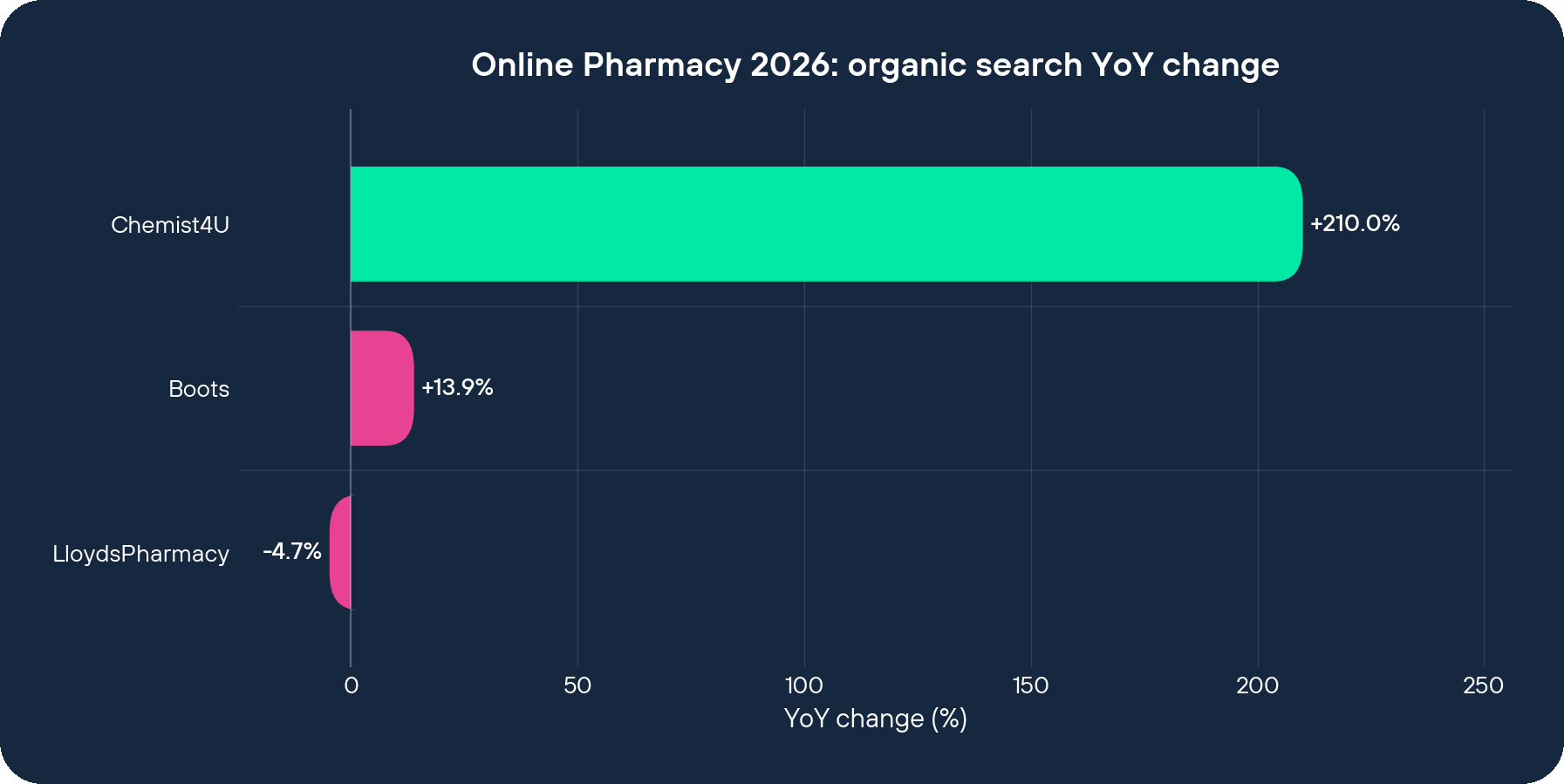
Chemist4U grew +210% while the market grew 15%
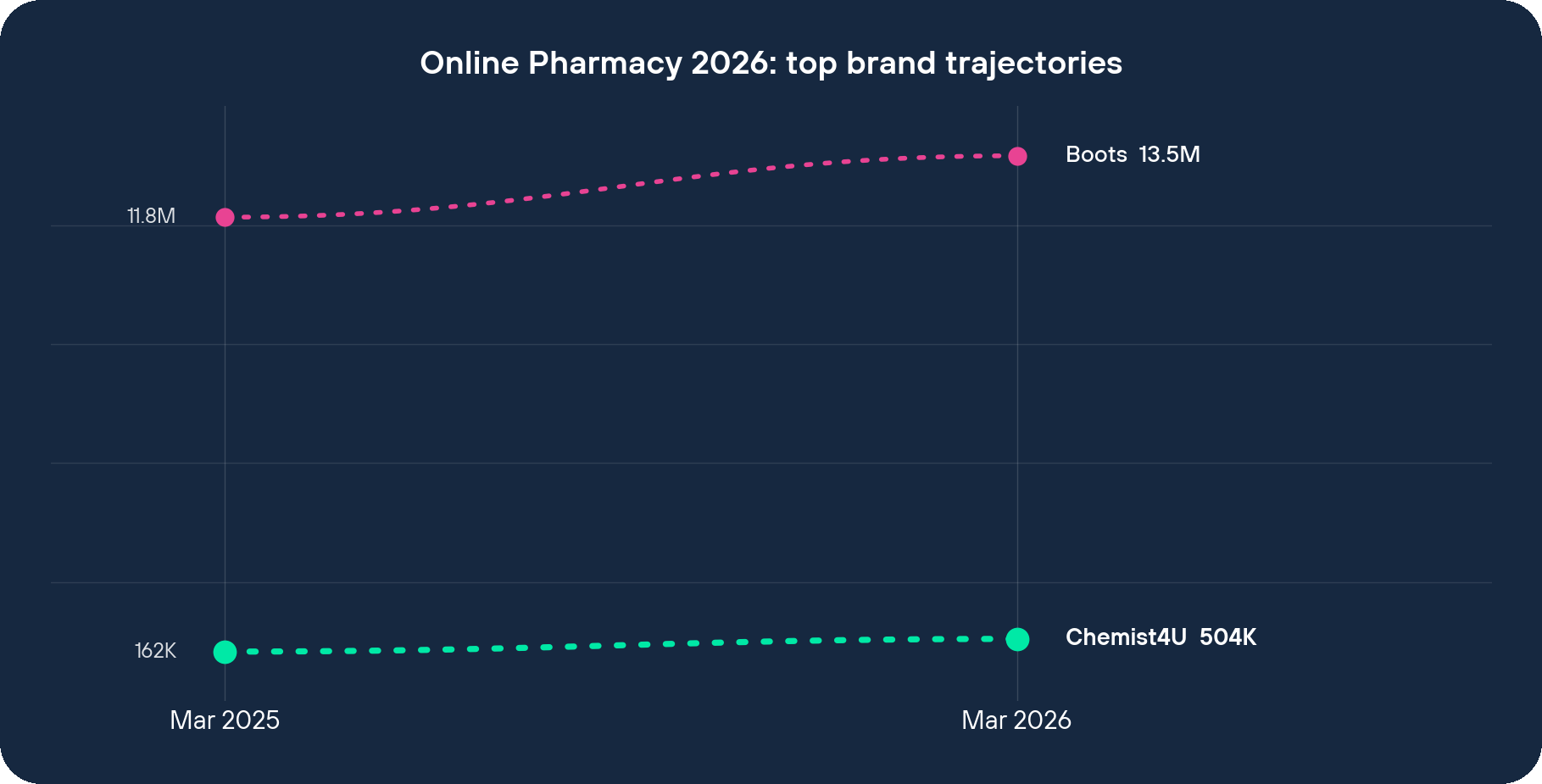
Between March 2025 and March 2026, Chemist4U grew from 162,442 to 503,626 monthly visits, a +210.03% increase in a market growing at +15.0%. That is +195.03 percentage points above the market rate. In absolute terms, the site added 341,184 visits in twelve months.
To contextualise that number: it is the second largest absolute traffic gain in the dataset. Boots, which holds 5,000,000 monthly brand searches and BRS rank 1, added 1,650,491 visits. Chemist4U, ranked 14th for brand reach with estimated brand search volume implying fewer than 50,000 monthly searches, added more than a fifth of that. The leverage ratio is not subtle.
The move from organic rank 8 to rank 5 happened in a market where rank 3 (LloydsPharmacy, 246,000 monthly brand searches) lost 37,644 visits in absolute terms, ending the period 19.71 percentage points below the market growth rate. Chemist4U now sits one rank below a brand with roughly 25 times the brand equity.
On trust signals: 119,750 Trustpilot reviews at 4.8 stars, review rank 2 across the sector. Only pharmacy2u.co.uk has more reviews (636,926), but at 4.6 stars. The combination of scale and rating places Chemist4U in a trust tier normally occupied by brands with far longer operating histories.
The growth is almost entirely non-brand organic. BRS rank 14 reflects modest brand search volume. The traffic number reflects something else.
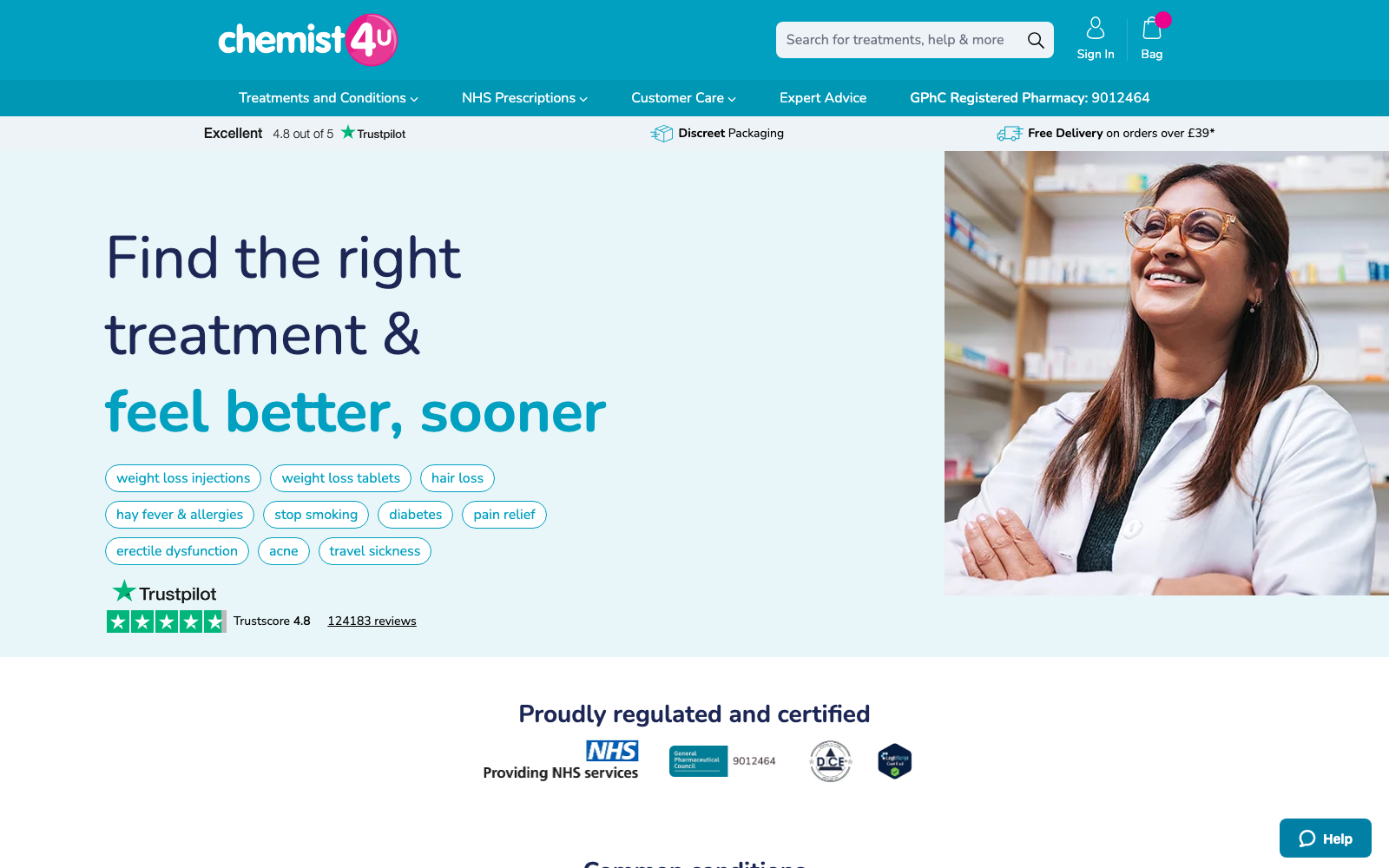
How Chemist4U built its site around 90+ health conditions
Chemist4U decided that the patient’s first question, not the pharmacy’s product range, should be the organising principle of the entire site.
Most pharmacy sites are catalogues with a search bar. Category navigation is structured around product types: vitamins, skincare, cough and cold, women’s health. This is inventory logic masquerading as UX. It tells you what the brand sells. It does not answer what the patient is searching for.
Chemist4U structured its navigation around 90+ health conditions. Eczema. Erectile dysfunction. Weight loss. UTIs. The site is architected to capture the moment of need, the informational query that precedes any purchase decision, not the moment of brand recall.
The cost of this bet is upfront. Building and maintaining condition-level content pages, pharmacist-reviewed articles, and clinical pathway UX for 90+ conditions requires sustained editorial investment that a brand-catalogue site never has to make. You don’t rank for “what causes a UTI” by uploading a product page for antibiotics.
What it protects is compounding. Every condition page that ranks creates a new entry point that doesn’t depend on Chemist4U’s brand recognition growing. The traffic profile becomes structurally less correlated with brand equity, which means it’s also structurally less vulnerable to a competitor outspending them on above-the-line. That’s the bet: trade brand dependency for content compounding.
A walkthrough of Chemist4U’s condition-led architecture
The architecture of this decision is visible within two scroll actions on the Chemist4U homepage.
Primary navigation doesn’t lead with product categories. It leads with conditions, a taxonomy built around how patients describe their problems to themselves, not around how a pharmacy stocks its shelves. The GLP-1 patch article visible on the homepage scroll is not an accident; it’s a signal that the content programme is tracking high-intent clinical conversations in real time, not publishing seasonal wellness content on a quarterly editorial calendar. The content hub is live and scaling. Every new condition covered adds another compounding topical authority signal.
Trust signals are embedded at the primary UX layer, not buried in the footer. The GPhC registration number (9012464) sits in the navigation bar. A Trustpilot score of 4.8 from 119,750 reviews is above the fold. For a user who arrived via an informational search with no prior relationship with the brand, these signals do the job that years of brand advertising would otherwise need to do. The friction between “this answered my question” and “I’ll trust them with my prescription” is deliberately compressed.
The NHS free contraception service and NHS prescription app are featured as distinct products, not an afterthought under a generic services tab. This is patient acquisition at the NHS relationship layer. Once a patient registers for a free service, the lifetime value calculation changes. It doesn’t require the high street footprint that established chains built those relationships through.
Now navigate to LloydsPharmacy.com. The primary prompt is: “Order your NHS prescription, with free delivery.” The site assumes the patient already has a relationship with Lloyds and is returning to complete a transaction. The navigation structure below, Allergy, Vitamins, Skincare, Cough Cold & Flu, Women’s Health, is product category logic. There is no condition-level entry point on the surface.
LloydsPharmacy holds BRS rank 5 with 246,000 monthly brand searches and social rank 7 across the sector. It lost 37,644 visits between March 2025 and March 2026, a decline of 4.71%, while the market grew 15.0%. The site is designed to serve people who already know they want Lloyds. In a market increasingly reached through condition-led search queries, that design assumption is a structural liability. The brand equity is real. The architecture is optimised to convert it, not expand beyond it.
The gap this creates is where Chemist4U’s 341,184 additional visits went.
What condition-led search means for pharmacy brands
If Chemist4U’s growth rate is directionally correct, and +195.03 percentage points above the market rate in a single twelve-month window is not noise, then several things are true for competitors that are uncomfortable to say in a marketing meeting.
First: brand recognition is not traffic. It converts traffic you already have. If your architecture doesn’t capture the queries that precede brand awareness, the brand awareness doesn’t compound. It sits there while someone else captures the patient first.
Second: category navigation is a confession. When your homepage is structured around product types rather than conditions, you’re telling the search engine, and the patient, that your site is a shop, not a clinical resource. Google’s preference for condition-level topical authority over product category breadth is not a prediction about where search is going. It is already the operating reality.
Third: NHS integrations are not a feature. They’re an acquisition channel. A patient registered with an NHS service has a materially higher retention rate than a patient who found you through a one-time search query. Brands treating NHS integrations as compliance checkbox items are leaving lifetime value on the table their competitors are collecting.
Fourth, and this is the one nobody wants to say in the room, being the largest brand in a growing market is not the same as winning the growing market. Boots grew from 11,844,026 to 13,494,517 visits, a gain of +13.94%. The market grew at +15.0%. Rank 1 in the dataset grew below market. Growth that looks like leadership is a lagging indicator of a structural shift happening underneath it.
The question for every brand not named Chemist4U is not “how do we grow faster?” It’s “what query are we not currently answering that a patient asked last night?”