by Sean
The visibility gain in numbers
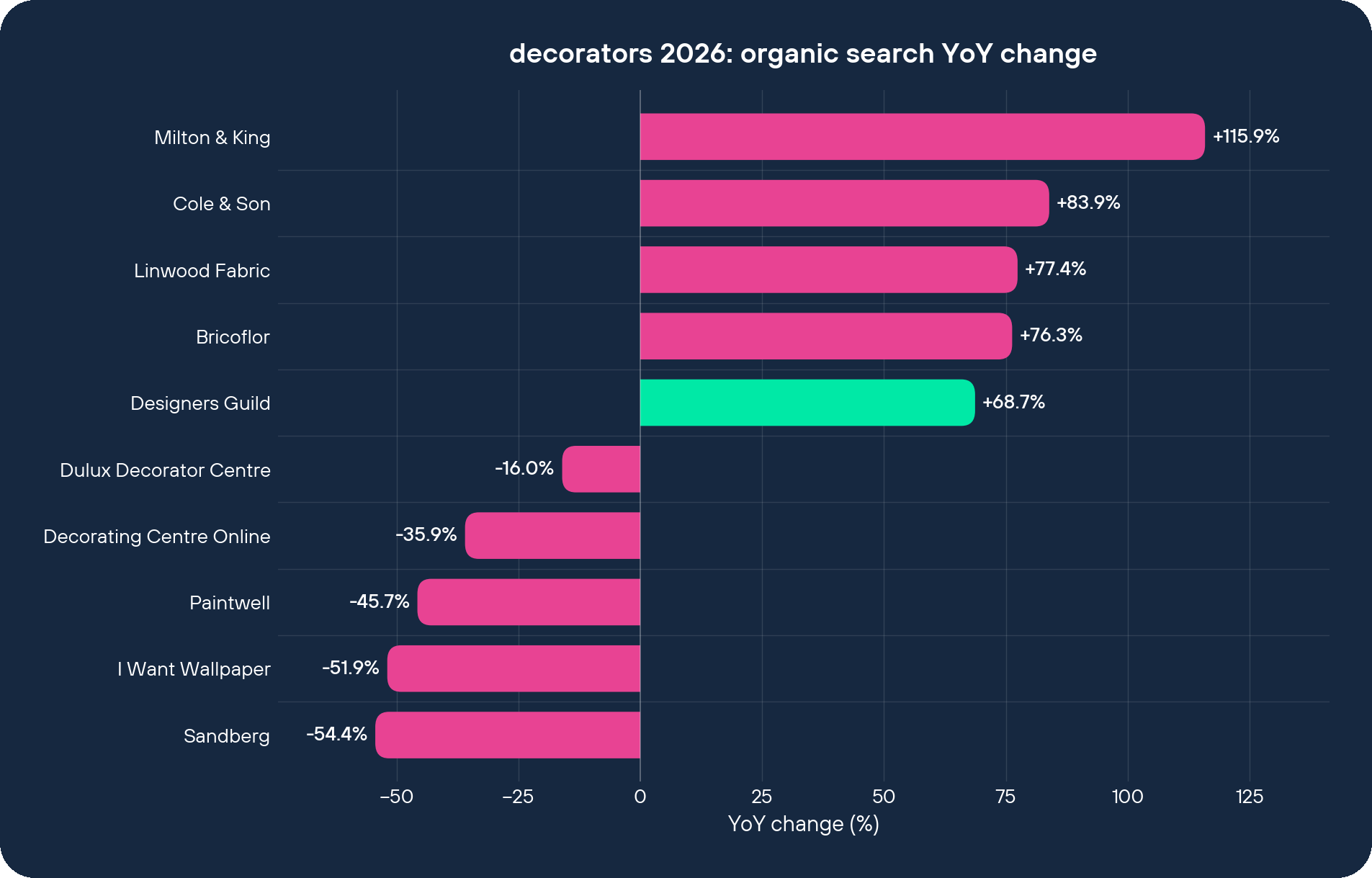
Between May 2025 and May 2026, Designers Guild’s organic visibility rose from 16,222 to 27,366. That is an extra 11,144 monthly visits and a year-on-year gain of +68.70%, which puts the brand 73.70 percentage points ahead of a sector that moved -5.00% over the same window. It now ranks 31st of the 237 decorator brands we track.
What the sector decline hides
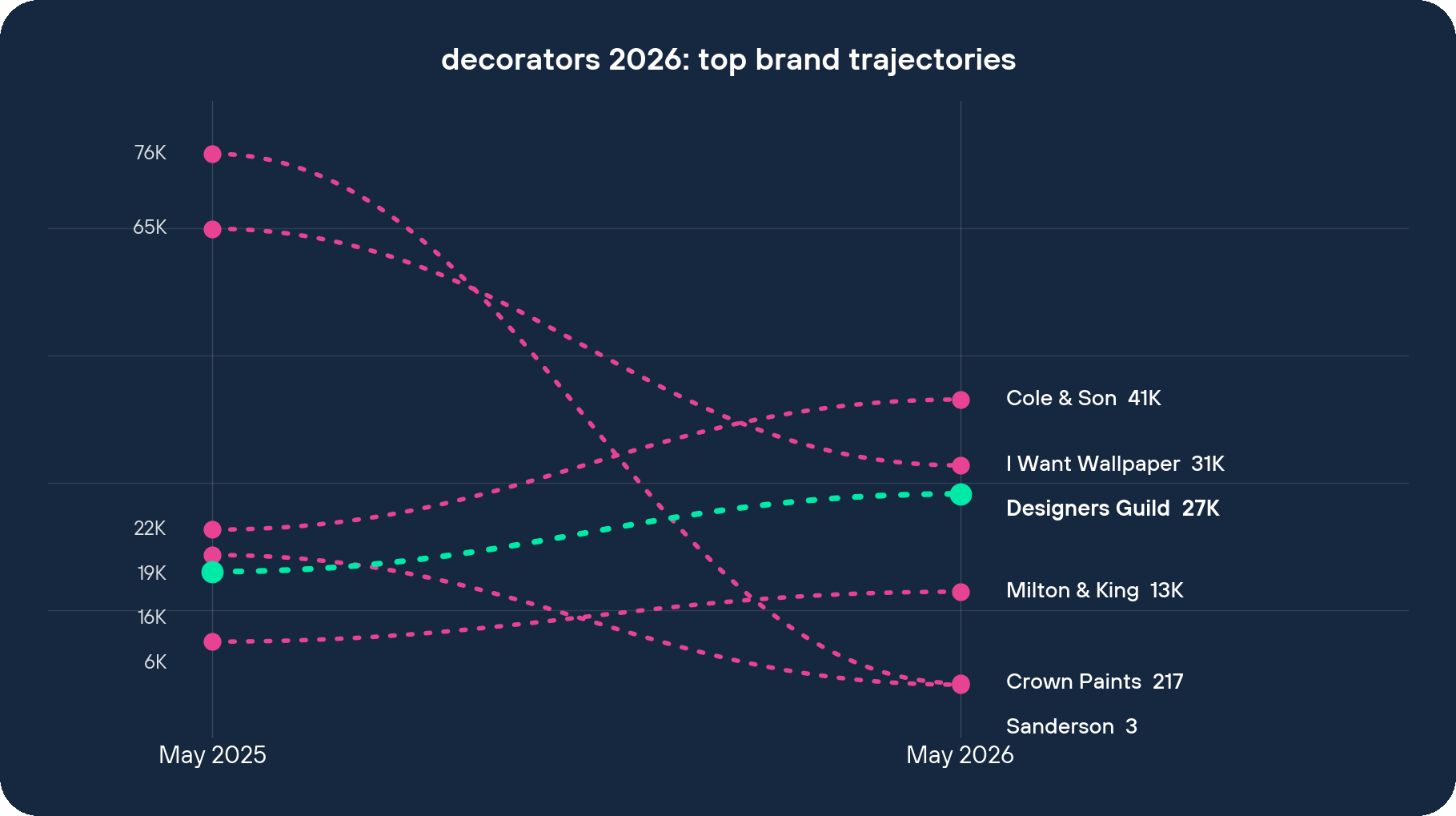
Before crediting any of that to something the brand did, it is worth being straight about the -5.00% headline, because it flatters the comparison. A large part of that decline is migration and indexation noise rather than lost demand. The Sanderson Design Group subdomains effectively disappeared from the dataset, sanderson.sandersondesigngroup.com fell from 18,597 to 3, harlequin from 8,530 to 2, clarke-clarke from 8,213 to 6, zoffany from 4,921 to 8, which is what consolidation onto a parent domain looks like, not households deciding they no longer want those wallpapers. Two more lines, janeclayton.co.uk (-81,268) and crownpaints.co.uk (76,169 down to 217, a -99.72% drop), are almost certainly tracking artefacts rather than a real collapse of two established names. Strip those out and the underlying market is close to flat. So Designers Guild’s gain reflects visibility moving toward it while the underlying market stands roughly still.
The brand’s premium positioning
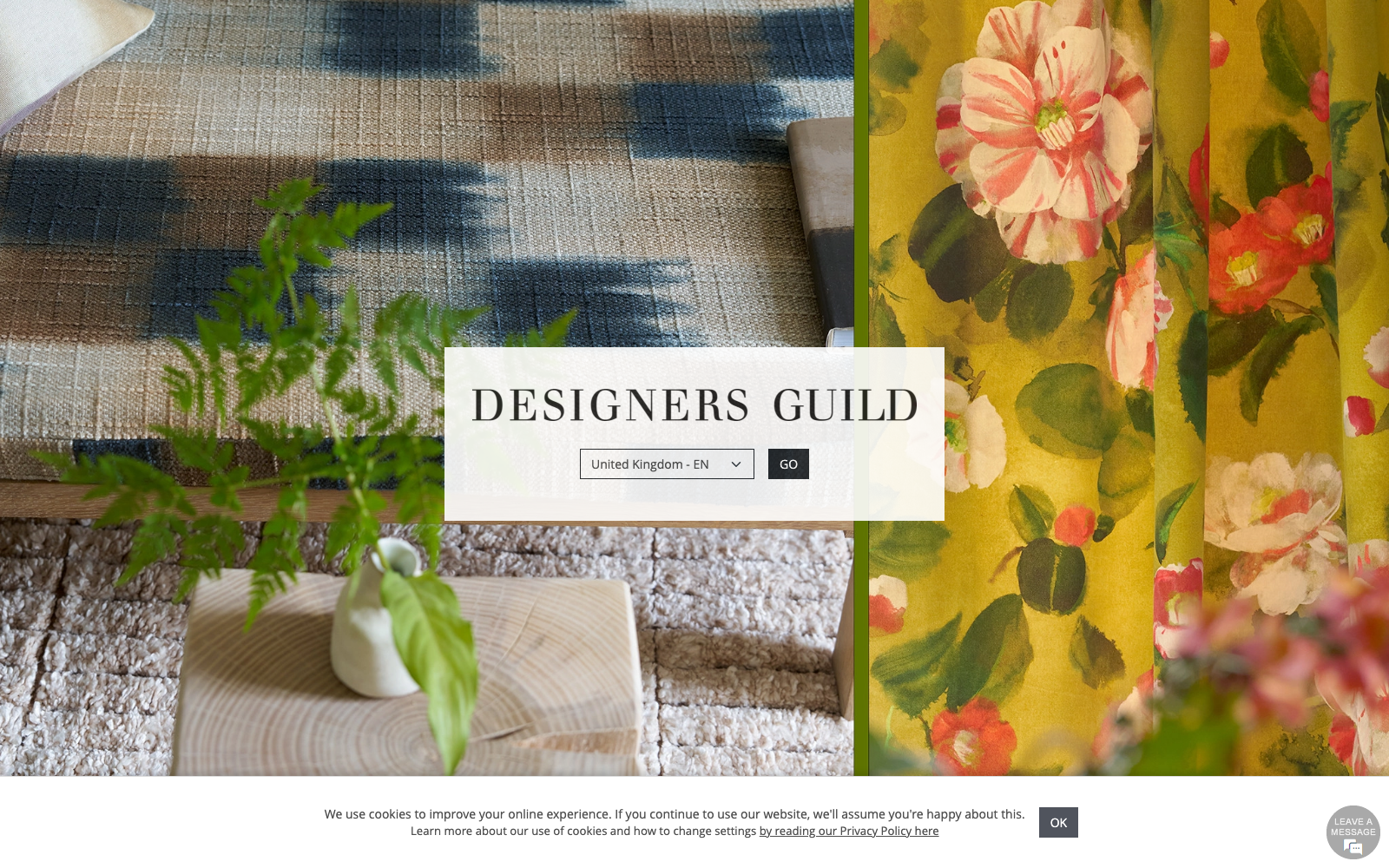
Designers Guild is a London design house founded by Tricia Guild in 1970, privately held, and positioned at the premium end of home furnishings. It sells fabric, wallpaper, paint, bed linen, cushions, upholstery and accessories, organised around Tricia Guild’s seasonal collections of bold florals, painterly prints and saturated colour. It also distributes other design houses in the UK, including Christian Lacroix Maison, William Yeoward and Ralph Lauren Home, so the catalogue is broad, but the thing the homepage actually sells is a specific aesthetic point of view.
How the rankings are earned
The figure that explains the growth is the brand’s branded search demand: 9,900 searches a month for the name itself, which places it 11th on our brand reach score. That is modest. A brand drawing 9,900 name searches a month would not, on its own, generate 27,366 monthly organic visits, so a large share of that visibility is non-branded, earned on category and product queries where a page has to rank on its merits against everyone else selling wallpaper or paint, which is exactly what strong ecommerce category and product page SEO is for. Whatever drove the +68.70%, most of it came from people who were not already looking for Designers Guild by name finding it anyway.
What they find when they land matches the positioning. The homepage opens on a full-width visual carousel of room sets and print close-ups, with an 18-country selector in the header and a collection-led navigation that sorts product by Tricia Guild’s named ranges rather than by price or promotion. There is no “lowest price”, no “free delivery over £X”, no clearance banner anywhere on the landing experience; the things a trade merchant leads with are simply absent. The paint range is sold by named colour and shown in styled rooms, the wallpaper is presented by collection and colourway, and the inspiration and room-set content is built to be browsed for ideas as much as to be bought from. For a category where a lot of competitors compete on stock breadth and delivery speed, that is a deliberately narrow, design-first presentation.
The pattern across the sector
The data shows that design-first presentation is where the visibility is collecting. Designers Guild’s +68.70% sits inside a clear cluster of design-led brands gaining over the same period: Milton & King rose +115.88% (6,176 to 13,333), Cole & Son +83.91% (an extra 18,664 visits, 22,244 to 40,908), Linwood Fabric +77.42%, Bricoflor +76.31%, and uWalls +39.42% on just 390 branded searches a month. Over the same window, the brands built on generic price-and-breadth went the other way: Sandberg -54.35%, I Want Wallpaper -51.89% (65,406 to 31,465), Paintwell -45.71%, Decorating Centre Online -35.94%. These are the same twelve months and the same category, with the design-led names rising while the price-and-breadth names fell.
The clearest sign that name recognition and search discovery have come apart is Farrow & Ball. It ranks second in the whole dataset for organic visibility at 475,429 visits, and it does that on only 2,900 branded searches a month, a clear example of how a boutique paint brand wins online. Dulux Decorator Centre has 74,000 branded searches a month, about 25 times Farrow & Ball’s name demand, and ranks eighth, on 90,701 visits. So the brand with the most name recognition in the sector is ranking well below design houses that far fewer people search for by name.
Dulux Decorator Centre is the obvious counterweight, and it is the most-searched brand in the sector at 74,000 name searches a month. Its model is trade scale and price: more than 230 physical stores, free delivery on orders over £60, next-day paint, in-store colour mixing, and “all your favourite brands” breadth across the catalogue. Over the year that model lost 17,283 visits and fell -16.01%, finishing eighth at 90,701. Carrying 25 times the branded demand of a design house like Farrow & Ball did not protect its ranking: the scale-and-price model has the name recognition and lost visibility over the year, while the narrow design houses have far less name recognition and gained it.
What the data cannot show
None of this proves that Designers Guild’s design-first presentation caused the +68.70% on its own, and it would be dishonest to claim it did. A gain from 16,222 to 27,366 is a real move but a modest absolute one, and several things that do not show up in this dataset could be feeding it. The May 2025 starting point may have been a soft comparison. A site change or re-platform can lift indexation and ranking independently of anything to do with design. New seasonal collections, a wholesale or licensing push, press coverage of a Tricia Guild range, or international traffic gathered through that 18-country selector would all add organic visits without being visible here, and paid activity that raised branded search would do the same. What the data does support is narrower and still useful: the growth is mostly non-branded, it lines up with a cluster of other distinctive design-led brands gaining while generic price-led retailers fell, and the brand most people actually search for by name is the one going backwards.
Over these twelve months and within this dataset, a defined design point of view, presented on collection-led pages that earn their category and product rankings on their own merits, is doing more for organic discovery than catalogue breadth or name recognition, with every causal caveat above still standing.
If you want the kind of design-led, collection-style content that earns non-branded visibility the way Designers Guild’s pages do, our content marketing for organic visibility service is built to produce it.
Further reading
- increasing organic traffic with product images, Designers Guild’s growth rests on visual, image-led pages, so this guide on how product imagery lifts organic traffic is a practical follow-up for design-first brands.
- our Home Furnishings sector report, Designers Guild sits at the premium end of home furnishings, so the wider sector report gives useful context on how the broader category is performing online.
- our Curtains & Blinds report, a brand selling fabric and wallpaper competes close to the curtains and blinds market, so this adjacent report rounds out the picture for soft-furnishing marketers.