by Sean
If brand recognition still guaranteed search visibility, this couldn’t happen.
Click here to access the latest Home Furnishings market report.
The UK has maybe four homewares brands a normal person could name in a pub quiz. Ikea. Next. Dunelm. The White Company. That recognition is what the boardroom talks about when somebody asks why the marketing line item is so heavy.
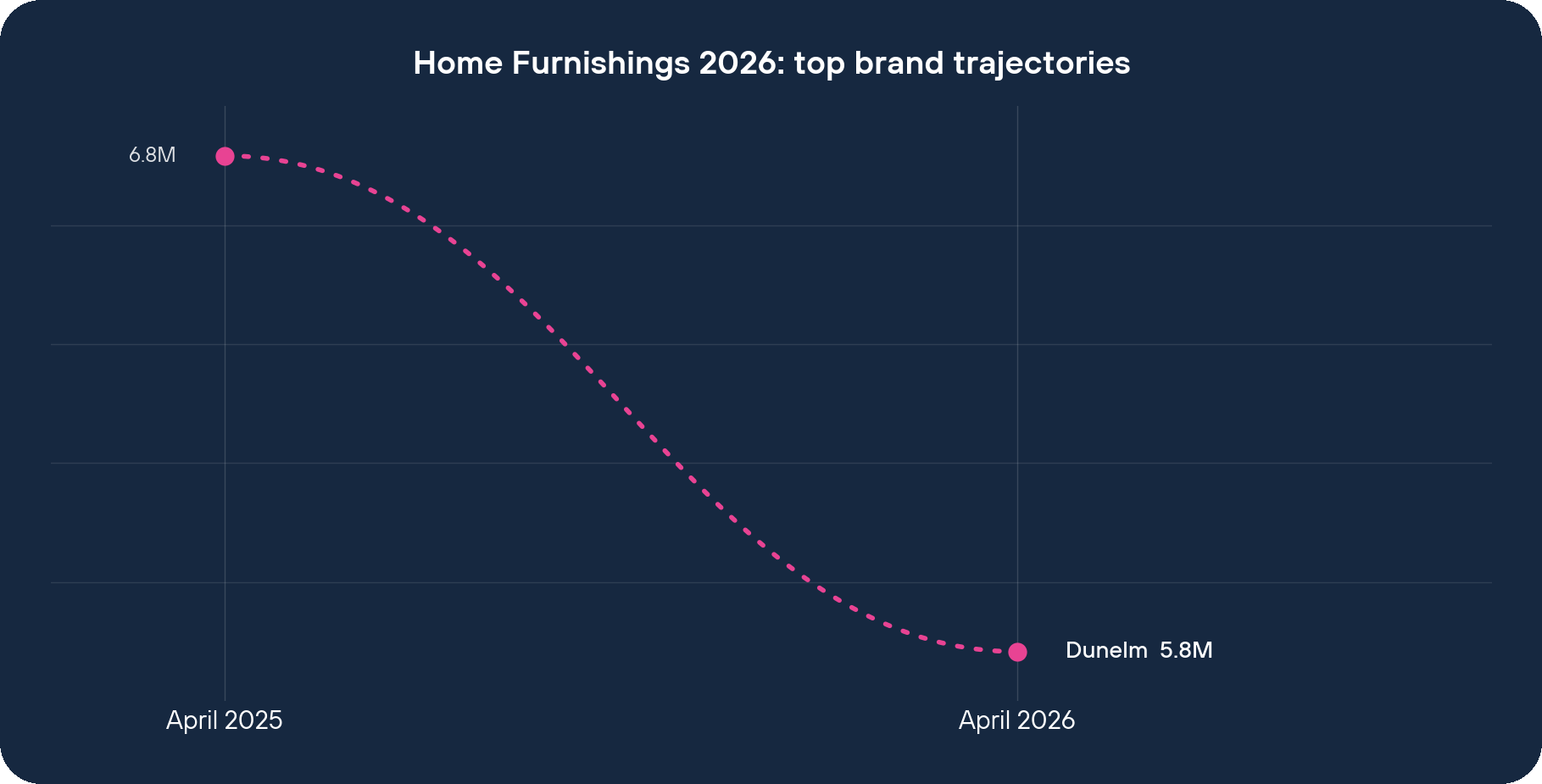
The brand tied with Ikea for second in the whole index on branded search demand, with 3,350,000 searches a month, behind only Next at 6,120,000, lost more organic visits over twelve months than any other brand in this report. By a long way.
That brand is Dunelm. The number tells us about the current limits of brand recognition, what it can still do for a business and what it no longer does on its own, rather than whether Dunelm had a single bad year.
It’s a useful example, and worth looking at closely.
The data window is April 2025 against April 2026, across 249 brands in the index. Market average movement on organic visibility over that period: -1.0%. Effectively flat. The category isn’t shrinking.
Dunelm shrank anyway.
April 2025: 6,768,729 monthly organic visits. April 2026: 5,847,165. That’s a net loss of 921,564 visits a month. The biggest absolute decline in the index. The -13.62% drop is more than thirteen times the size of the market drift.
And there’s no brand-awareness explanation for it. Dunelm tied with Ikea for second in branded search demand at 3,350,000 a month. Brand recognition, the thing the marketing budget pays for, is intact. People are still typing “dunelm” into Google.
The traffic didn’t move to Next. Next is down too, -455,718, -2.88%. Wayfair is down -9.94%. The top five brands combined fell from 33,088,426 to 32,098,214 in twelve months. A -3.0% decline against a category that moved -1.0%. The biggest brands are losing visibility three times faster than the market.
Meanwhile, Furniturebox grew +119.68% on 8,100 monthly brand searches. Homary grew +120.32% on 9,900. The visits Dunelm lost are going to brands with less than 0.3% of its branded demand.
Dunelm has made a bet, and it’s a coherent one if you accept the premise.
They’ve built the site around the assumption that the customer arrives with brand intent. “I’m here for Dunelm. Show me the range.” The homepage hard-leans on “made to measure curtains” and seasonal range merchandising. The taxonomy is brand-internal, organised the way a buying team thinks rather than the way a person searching “thermal blinds for bay windows” thinks.
That bet protects something real. It protects the cross-sell logic and the seasonal margin, the “while you’re here, also look at cushions” selling that makes Dunelm a multi-billion business. It’s the same logic as a big supermarket aisle layout. The whole site assumes the customer is already in the building.
What this costs Dunelm is the searching that happens outside the brand: the non-branded query, the problem-led search, the “how do I stop my bay window letting light in at 6am in June” search. Those searches have grown. That’s where 921,564 monthly visits went, to a long tail of specialist product pages that match how the buyer actually types, spread across many small brands rather than any one big name.
Walk Dunelm’s homepage today and you can see the bet on the screen. The hero rotates seasonal range content. “Made to measure curtains” gets a permanent place in the navigation, because that’s a category Dunelm owns in-store and wants to own online. The mega-menu is organised by room, then by product type inside the room. Cushions sit under “Living Room,” filed by product category instead of by the problem a customer is trying to solve, like “I want my sofa to stop looking tired without buying a new sofa.”
The category pages themselves are inventory grids. Filter by colour, by size, by price. They assume you already know the product class. They don’t try to teach you what a blackout roman blind is, or when you’d choose one over a thermal roller. The assumption is: you searched Dunelm, you arrived, now browse.
The homepage opens with “Up to 50% Off The Garden Sale,” then a category sweep: Garden Sofas. Egg Chairs. Garden Dining. Bistro Sets. Garden Chairs. Garden Accessories. Each one a single-keyword landing page with tight on-page SEO and almost no brand merchandising. There’s no “Furniturebox Spring Collection.” There’s “Ottoman Beds.” There’s “Accent Chairs.” The site reads less like a brand store and more like a directory of buying intents.
The trust signals are stacked and loud. Free Next Day Delivery, order by 8pm. Free 30-Day Returns. Interest Free Finance via Klarna and PayPal. 2 Year Guarantee. Trustpilot reviews on the homepage. They’re handling the “is this legit?” objection that a buyer would never need to ask about Dunelm, because the brand resolved it for them already.
Furniturebox has 9,788 Trustpilot reviews at 4.9 stars. Dunelm has more brand equity than that on its own. Furniturebox has more visible proof on the page than Dunelm shows above the fold.
The result is two completely different intent funnels meeting in the same SERP. One built for “I want a sofa bed under £400 by Tuesday.” One built for “Show me Dunelm.” The customer with the first query never finds the second site, because the second site never tried to rank for the first query.
So what does this mean if you run a brand with real recognition?
It means brand search and category search are now two separate businesses, and you can’t fund the second by being good at the first. Building the second means treating category and product page SEO as its own discipline.
I’ve put myself on a tangent here, but stay with me. There’s a behavioural shift sitting underneath this that nobody in the boardroom wants to say out loud. The customer who used to type your name into Google has not gone away. What’s broken sits upstream of that. It’s the moment somebody decides what they want, before they decide who to buy it from. That moment used to live inside your brand. Now it lives in Google, ChatGPT, Reddit threads, and a long tail of specialist product pages.
Anyway. Back to the point.
Consider the head of digital at a brand with Dunelm’s profile. The board sees brand search holding steady and treats the visibility loss as a technical SEO problem. “Fix the indexing.” “Get a new agency.” “Tighten the meta titles.” None of that touches what’s actually happening: customers stopped arriving with the brand already in their head, and the site was built only for the customers who do.
The strength of the brand is exactly what hides the missing traffic from the people inside the business. The number on the brand awareness slide is great. The board claps. Nobody asks where the 921,564 visits went. They went to a long tail of single-product landing pages owned by brands the board has never heard of.
The job to be done is to win the category page before the buyer knows your name. We’ve broken down how to build a category page that ranks in detail elsewhere.
A caveat. One year of organic visibility is one slice of one channel. Dunelm has stores, app users, email lists, and paid demand we can’t see from here. Some of the decline may be seasonal. Furniturebox and Homary are growing from small bases, and at some point the slope flattens.
What’s hard to argue away is the asymmetry. The brand with the biggest branded-search demand in the category just lost the biggest absolute pile of visits in the index. If brand recognition was still doing the work, that wouldn’t happen.
Brand recognition delivers the visit from someone who was already going to search for you; it does nothing to capture the demand that forms before the buyer ever types your name.
If your brand is watching non-branded search drift toward smaller competitors, the work starts upstream of the website, with content that wins problem-led search: the questions and problems people search before they have a brand in mind. To see where your own brand sits in the same category, read the full report.
Further reading
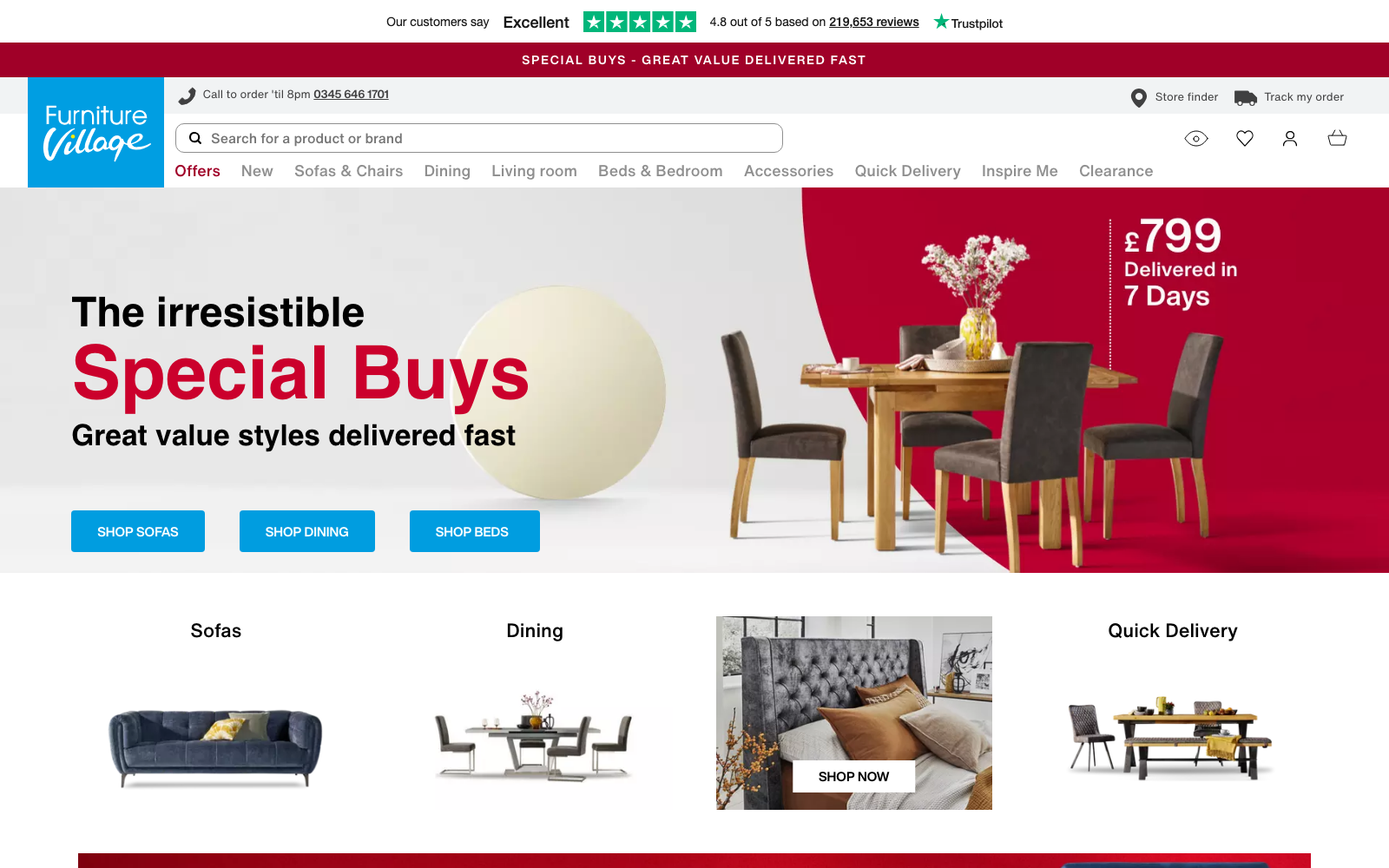
- Furniture Village: turning browsing into buying, A home furnishings deep dive on converting search visitors, with a worked example from the same sector.
- Curtains and Blinds market report, The article uses made-to-measure curtains and blinds as its example category, so this report gives the underlying sector data.
- Sofa and Chair industry report, Furniturebox and the sofa category run through the whole piece, and this report ranks the brands competing for that same search demand.