by Sean
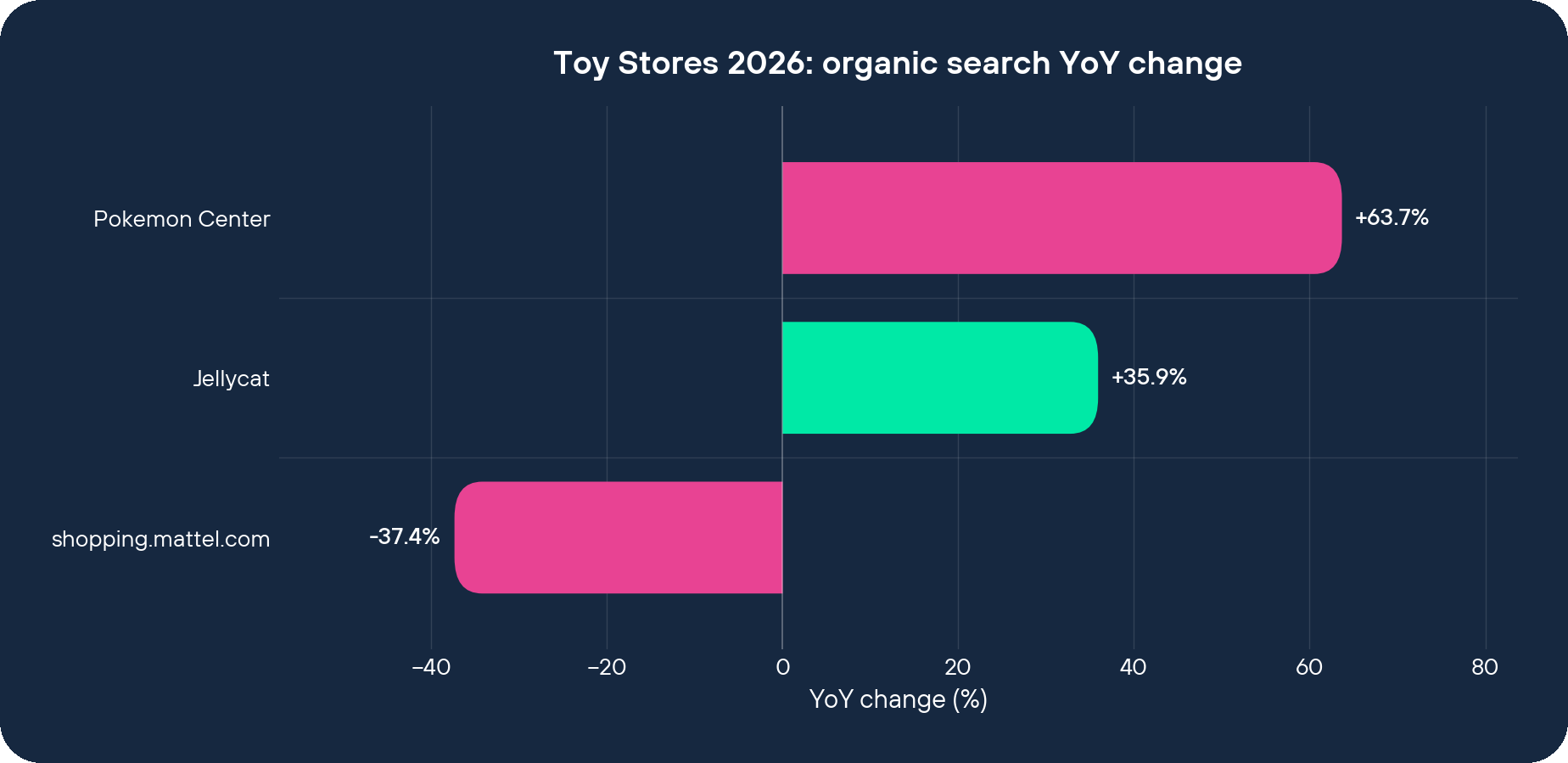
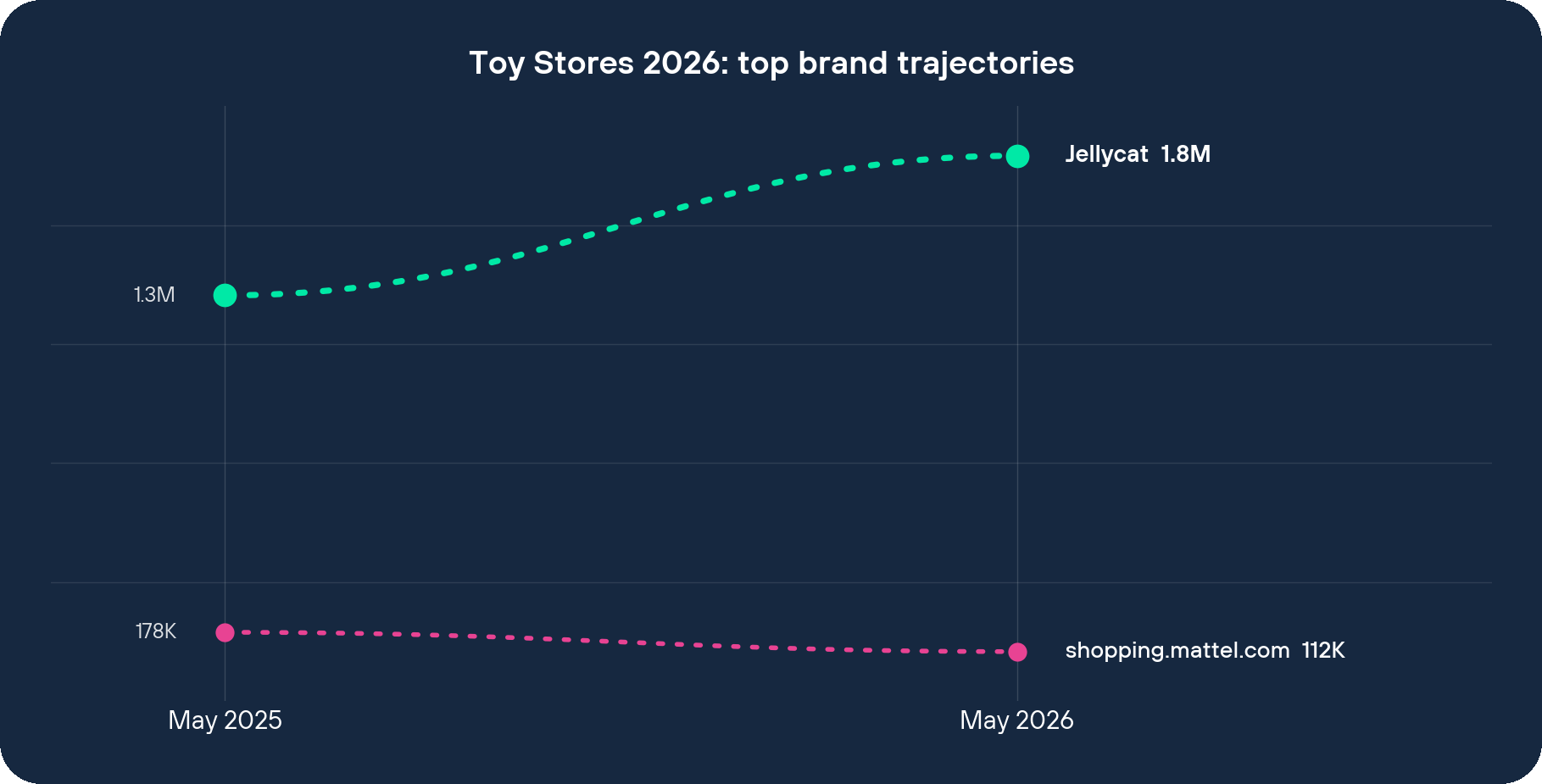
In a sector that grew 5.0% year on year across 338 brands, jellycat.com added 482,131 in organic visibility between May 2025 and May 2026, climbing from 1,342,380 to 1,824,511 and finishing the period at rank 3. That is a 35.92% increase, which is 30.92 points ahead of the market. Only two domains sit above it: Smyths Toys at rank 1 on 4,955,080, and Lego at rank 2 on 2,183,166, as our deep-dive into UK toy-store search results sets out in full. Both are far bigger operations, one a national multi-channel retailer, the other the most-searched toy brand on the planet. Jellycat is a privately owned soft-toy maker founded in London in the late 1990s, with no superstores and no film franchise attached to it. So the question worth asking is not whether it grew, but why a brand this size outgrew almost everything around it in a year when several established retailers in the same table went backwards. Click below to access the latest Toy Stores market report.
The part of the number that is genuinely defensible
Jellycat draws 823,000 brand searches a month, which puts it at Brand Reach rank 2, behind only Lego on 1,000,000, and ahead of national retailers like Smyths (Brand Reach rank 7) that carry several times its organic visibility. That is a very large volume of people typing the brand or its products into Google by name every month, and it matters for one specific reason: a search for “jellycat ricky rain frog” or “bartholomew bear” has a single obvious destination, and no retailer or competitor can outrank Jellycat for the names of Jellycat’s own products.
That is the kind of query that holds up under the change CT1 described. Generic category searches, “soft toys”, “teddy bear gift”, “cuddly toy for newborn”, are precisely the searches Google now tends to answer inside an AI Overview or other zero-click result, so a chunk of the visibility a retailer earns from them is skimmed before anyone clicks through. Name-level searches are far harder to intercept that way, because the intent is specific and the answer is one named product page that belongs to the brand. So the defensible reading of the 35.92% is this: a large and growing volume of branded, name-level demand resolves directly to jellycat.com, and that traffic is structurally harder to erode than the generic category traffic that fell for others in the table. The same pattern shows up elsewhere in the data, Pokemon Center, another named-franchise destination, grew 63.68% to rank 8 over the same months while several generic retailers declined.
What Jellycat actually does to keep people typing its name
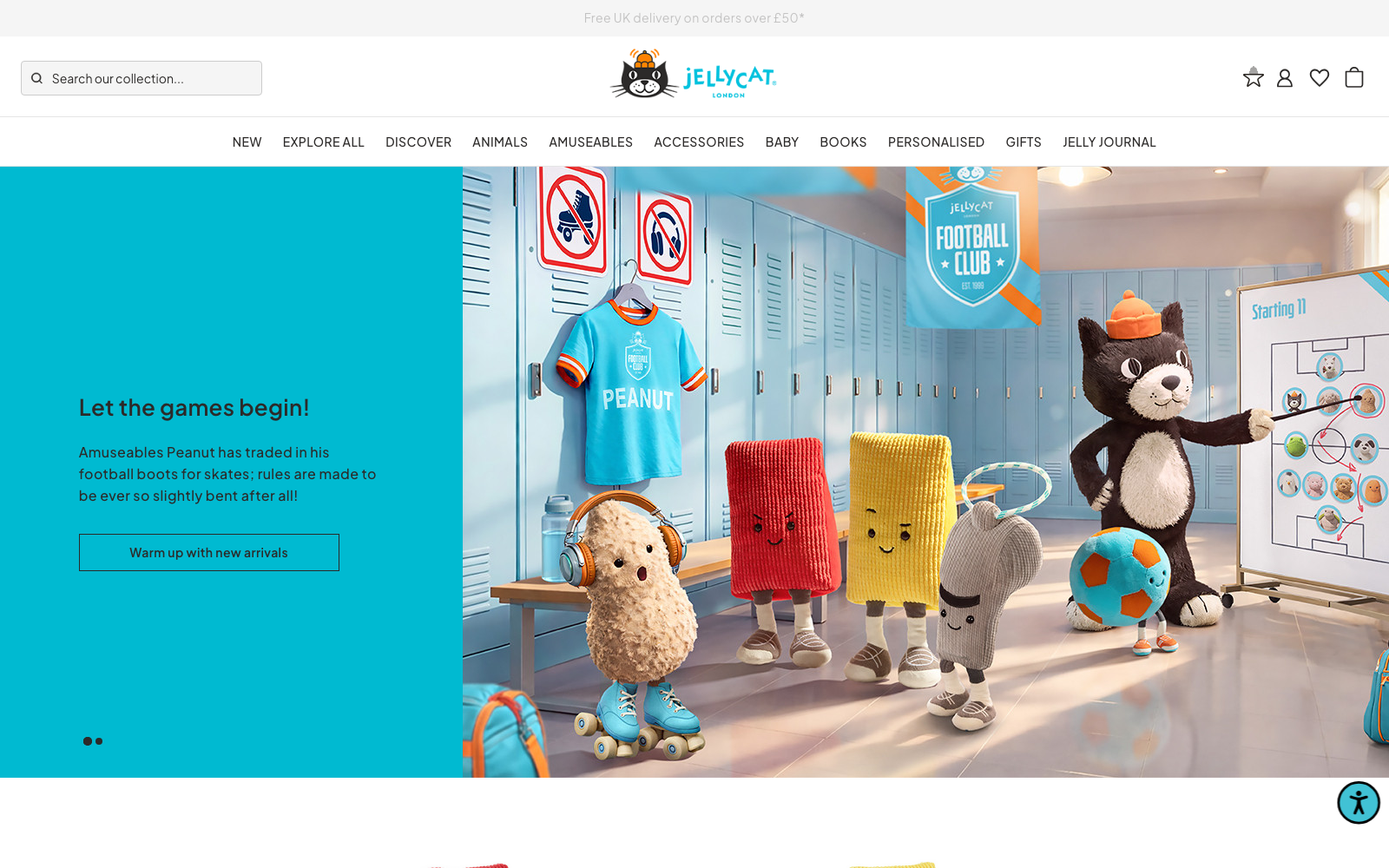
The site is built to manufacture searchable names rather than to win generic category rankings. Jellycat’s products are individually named, collectible characters with their own personalities, Ricky Rain Frog, Bartholomew Bear, Rockleton, described on the site as a “part rock, part cuddle monster”. Every one of those is a branded query that did not exist before the character launched, and each new release adds another. People do not search “green frog soft toy” and find Jellycat; they search “Ricky Rain Frog” because they already know the name.
Two things on the site are clearly engineered to turn one-off buyers into recurring brand-search traffic. There is a loyalty programme called Purrks, “Collect Jellies. Earn Purrks Points. Unlock Rewards”, which gives buyers a reason to come back directly rather than via a generic query. And there is an #sharingjoy Instagram community that keeps the characters circulating socially; Jellycat’s social score of 3557.750 (social rank 5) confirms that demand is not search-only. The merchandising reinforces the same loop: constant drops, an Amuseables Sports range, and “Back In Stock” and “Trending” rails that give people a concrete reason to type the name in again, “is it back yet”, “new jellycat”. The brand-world copy (“Born in London. Loved worldwide.”, “Expect the unexpected”, “Jump into Jelly Joy!”) is doing the same job at the top of the funnel: making the brand itself the thing people remember and search for.
The drivers this dataset can’t see
A 35.92% rise has more than one cause, and most of them are invisible here. This dataset shows organic visibility only. It does not show what produced the rise, and the correlation between 823,000 brand searches and 482,131 in growth is suggestive rather than proof. It would be wrong to credit the Purrks programme, or any single on-site decision, for the whole number.
The bigger drivers over this period sat largely outside jellycat.com. Jellycat had a genuine cultural surge through 2024 and 2025, viral TikTok unboxings, a wave of adult collectors, and experiential retail activations like the café- and diner-style pop-ups that ran at Selfridges in London and FAO Schwarz in New York. Those generate brand searches directly, regardless of anything the website does. The scarcity marketing compounds it: Jellycat retires characters and runs limited drops, which is exactly what drives “is X back in stock” and “new jellycat” searches. Wide wholesale distribution through John Lewis, Selfridges and independent gift shops raises awareness that later converts into branded search. Any paid activity, or digital PR to earn brand coverage, would push brand search up too, and part of a year-on-year jump always comes down to what the comparison period looked like. The honest version is that the 35.92% is the sum of cultural momentum, scarcity-driven repeat search, distribution reach and deliberate on-site demand engineering, and this table can only see the result, not the mix.
One figure in the data complicates the tidy story. For a brand pulling 823,000 searches a month, jellycat.com carries only 2,782 reviews at 4.4 stars (review rank 13), modest next to retailers like Baker Ross on 53,929 or Magic Madhouse on 43,286. That low count fits a brand where a lot of buying happens through third-party retailers and as gifts, with customers who never return to jellycat.com to leave a review. The search demand resolves to Jellycat’s domain for visibility purposes, but the site is not necessarily capturing the matching transaction volume. The visibility number and the commercial picture are not the same thing, and the reviews are a useful reminder of that.
What renting traffic looks like by comparison, Mattel’s shop
shopping.mattel.com is the cleanest contrast in the table. It fell from 178,258 to 111,654 over the same year, down 66,604 (-37.36%, or 42.36 points behind the market), settling at rank 12. It built that visibility almost entirely on generic category and product queries, its homepage is organised around “Shop by Category” blocks (Cars & Playsets, Action Figures & Playsets, Dolls & Dollhouses, Building Blocks & Sets, Games) and “Recommended Searches” like Polly Pocket, Monster High and Imaginext. It carries just 10 brand searches a month, Brand Reach rank 45. Mattel owns Barbie and Hot Wheels, brands with enormous demand, but a search for “Barbie” or “Hot Wheels” lands on a franchise site or a large retailer like Amazon or Smyths; the shop subdomain barely registers in that demand. So when Google’s zero-click results took over the generic category searches the shop relied on, there was very little name-level demand pointing at it, and it declined. Same market, same year, opposite result, and the difference tracks whether the domain gets searched for by name.
What this means if you sell toys
The practical read for anyone running ecommerce or brand in this sector is about which visibility you can actually keep. Visibility earned on generic category terms is now shared with Google’s own answers and is the first thing to go when those answers expand. Visibility earned on names you created, characters, ranges, a house style distinctive enough that people search for it directly, resolves to your own domain and is far more durable. Jellycat spent years building those names through products, drops and a recognisable world, and that work is slow and hard to copy; it is not an SEO tactic you can switch on next quarter, and the data here cannot tell you how to replicate it. What the May 2025 to May 2026 figures do show is that the two kinds of visibility now behave very differently inside the same growing market, and the brands carrying real name-level demand are the ones pulling away from the pack.
Building names that people search for directly, characters, ranges, a recognisable house style, takes patient content work that compounds over years. If you want to grow that kind of durable, name-level demand for your own brand, our content marketing for topic authority explains how we go about it.
Further reading
- Passenger’s content-as-commerce case study, shows how another brand turned content into a direct sales channel as AI Overviews started reshaping search, the same pressure described here.
- the UK gifting industry report, much of Jellycat’s sales happen as gifts, so the gifting sector report shows the wider buying behaviour behind the brand.
- the baby products market report, toys and baby products share buyers and gift occasions, so this neighbouring sector report is a useful comparison.