by Sean
Across 211 UK sexual wellness domains, visibility fell -20.31% between visibility jan 2026 and visibility june 2026, a net loss of 454,547 monthly points, and 92.03% of that came out of the five brands that started at the top. Four of those five lost 441,439 points between them. The fifth added 23,133. Click below to access the latest Sexual Wellness market report.
That fifth brand is a condom manufacturer whose title tag claims exactly four categories.
What Durex actually is in this market
Durex is not a sexual wellness retailer in the sense that the rest of this index is. It is a Reckitt brand, acquired with SSL International in 2010, and one of the small group of Powerbrands Reckitt kept when it decided to narrow the group, the Essential Home portfolio went to Advent, Mead Johnson has been under review for years, and Durex sits in the retained Health business alongside Gaviscon, Nurofen and Strepsils. That matters for two reasons a search-marketing peer will recognise immediately. First, Durex carries above-the-line media budget that nobody else in this index has access to, and that budget generates branded search volume which only durex.co.uk can capture. Second, its real distribution is Boots, Superdrug, Tesco, Sainsbury’s, Asda and Amazon. The DTC site is not where most Durex units are sold, which means it is under no pressure to behave like a general merchant.
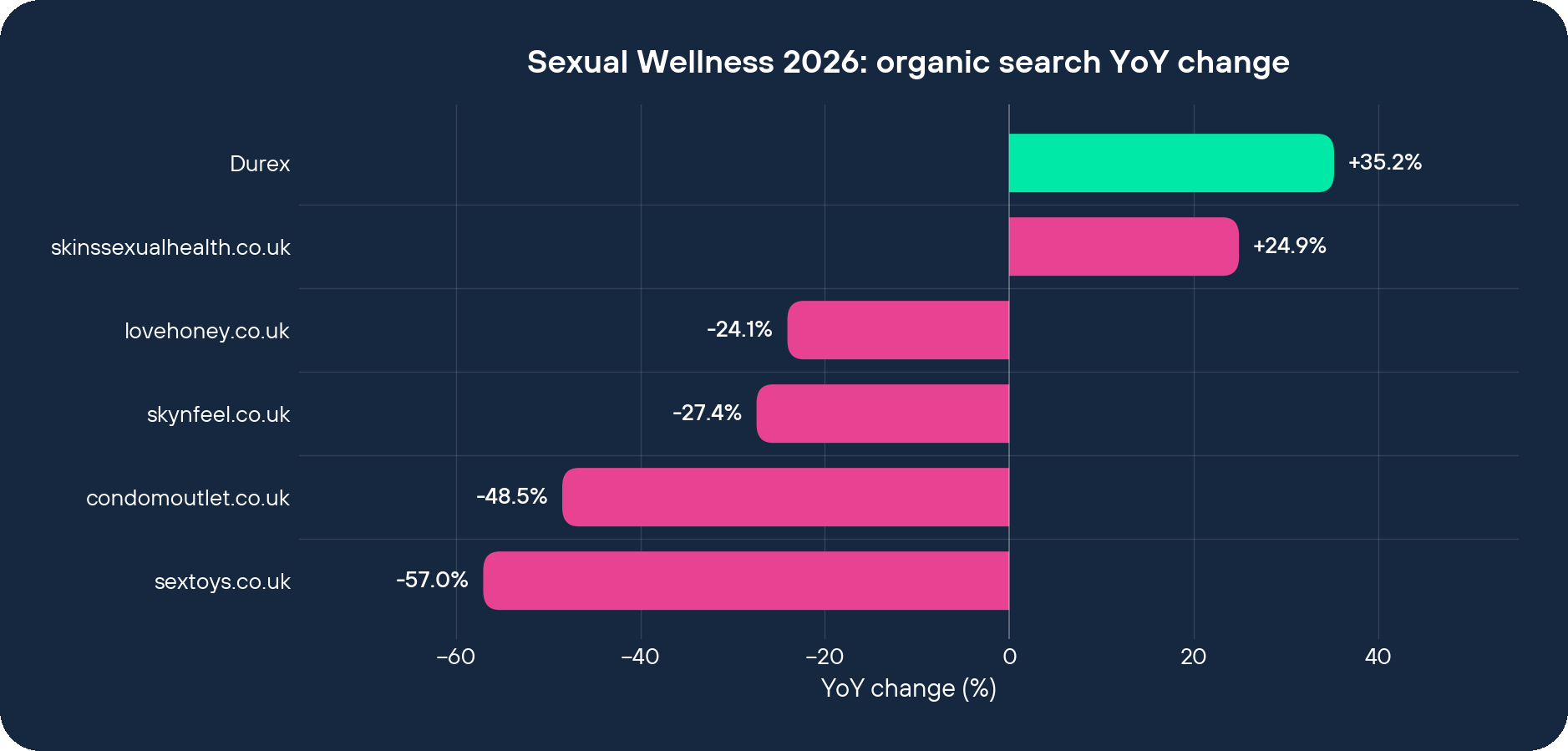
Its product-level competitors inside this sector are not Ann Summers or the other big catalogue retailers. They are SKYN, Skins, Pasante, Mates, EXS and the grocers’ own-label. Three of those have domains in this dataset: skynfeel.co.uk fell from 11,873 to 8,619 (-27.41%), condomoutlet.co.uk fell from 2,232 to 1,150 (-48.48%), and skinssexualhealth.co.uk grew from 6,573 to 8,211 (+24.92%). So the condom end of the category did not simply hold up while the toy end collapsed, SKYN, which competes directly with Durex’s Real Feel polyisoprene line and which we covered in our earlier analysis of SKYN’s growth, lost more than a quarter of its visibility over the same six months.
Six products on the homepage and four categories in the title tag
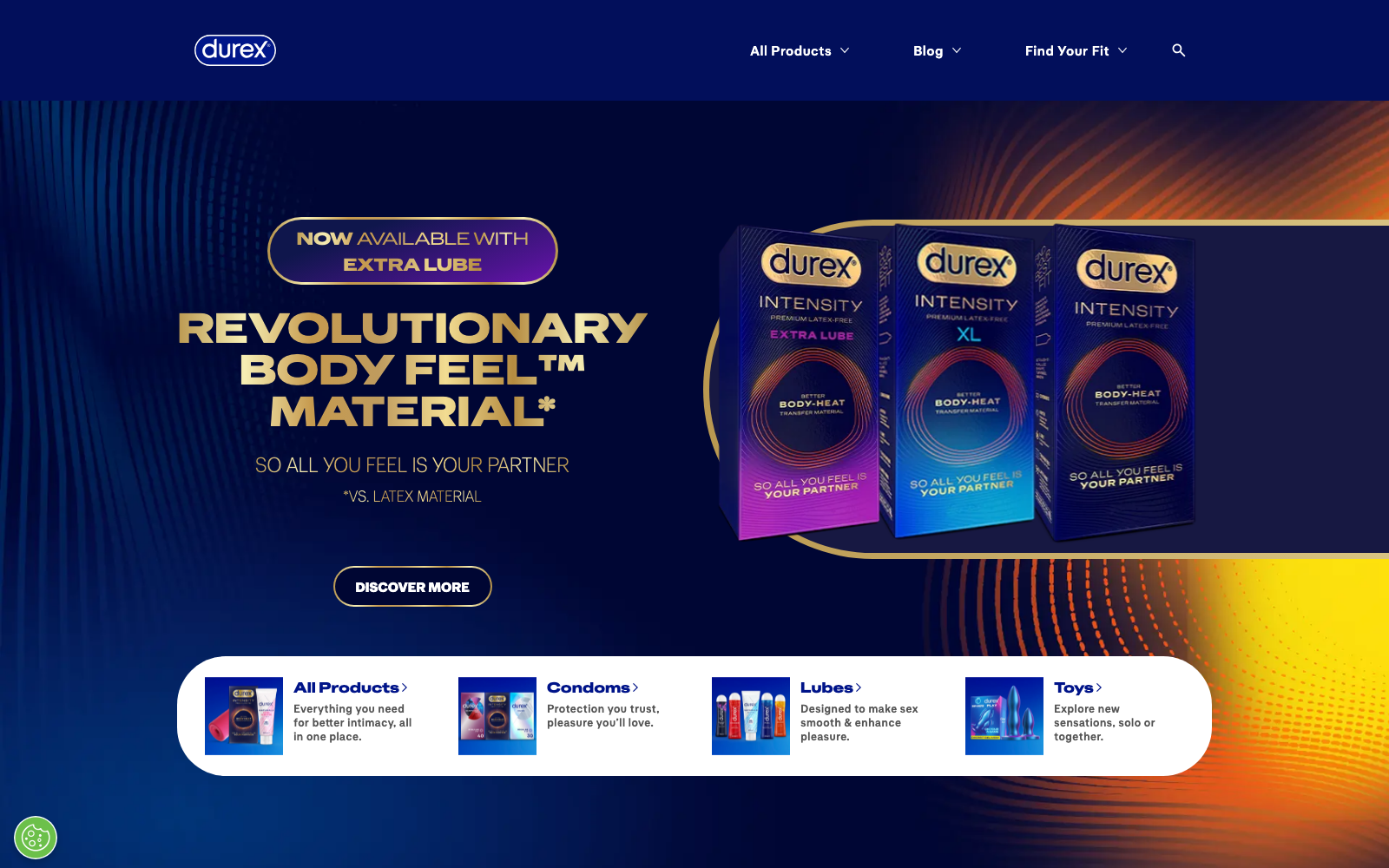
The Durex homepage is one shelf deep. The “Our Most Loved” module surfaces six SKUs: Intensity Regular Fit 5 Pack, Intensity Extra Large 10 Pack, Nude Ultra Thin Regular Fit 6 Pack, Surprise Me 40 Pack, Naturals Intimate Lube Extra Sensitive, and Slide & Ride Masturbation Sleeve. The title tag claims four things, “Condoms, Lubes, Massage Gels & Sex Toys”. That is the whole commercial proposition, above the fold, in one screen.
Compare that with the navigation the reader is used to in this sector. sextoys.co.uk stacks 48 category links across three menus, and its “For Couples” menu has not opened yet.
There is also no discount merchandising anywhere on the Durex homepage. Ann Summers leads with “UP TO 30% OFF SELECTED LINES” and “BUY 1 GET 1 HALF PRICE SEX TOYS”. Sinful leads with “Summer sale | save up to 60%”. Three of the four largest catalogue sites in the index put price in the first viewport. The one that grew puts product specification there instead.
One physical product, sliced into five queries
The interesting part is how Durex grows the range without growing the catalogue. Every product carries the same four spec chips, Girth, Lube, Thickness, Latex, so a single physical object gets split into query-shaped variants: ultra thin, extra lube, wide fit, latex-free, regular fit. Those are the terms people actually type. A retailer answers them with faceted filters on a PLP, which produces parameterised URLs that are usually canonicalised away or noindexed, a familiar problem in ecommerce SEO for category and product pages. Durex answers them with product pages that already carry the attribute in the title and the on-page copy.
Product lines then get their own editorial landing pages. `/pages/intensity-extra-lube` is a `/pages/` URL, a Shopify content route, so this is a marketing page for one line rather than a PDP. It carries a variant selector (Regular Fit / Wide Fit / Extra Lube), a store-availability check, and claim copy written like a spec sheet: “REVOLUTIONARY BODY FEEL™ MATERIAL”, “Our Thinnest Condom Yet”, “2x lube vs Durex standard lube level”, “For better BODY-HEAT transfer”. No retailer in this index can write that page, because no retailer owns the material science claims.
Non-transactional demand is handled on-site as well. There is a “SEX GUIDE” hub under the “HONEST & GOOD SEX FOR EVERYONE” banner, and a “Why Durex?” block answering the fit and usage questions the category generates constantly, “RIGHT WAY UP, the Durex logo on the foil shows you the bottom of the condom”, “BASIC CONFIDENCE, helping people find their best fit”. A manufacturer is publishing the informational content that a retailer would normally have to commission from a blog team.
Sex Toys UK answered the same demand by adding categories
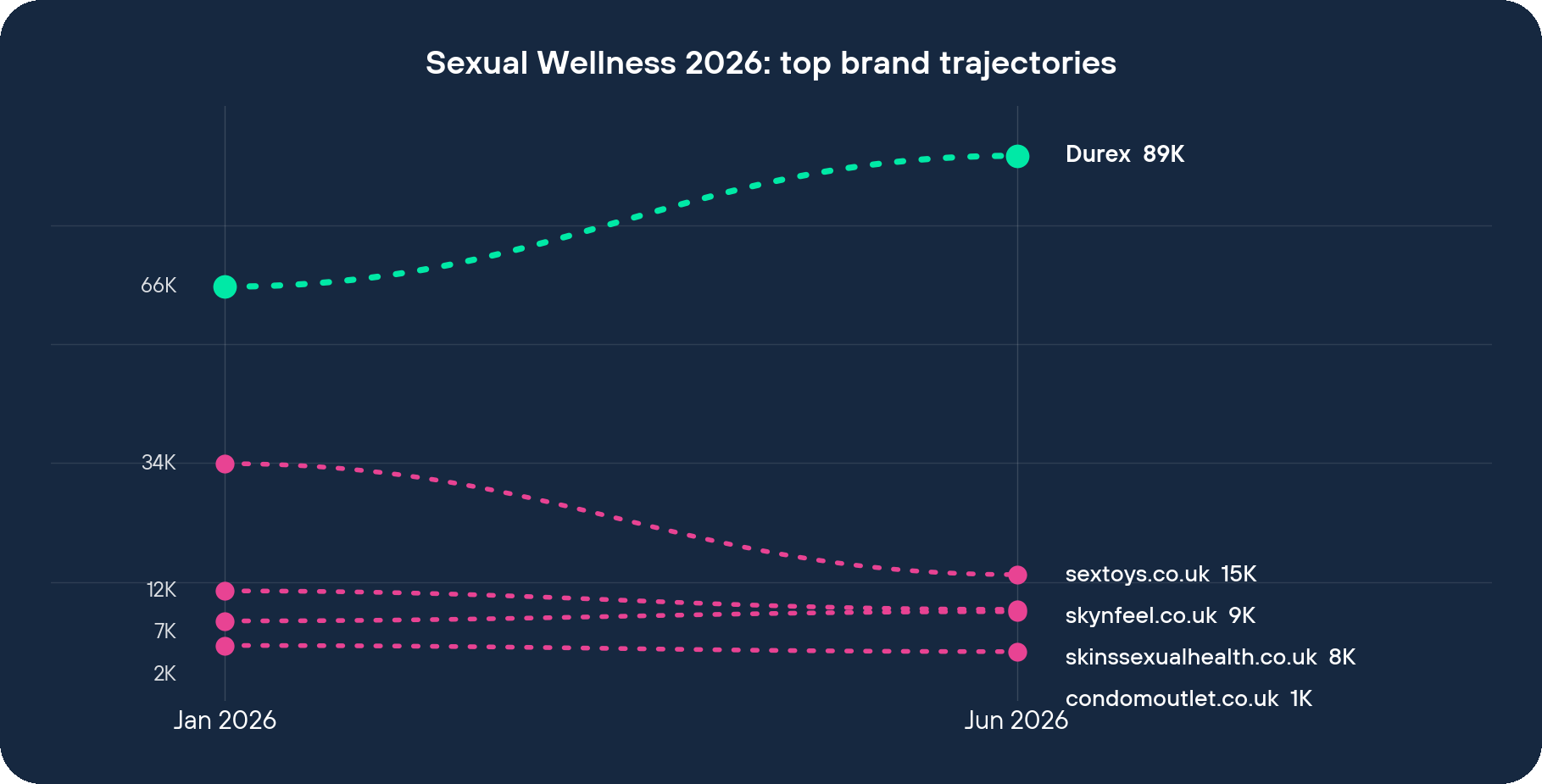
sextoys.co.uk went the other way and it is the clearest counter-example in the index. Its scraped navigation carries 18 vibrator links, 16 dildo links and 14 penis-toy links, 48 category pages across three menus, each menu carrying its own blog cluster (“Why a Small Dildo is Essential to Your Sex Toy Collection”, “The Male Rose Sex Toy That’s Predicted To Take Social Media By Storm”). It owns the most literal generic keyword domain available in this market. It fell from 34,369 to 14,762, -57.05%, from rank 7 to rank 17, the sharpest decline of any established name in the index, and a 92.28-point swing against Durex over the same six months.
What the numbers prove and what they don’t
Durex moved 65,662 → 88,795: +23,133 points, +35.23%, which is 55.54 points clear of the market. It moved from fifth to third. Of the nine brands that started above 30,000 visibility points, eight declined. Of the 48 brands in the index that grew, exactly one started above 30,000.
Now the honest part, because several things other than site strategy are pushing those numbers.
Reckitt’s media spend is invisible here and probably substantial. Any above-the-line Durex activity converts into navigational searches for “durex”, “durex intensity”, “durex nude”, queries that resolve to durex.co.uk by definition. This dataset cannot separate branded demand created by television from organic visibility earned by pages.
The site may simply be newer as a commerce property than the retailers it is being compared to. The `/pages/` routing and the store-availability checker read like a Shopify build. If Durex’s transactional pages are recent, then new indexable PDPs and collection pages generate new rankings by existing, independently of how well they are written. Six months of visibility readings cannot date that build.
Google may have shifted how it resolves branded product queries. If the SERP for “durex thin feel” now favours the manufacturer over retailer PLPs, Durex gains and four catalogue sites lose, and the on-site work explains none of it. That would produce exactly the distribution we are looking at.
Owning the product is clearly not sufficient. Across this table, manufacturer-owned domains split close to evenly. Lovense grew +17.49% and Lelo grew +3.69%; Tenga fell -59.21% and Rocks-Off fell -44.74%. I have detailed site observations for Durex, for sextoys.co.uk and for the four largest catalogues. I do not have them for Tenga or Womanizer, so the argument here is bounded to the sites I can actually quote.
And the scale needs stating plainly. Durex’s +23,133 is smaller than what Sinful alone lost (-58,356). Durex climbed two ranks partly by growing and substantially because Sinful (-44.59%) and Bondara (-42.39%) fell past it.
The read for anyone running a catalogue in this category
What survives all of those caveats is narrow but real. Durex publishes a distinct, indexable page for each specification variant of what is physically one product, writes claim copy no reseller can replicate, answers usage questions on-site, and puts none of its homepage real estate into discounting. The four catalogue sites above and around it compete for the same specification queries with templated PLPs, faceted URLs that mostly don’t get indexed, and a first viewport given over to percentage-off messaging. Over these six months the first approach returned +35.23% and the second returned somewhere between -24.06% and -57.05% depending on the site.
The test for next period is whether Durex holds the gain once whatever media weight sat behind it in H1 comes off. If the 88,795 holds while Reckitt’s spend rotates elsewhere, the page-per-variant work is doing the load-bearing. If it drops back toward 65,662, the campaign was.
Durex answers fit, usage and safety questions on its own site through the sex guide hub, and any retailer in this category could do the same. That is what content strategy for informational search demand covers, working out which questions a category generates, then planning and producing the pages that answer them. If you want the full six-month table this article is drawn from, with all 211 domains and both visibility readings, you can request the sexual wellness data.
Further reading
- UK lingerie retailers market report, Ann Summers and Lovehoney both trade in lingerie as well as toys, so this table shows how the same names performed in a neighbouring category.
- Our online pharmacy industry report, Boots and Superdrug carry most Durex units in the UK, and this report covers how those stockists perform in organic search.