 by Michael
Two of the most respected people in search said this week that most of the industry is optimising for the wrong AI. We checked their numbers against our own client portfolio.
On 21 October Marie Haynes published a piece arguing that GEO is a distraction. Within a day Rand Fishkin had picked it up in a 5 Minute Whiteboard, set it beside two other studies, and landed in roughly the same place.
Their numbers are hard to argue with. Our client portfolio shows a different traffic trend.
It also shows why the channel debate is the wrong argument. Traffic numbers stand for people. The useful question is where your customers are looking, and whether they find you there.
Traffic numbers stand for people.
TL;DR
Google organic still drives about 98% of the attributed revenue in our comparison, so Marie Haynes and Rand Fishkin are right about scale. Our client portfolio shows a different trend, though. AI assistant sessions grew 4.4 times year on year, January to September, while Google organic sessions fell 17.9%. Chasing ChatGPT with tricks is the distraction. Your time is far better spent earning people’s trust wherever they search.
On this page
02 We ran the same test on our portfolio
03 AI traffic kept growing after GPT-5
What they found
Haynes looked at twelve months of GA4 data across 100 websites and more than 145 million sessions.
ChatGPT sent traffic equal to 0.62% of what Google organic sent. Add every other LLM and the figure only reaches 0.73%.
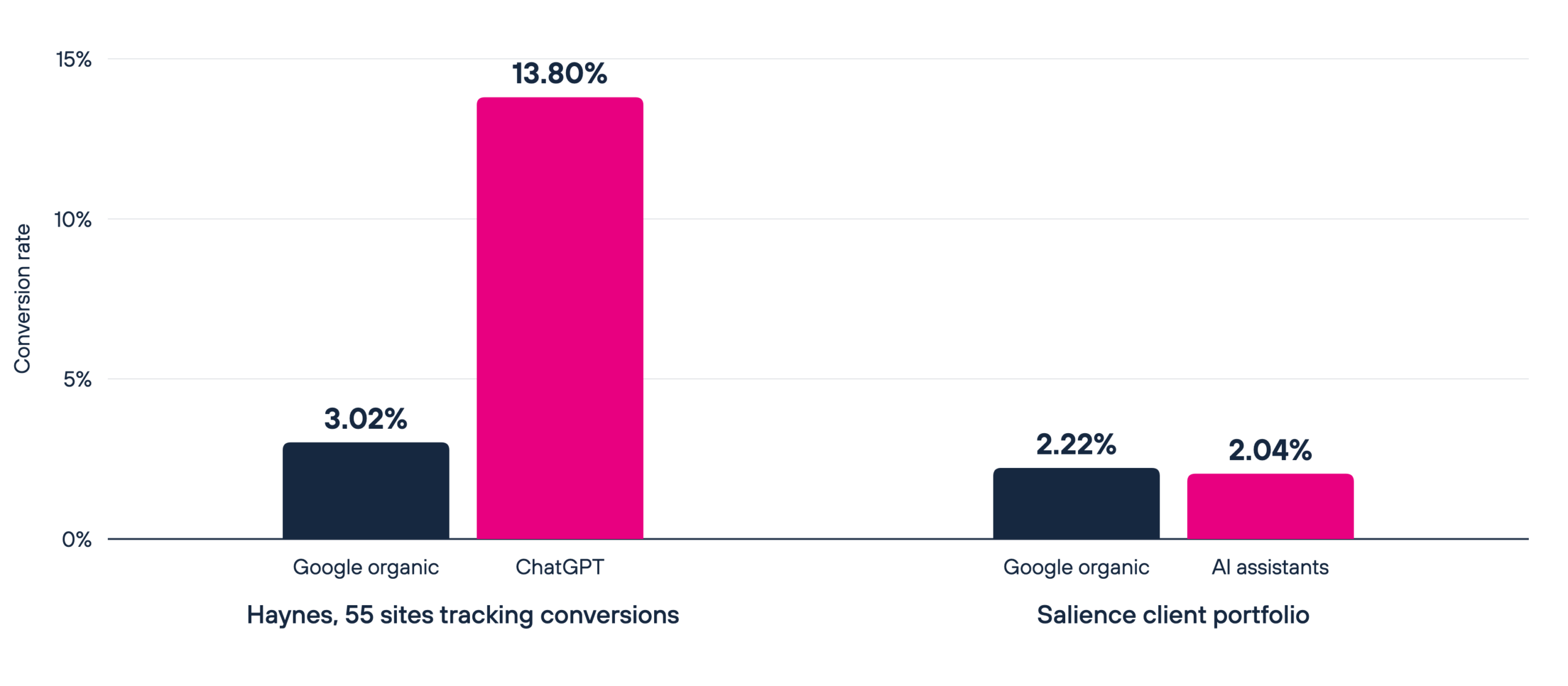
Of the 55 sites tracking conversions, ChatGPT visitors converted at 13.8% against 3.02% for Google organic. Google still won on volume, driving 27 times more conversions than all LLMs combined.
Then the trend. Haynes dates a turning point to August 2025 and the release of GPT-5, and says ChatGPT has been sending fewer visitors since.
Fishkin added two more studies. The SEO Works AI referral traffic benchmark covered 95 websites from September 2025 to August 2026. Organic search sent around 39 times more visits than AI assistants: 2.83 million organic sessions against 72,095 from AI. AI converted slightly better overall, at 7.18% against 6.08%, but worse than organic on 23 of the 63 sites with enough data to compare.
Then Kevin Indig tested a common defence of GEO in Growth Memo: does AI drive more direct traffic? The idea is that people see you in an assistant, then come back to you directly. Across 12 sites he found much of the recent growth in direct traffic was bots, and engaged direct traffic had been flat all year. Some sites showed a correlation with AI share of voice, but misaligned dates produced correlations just as strong. Neither test could isolate a reliable relationship. That isn’t the same as showing there’s no effect, and Fishkin weighs that indirect route in his post too.
We ran the same test on our portfolio
We pulled GA4 data across our client portfolio, covering October 2025 to September 2026. Most are UK retailers, alongside travel, events and professional services. We compared sessions from google / organic against sessions from ChatGPT, Gemini, Perplexity, Copilot and Claude, with paid traffic removed. Conversions here are ecommerce purchases, and revenue figures use only properties reporting in sterling.
Our findings show similarities and differences.

Volume points the same way. AI assistants sent 463,211 sessions against 38.6 million from Google organic. That’s 1.2%, higher than her 0.73% but the same order of magnitude.
-
Purchases point the same way. Across our ecommerce clients, Google organic drove 814,104 purchases and AI assistants drove 8,947, so Google organic drove 91 times as many. Haynes reports 27 times as many conversions. Between the two channels, Google organic also took 98.1% of the attributed purchase revenue.
-
ChatGPT dominance is the same. ChatGPT accounted for 92.3% of all AI assistant sessions. Gemini was a distant second.

Conversion rate differs. Our AI visitors converted at 2.04%, against 2.22% for Google organic. That’s closer to the SEO Works result than to Haynes’s. AI sessions did generate more attributed revenue per session, at £3.46 against £2.13.
The trend differs. This is the big one.
AI traffic kept growing after GPT-5
To keep the trend honest, we used only properties with continuous GA4 measurement from January 2025 to September 2026: sessions recorded every month, no month below a quarter of the property’s typical volume, and Google organic traffic every month. New properties and tracking gaps can’t inflate it.
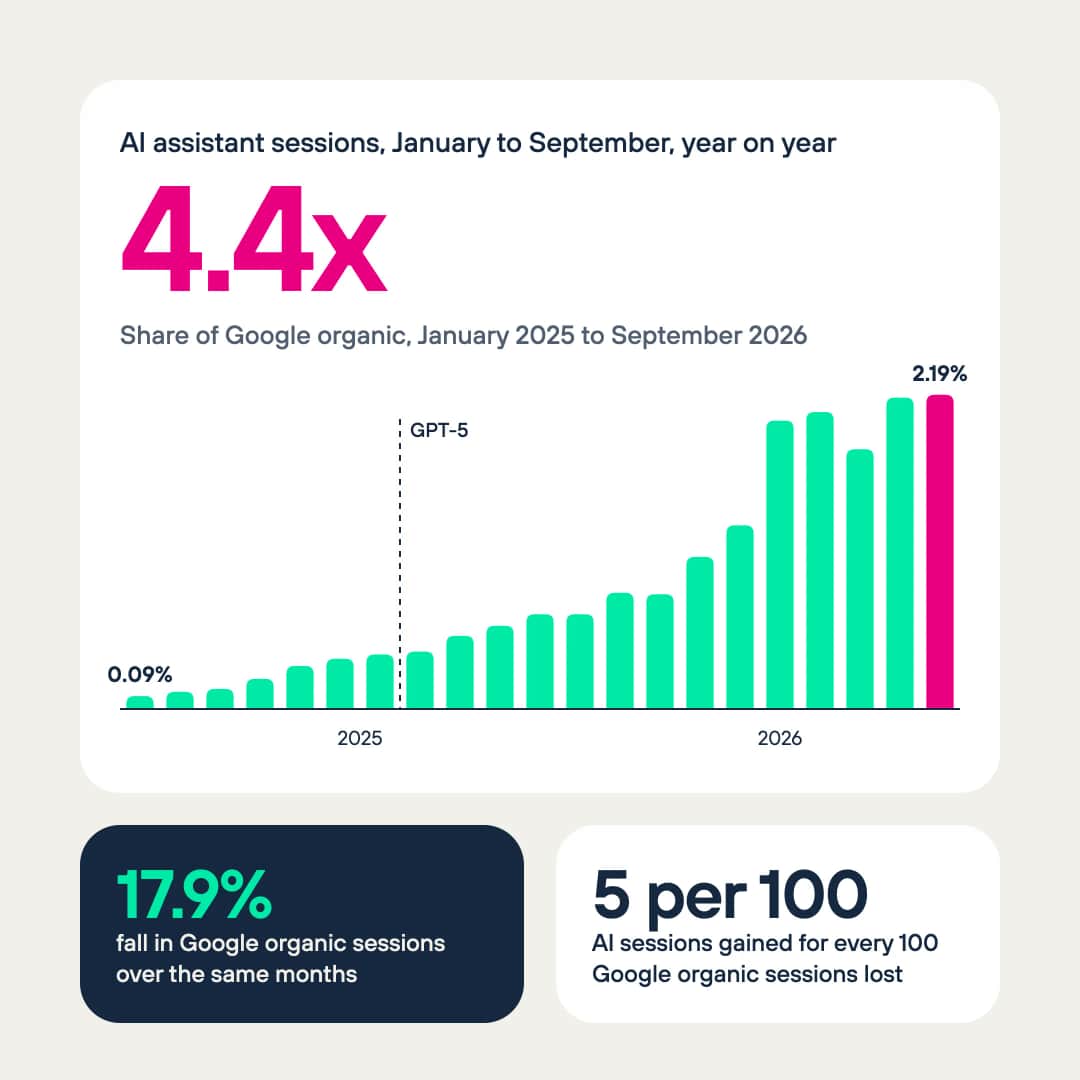
In January 2025, AI assistants sent traffic equal to 0.09% of Google organic. By September 2026 that was 2.19%. Haynes measures ChatGPT specifically, so we checked it on its own too. ChatGPT went from 0.07% of Google organic to 2.09% over the same months.

4.4x
more AI assistant sessions in January to September 2026 than in the same months of 2025, across properties with continuous measurement. Google organic sessions fell 17.9% over the same period.
Compare January to September 2026 with the same months of 2025. AI assistant sessions rose from 84,043 to 371,567, which is 4.4 times as many. ChatGPT sessions alone rose 4.6 times. Over the same months, Google organic sessions fell 17.9%.
So part of that rising line is Google shrinking, and part is AI growing. Both are happening on the same sites at the same time.
The two aren’t the same size, though. For every 100 Google organic sessions these sites lost, AI assistants added about 5. Whatever is taking traffic from Google, it mostly isn’t ChatGPT.
We can’t say why our trend differs from Haynes’s. Ours is a different sample, weighted towards UK retail and travel, and we can’t compare that mix directly with hers.
Free Black Friday discoverability audit
You’re losing Google visitors, and few of them are going to ChatGPT. So where are they going?
For every 100 Google organic sessions our clients lost in the first nine months of this year, AI assistants added about 5. The rest didn’t show up as AI assistant visits. Meanwhile the results page has filled up. In our July research, product grids fired on 89% to 94% of commercial searches, and AI Overviews on 40% to 100% of research queries.
Our audit maps every feature on your Black Friday searches and shows where your brand appears, and where it doesn’t. It’s free, and we run it for one domain.
It varies a lot by sector
The portfolio average hides a wide spread. Travel, events and leisure sites see the most AI traffic, at 2.27% of Google organic across five properties. Baby and toys see the least, at 0.29% across four. These groups are small, so one large client can move a sector average.

Two sectors stand out.
Health and wellbeing is the only one where Haynes’s conversion pattern shows up. Across its four properties, AI visitors converted at 6.39%, against 2.85% from Google organic.
Travel, events and leisure is where AI sessions generated the most attributed revenue: £11.03 per session, against £7.71 for Google organic, across three sterling ecommerce properties. One plausible explanation is that these are considered purchases, researched over weeks, where people often ask an assistant for help. This analysis doesn’t establish that.
Where that leaves the argument
Haynes and Fishkin are right about the scale. Google organic still drives about 98% of the attributed revenue in our comparison.
They’re also right about where the AI that matters lives. Haynes’s best line is that the AI search actually sending people to websites is Google’s. AI Overviews and AI Mode are where millions of people use AI search every day without leaving Google. In our July SERP research across eight UK keyword universes, AI Overviews fired on between 40% and 100% of research queries, depending on the market. We wrote that up in Being well known is not the same as being findable.
What our data adds is the direction of travel. On our sites, AI assistant sessions grew 4.4 times year on year, January to September, while Google organic sessions fell by nearly a fifth. At around 2% of Google organic, that still argues for keeping Google first, and for monitoring and testing assistants rather than ignoring them.
These figures measure identifiable assistant-referred sessions, not the full influence of AI-assisted discovery. People may discover a brand in an assistant and later visit through Google or directly; this analysis cannot quantify that contribution.
So I’d put it differently. Chasing ChatGPT citations with tricks is a distraction. Lily Ray made this point under Fishkin’s post. A lot of GEO tactics are exploits the platforms will patch, and some firms have already been demoted by Google for them. Becoming the site that other websites, Google’s AI and ChatGPT all cite is the job SEO has always done.
Chase humans, not algorithms.
This is where we’ve always landed at Salience: chase humans, not algorithms. GEO tricks optimise for a model’s current behaviour, and models change every few months. The people behind those AI sessions haven’t changed. They’re planning a trip, comparing a sofa or checking a supplement, and they want a trustworthy answer. Earn that, and you show up whichever interface they happen to use.
What I’d actually do
Four things, in this order.
1
Fix your measurement first.
Haynes found 45 of her 100 sites tracking no key events. In our data, only 22% of AI assistant sessions carry a referral medium. Most arrive as ai-assistant or (not set), so a report that filters on referral traffic misses more than three quarters of them. Check what your GA4 is actually recording before you decide anything. It’s also worth asking customers how they first found you, and comparing that with what they went on to buy.
2
Run this analysis on your own site, monthly.
The portfolio average told us very little. The sector spread, and the trend, told us a lot. Your own number is the one that matters, so it’s worth joining your channel data up so you can see it.
3
Measure AI visibility where your customers actually see AI.
For your category, find out how often AI Overviews fire, and on what share of those you’re cited. That’s the core of GEO done properly. That’s still the bigger lever.
4
Write for the person, not the model.
Digital PR, genuine reviews and content built on real expertise are what get you cited, in Google’s AI and in ChatGPT. They’re built for people, so they also survive the next model update.
The bottom line
The data says Google is still where the money is, by a very wide margin. It doesn’t say AI traffic is fading. On our sites it grew 4.4 times year on year, January to September, while Google organic shrank.
The distraction is treating GEO as a separate job with its own tricks.
Most of your customers are still on Google. A small, fast-growing group asks an assistant first. They’re the same people. Chase them, not the algorithms in between.
That’s all. Stay human 💜
Get our thinking on search, every Friday.
Campaign breakdowns, what is actually shifting in search, and the numbers behind the work. One email each Friday, and one click to leave.
Sources: Marie Haynes, “GEO is a distraction”, 21 October 2026. Rand Fishkin, 5 Minute Whiteboard, LinkedIn, October 2026. SEO Works, AI referral traffic benchmark, 95 websites, September 2025 to August 2026. Kevin Indig, Does AI drive more direct traffic?, Growth Memo, October 2026. Salience client portfolio, GA4, October 2025 to September 2026; trend on properties with continuous measurement, January 2025 to September 2026. AI assistant traffic is sessions whose source names ChatGPT, OpenAI, Gemini, Perplexity, Copilot or Claude, excluding paid mediums. Conversions are ecommerce purchases; revenue uses sterling properties only. Salience SERP composition data, eight UK keyword universes across six sectors, July 2026.