 by Liam
We’re sure you’re already aware of featured snippets, so we’ll skip the introduction and deep-dive into why they’re important and how to challenge for that position-0 spot.
Jump to:
- Why featured snippets are valuable
- What type of search queries have the best chance
- How to find featured snippets for your site
- How to steal a featured snippet
- Are they worth the hassle?
- Going further…
Why featured snippets are valuable
With algorithm and SERP updates a-plenty over the last few months, there’s been a huge change in how you should focus your content efforts. Authority, trust and brand-building are now key ingredients for the perfect SEO-cocktail. And to drag that metaphor unnecessarily onwards – it is party season, after all – featured snippets are the Cosmopolitans of SEO:
- Simple.
- Solve the user’s problem.
- Quietly but surely, draw the user further down the rabbit hole.
We’ll go into the data a little later. For now, here are the top reasons you should make featured snippets a major part of your content strategy:
- DOMINATE THE SERP – featured snippets take up a substantial amount of the SERP landscape.
- STEAL THE CLICK – Only a third of featured snippets come from rank 1 pages.
- IMPROVE CTR – If Google rates you worthy, users will too.
- VOICE SEARCH – 60% of voice searches result in a no-click search. While nobody but the user wants no-click SEO, it’s here to stay, and you don’t want to get left behind.
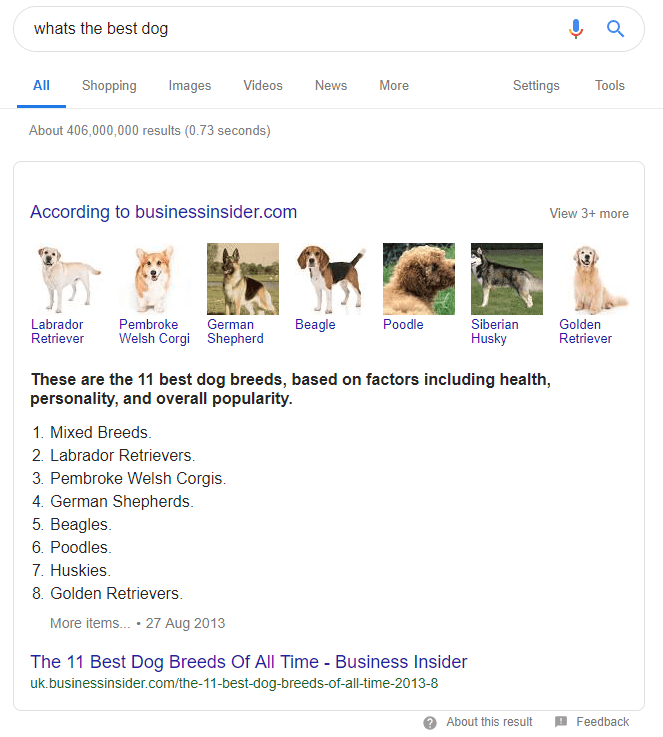
Rolled out predominantly in the US and UK markets, featured snippets have quickly become a common feature of the search landscape. They may only make up around 12.3% of queries, according to a study by Ahrefs, but they’re often from users who aren’t yet sure what they’re after.
AKA willing to listen.
AKA ready to be converted.
What type of search queries have the best chance?
Question, comparison and instruction queries trigger most featured snippets:
- The W’s – what, which, why, where, when, who.
- How To’s – anything instructional / requiring advice.
- Comparisons – Best, top ten, useful, etc.
How to find featured snippets for your site
Nearly all pages that have featured snippets already rank in the top 10, with around 30% in position 1. So, you should only be optimising content that’s already doing well or creating content that has a chance to rank well.
Once you’ve identified which of your content ranks well, you need to break this down further to what has a chance of becoming a snippet. As mentioned, content that provides information – questions, lists, instructions – are your best bet.
More importantly, the most valuable featured snippets are those which answer a question but lead the user to a product or service you offer. Izzi Smith, SEO Manager at Sixt, identifies queries which are midway between transactional and informational as the golden spots you should be aiming for. See her useful presentation from BrightonSEO.
Related: The Best Rich Snippets & How to Get Them
Tracking Featured Snippets with SEMRush
If you’re working with lots of content or numerous sites, it can be a little long-winded to manually search for the opportunities. SEMRush have a useful featured snippet tool as part of their Position Tracker. This will do the work for you, highlighting the keywords for which you could easily steal a and the URL that’s currently featured. It’ll also show you what keywords and landing pages you are already featured for.
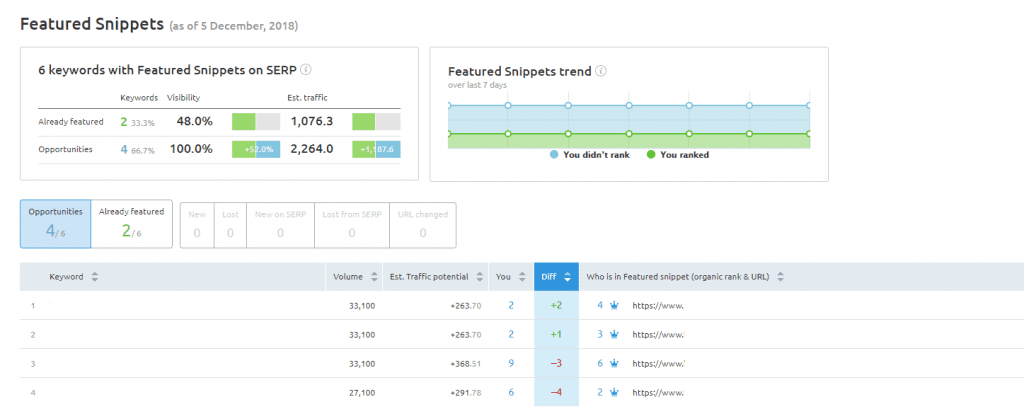
To find this section on SEMRush:
- Click projects in the left navigation panel
- Choose your project
- Go to position tracking
- Click the Featured Snippets tab
Tracking Featured Snippets with Ahrefs
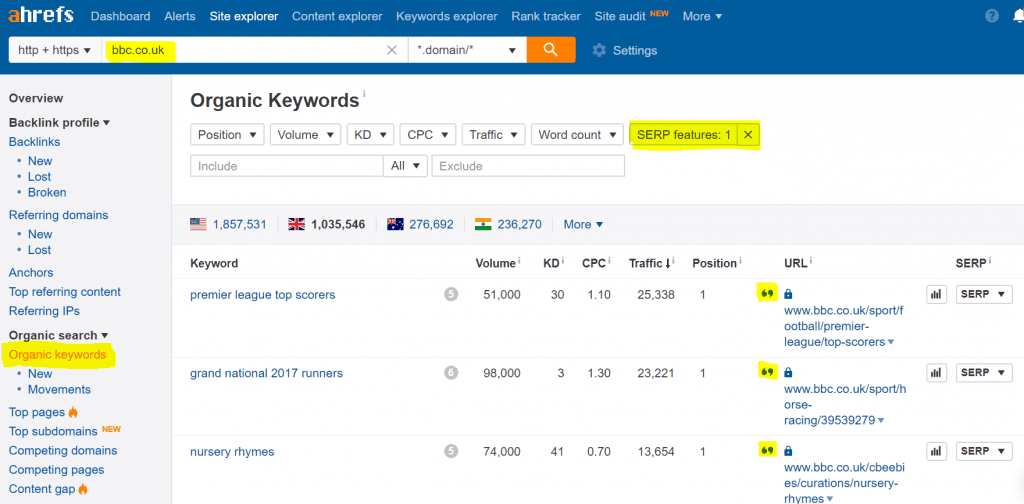
Ahrefs is also a great tool to use for tracking featured snippets. Follow these steps to track featured snippets your site or a competitor’s site currently ranks for:
- Enter the domain in the top bar
- Choose Organic Keywords in the left side panel
- Click SERP Features in the filter bar
- Select Featured Snippets
- Hit Apply
This will bring up a list of all the keywords you are featured for alongside search volume, your traffic and position. Use the same process for your competitors and you can start to work out where your opportunities lie.
How to Find Featured Snippets Without Paid Analytics Tools
Of course, there are digital marketers and businesses who don’t have the cash for expensive analytics software. If this sounds like you, don’t worry, you can still challenge for that valuable position-0 spot.
- Identify your high-ranking content
- List your keywords
- Search Google for featured snippets around those keywords
- Analyse what is featured in terms of style, length and content.
- Create a spreadsheet of the opportunities
- Optimise your content for the featured snippet (see How to Steal Featured Snippets)
- Check, record results, and repeat.
[salience_cta heading=”Steal. That. Snippet.” copy=”Serving up the perfect SEO-cocktail” image=”” background=”https://salience.co.uk/wp-content/uploads/Challenge-Us_Background.png” link=”https://salience.co.uk/services/seo-agency/” button_copy =”Challenge Us”]
How to Steal Featured Snippets
Now you know which content you should be optimising for featured snippets, it’s time to go and grab them. Like anything SEO-related, there’s no one-size-fits-all answer, and what works one time might not work the next. But don’t let this put you off; there are methods you can implement site or client-wide, which will stand you in good stead to start getting snippets.
GOOD CONTENT GOOD CONTENT GOOD CONTENT:
We can’t drum home how important good content is, especially since the August 1st EAT update. Without it, you’ve no chance of ranking well, and, therefore, no chance of getting a featured snippet.
But what counts as good content?
Easy answer: good content is that which answers the question.
There’s no need to pack your page with fluff. We find 750 words per page should suffice to rank for most keywords, but only if relevant.
For featured snippets, you’ll want one part of your content to answer the long-tail query you’re targeting precisely and the rest of your page to back that knowledge up. Here are our tips:
- Match up your subtitles with long-tail queries.
- Answer those queries briefly and precisely. 40-60 words seem to be the sweet spot.
- Add additional content to the page which explores the topic in further detail.
- If you’re targeting a featured snippet that’s a how-to or list, include enough steps or items to make your user need to visit your landing page. (Google will add a ‘see-more’ link once you go past around eight steps/items)
Structured Data:
You’ve probably heard that structured data can help you get a featured snippet. It’s true, but not quite in the way you may think.
Like all things SEO, the user is the central factor. This means Google will look for the snippet that best answers the question.
Simple, right?
Well, not quite. Another big factor is the presentation. Google looks for what is presented best to answer the query. But don’t present a simple answer in a table or list just because it’s ‘structured data’.
Instead, decide on your format by analysing the query and what’s already ranking. Then, update your content accordingly.
You should do this on a case-by-case basis, but here’s a general guide to what we’ve found works well:
- Use ordered lists for how-to’s, recipes and listicles.
- Use paragraphs for questions that need simple answers.
- Use tables for more complicated data sets.
If you have a retail site, see our SCHEMA for eCommerce sites guide.
Are they worth the hassle?
Put simply, yes.
There’s been a lot of debate about how updates to the SERP are affecting the role of SEO. While no-click searches – queries answered on SERP – will inevitably increase with snippets, there are advantages to be had too, especially if you aren’t ranking top.
Example 1:
A landing page we recently created for a client ranks top for the main search term but doesn’t rank well for longer-tail queries. However, it does take the snippet for those long-tail queries.
This steals, on average, 8% of searches from the top position. Spread over 44 different queries, this is substantial, helping us consistently steal traffic off competitors who are winning the battle for long-tail search.
The added bonus: Our authority, trust and reputation all see an increase too.
Example 2:
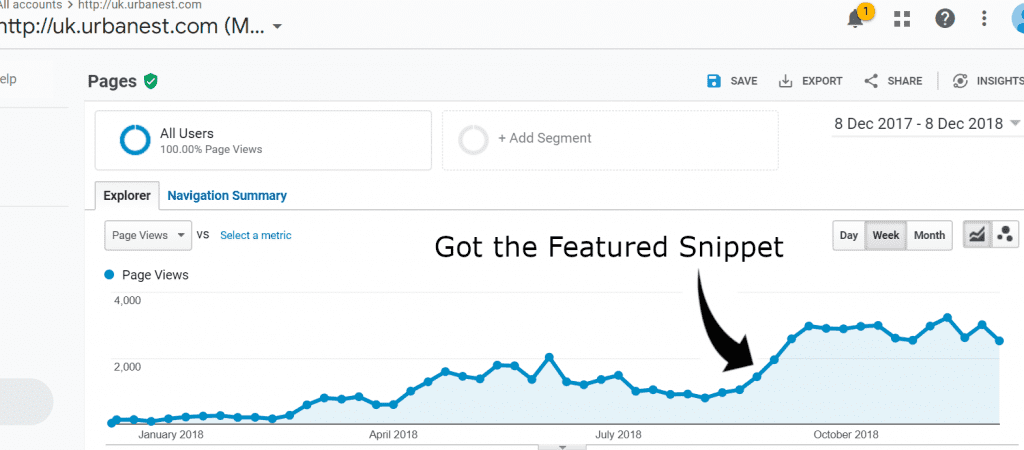
This graph shows the organic traffic of a ‘facts about London’ post we produced for London student accommodation provider, urbanest. Having optimised the post in April, we saw an increase in traffic, due to its movement up the SERP.
Then, in September 2018, we saw a 250% increase in traffic. Looking back to the same period in the previous year, there was no increase in traffic. The big difference, as far as we are aware, was the fact this page now ranked for featured snippets as well as the top spot. The keywords this page featured for included:
-
- Best facts London
- Interesting facts London
- Fun facts London
Going further…
As we’ve mentioned, good, precise content appropriately formatted is the key to getting a featured snippet. However, there are other methods which can help too.
- Schema Markup:
It’s not necessary to use Scheme Markup. However, it can help Google read your site faster and know you’re providing the correct answers. - Subtitle Questions:
For simple question and answer queries, try match up your header titles with high search volume question keywords. A good tool for this is answerthepublic.com. - Content Documentation:
Keep a spreadsheet of the content you’ve produced, what featured snippets you are targeting and whether you’ve been successful. There’s a lot of movement between which page Google uses for the snippet, so keep up with the competition by making frequent checks. - Mobile Friendly Sites:
Sites optimised for mobile users have a much higher chance of getting a featured snippet. A large scale study by SEMrush found that the average Mobile Friendly Score for sites with featured snippets is 95/100.
- External Links:
Strong external links will go a long way to increasing your site’s authority and trust in the eyes of Google. Most pages that rank for featured snippets have outbound links to other, relevant sources.
Want us to do the job for you, helping you improve rankings and compete for featured snippets? Challenge us now, and we’ll get straight to task.