by Sean
Apple was the only meaningful grower in the top 20
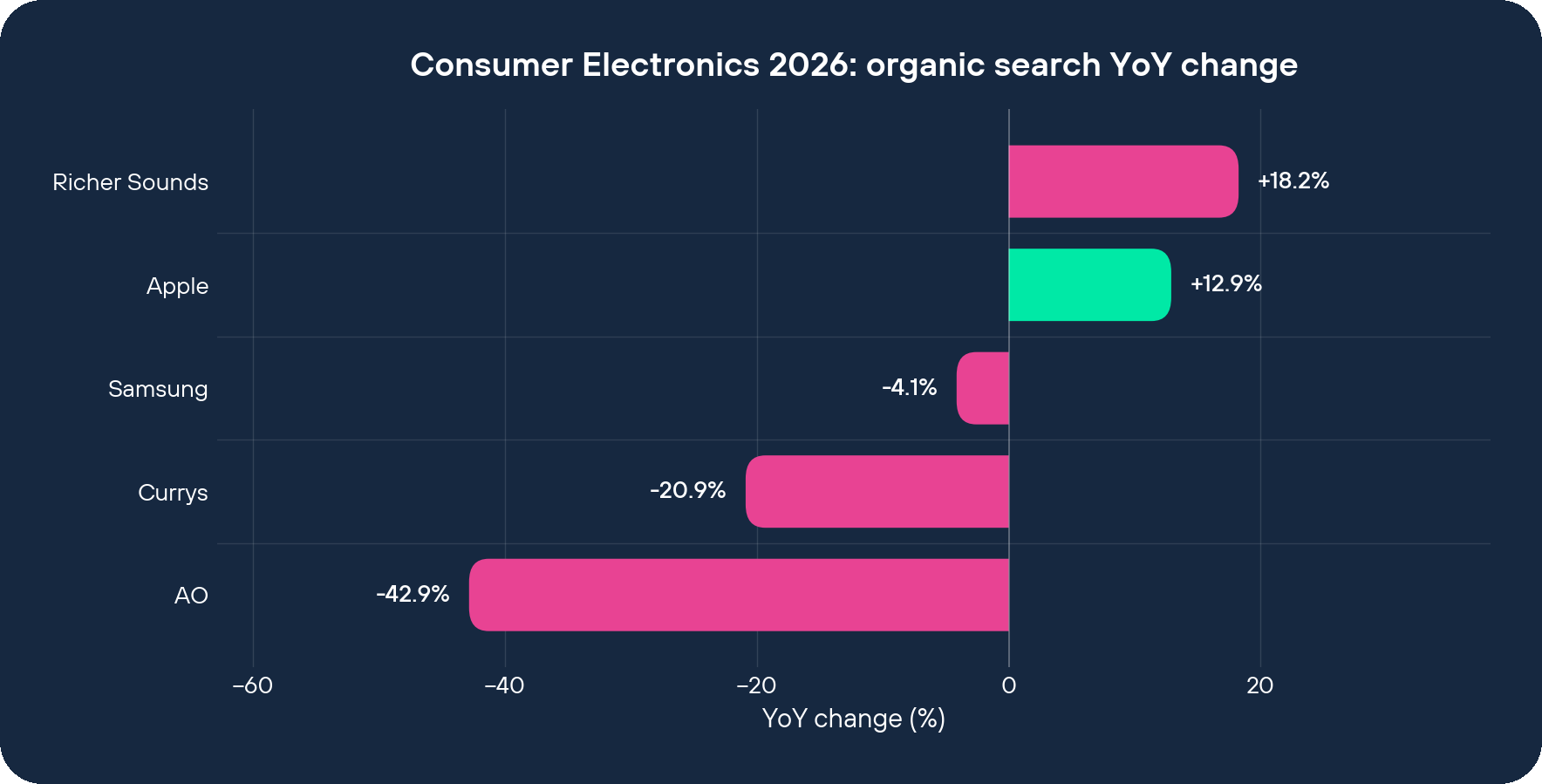
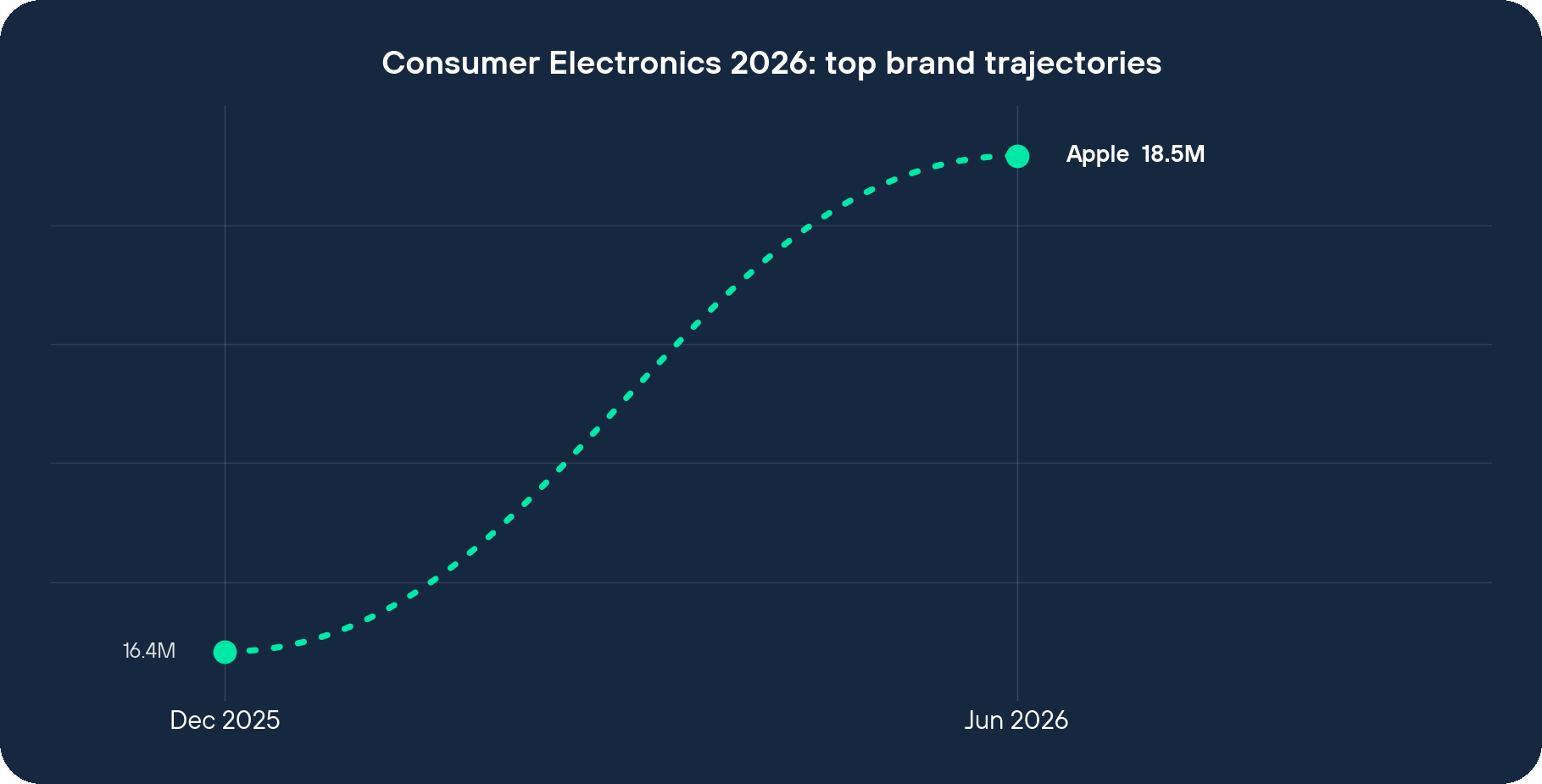
Apple finished the six months to June 2026 on 18,546,736 monthly organic visits, up +12.90% (+2,118,620) from 16,428,116 in December 2025, holding rank 1 in a dataset of 382 brands. That it sits at rank 1 is not the story, Apple is always rank 1. The story is the company it kept. Of the top 20 consumer-electronics brands, 18 lost organic visibility over the same period. Currys fell -20.89%, AO fell -42.85%, Samsung slipped -4.14%. Apple and Richer Sounds (+18.25%, +55,828) were the only two of the twenty to grow at all, and Apple’s gain was in a different order of magnitude entirely, how Richer Sounds grew its search visibility looks at how a smaller hi-fi retailer managed it over the same period. Click below to access the latest Consumer Electronics market report.
Take Apple out and the sector’s reported number falls apart. The top 20 minus Apple fell -16.47%, a real loss of 3,386,306 visits (20,564,522 down to 17,178,216). The market’s headline -4.36% is, in practice, Apple’s single +2,118,620 sitting on top of that loss and hiding it. Apple’s share of top-20 visibility rose from 44.41% to 51.92% over the period, which means one brand now outweighs ranks 2 to 6 combined: Currys (7,317,503), Samsung (2,915,360), Back Market (785,383), Dyson (767,232) and AO (697,152) sum to 12,482,630, against Apple’s 18,546,736.
The homepage carries the whole strategy
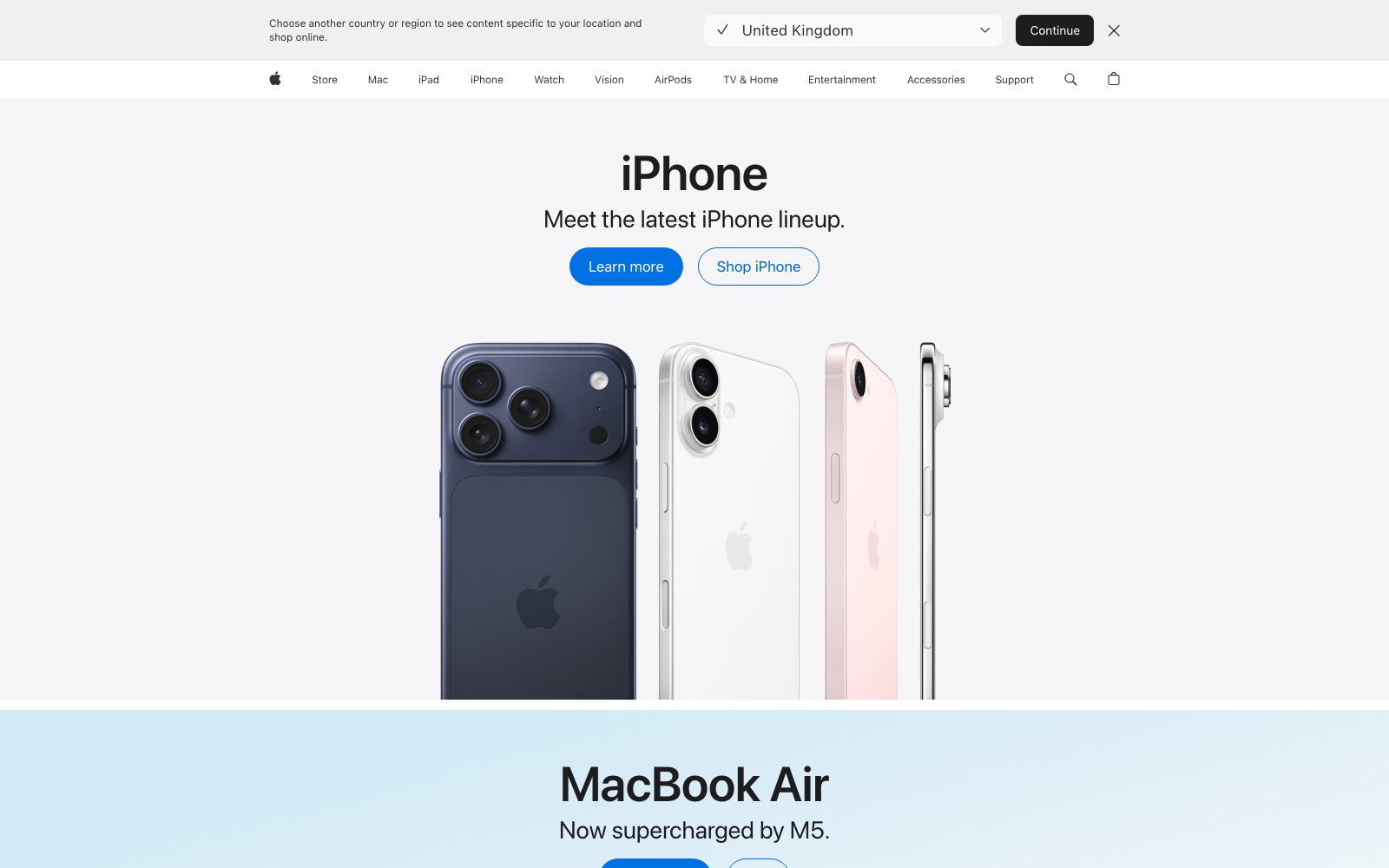
Apple’s UK homepage is a vertical stack of full-width product tiles and nothing else. The current build leads with iPhone, then MacBook Air, iPad Air, MacBook Pro, AirPods Pro 3 and Apple Watch Series 11, six products, each given the full width of the screen, each with a short “Learn more” and “Buy” pair under a product name. The top navigation is just as spare: Store, Mac, iPad, iPhone, Watch, Vision, AirPods, TV & Home, Entertainment, Accessories, Support. That is the entire menu.
The absences matter as much as what is present. There is no shop-by-category grid, no “Deals” or “Clearance” tab, no “found it cheaper” price-match promise, no representative APR banner, no seasonal-sale furniture anywhere on the page. Financing does exist, you meet it as “or £x/mo.” on an individual product page, but it is never the headline. A shopper who lands on apple.com is shown six products by name and asked to pick one.
Branded searches still resolve in a zero-click SERP
Apple’s product names are also the search terms people type. “iPhone 17”, “MacBook Air”, “AirPods Pro 3”, “Apple Watch Series 11” are branded, navigational queries, and Apple’s own page is the only correct destination for each of them. There is no generic answer a search engine can substitute and no competitor page that satisfies the intent. That is what category-defining authority means in practice, and a large part of why brand now leads SEO strategy: for a large share of Apple’s query set, the brand name and the category name are the same word, so the person who wants the category is already searching for Apple.
This is why an AI Overview, zero-click SERP treats Apple differently from a broadline retailer. When Google answers a query inline, “what’s the best budget laptop”, “how do I descale a kettle”, “cheapest 65-inch OLED”, it satisfies the searcher without sending them to a retailer’s page, so even a strong ranking position converts to far fewer visits. Those are generic, informational and commercial-research queries, and they are exactly what a broadline electronics retailer ranks for across its range. A navigational branded query behaves differently: even when the SERP shows an AI Overview, “airpods pro 3” still resolves to apple.com, because the intent is Apple’s page specifically. Apple’s own support and product documentation is also what AI Overviews cite when they answer factual questions about Apple products, so the brand gets surfaced as the source rather than summarised out of the click, the same result content built to be cited by AI Overviews is meant to produce for brands without Apple’s built-in authority.
What is actually driving the number
None of this means the homepage design produced the +2,118,620. It did not, and this dataset cannot show that it did. The largest single driver of Apple’s organic movement is the product-launch calendar, which the dataset does not break out. The six months to June 2026 captured the tail of the autumn iPhone 17, AirPods Pro 3 and Apple Watch Series 11 launches and the spring MacBook Air and iPad Air refreshes that lead the homepage now. Each of those launches drives a spike in branded search for the product name, and that volume lands as organic visits whatever the homepage looks like. The December 2025 starting point is a comparison choice too; a different base month would give a different year-on-year figure.
The dataset also cannot separate branded search from non-branded, so the claim that Apple’s visibility is mostly navigational is an inference from Apple’s catalogue of product-name queries, not something measured here. It is a well-founded inference, Apple’s queries are overwhelmingly its own product names, but it is worth naming as an inference rather than a reading straight off the table.
What the homepage does show is that Apple’s strategy is consistent with the kind of search visibility that holds up in a zero-click SERP. A brand whose entire homepage is six named products, with no price-war or breadth signalling anywhere, is a brand assuming people arrive already knowing what they want and searching for it by name. The +12.90% is consistent with that assumption holding in a period when generic commercial queries are increasingly answered inline and branded navigational queries are not. That is a weaker and more honest claim than “the homepage caused the growth”, and it is the one the data actually supports.
Currys chose breadth and paid for it
Currys is the useful contrast because it made the opposite choice and posted the single biggest loss in the index, -1,932,692 (-20.89%), at rank 2. Its homepage stacks around fifteen shop-by-category links, washing machines, laptops, TVs, consoles, mobiles, fridge freezers, gaming, laundry, health & beauty, digital cameras, garden & outdoors, sports & fitness, behind “Found it cheaper? We’ll match it” and a 29.9% APR flexpay banner. Everything-under-one-roof visibility of that kind depends on ranking for generic commercial queries across a dozen categories, which is precisely the traffic an AI Overview now intercepts before a retailer sees the visit. The 33.79-point gap between Apple’s +12.90% and Currys’ -20.89% over the same six months is the clearest single illustration in the top 20 of which approach the current SERP rewards.
What Apple’s position tells you
A company that owns its category will usually grow, so Apple’s +12.90% is not surprising in isolation. Its growth matters here because of what it does to the rest of the data. Without Apple’s +2,118,620, the top 20 fell -16.47% and the sector’s headline reads as a recession rather than a -4.36% wobble. The other 19 brands are competing for generic search visibility that is being answered inline and is worth fewer visits every quarter, while Apple holds a query set a zero-click SERP cannot answer without sending the click to apple.com. For anyone in consumer electronics who reads the -4.36% and takes some comfort from it, the more useful number is the -16.47% with Apple stripped out, because that figure is far closer to the search environment most brands in this index are actually working in.
If your brand is one of the broadline retailers in this index competing for generic category queries, that is the position most exposed in the current data. The work that helps is ecommerce SEO for category and product pages that keeps those pages earning visits when an AI Overview sits above the results. To see where your own brand sits across all 382, you can download the full Consumer Electronics report.
Further reading
- the 2025 Headphones and Audio report, audio is the closest adjacent category to consumer electronics, and this report benchmarks how those brands are performing in search over a comparable window.
- all Salience Index sector reports, readers who want to compare consumer electronics against other sectors can browse every benchmarked industry from one page.