by Sean
Smeg’s kettle comes in 16 colours. Its website lists every one of them before it tells you the kettle’s name. Click below to access the latest Kitchenware market report.
That order is the whole strategy, and it shows up on almost every page we looked at.
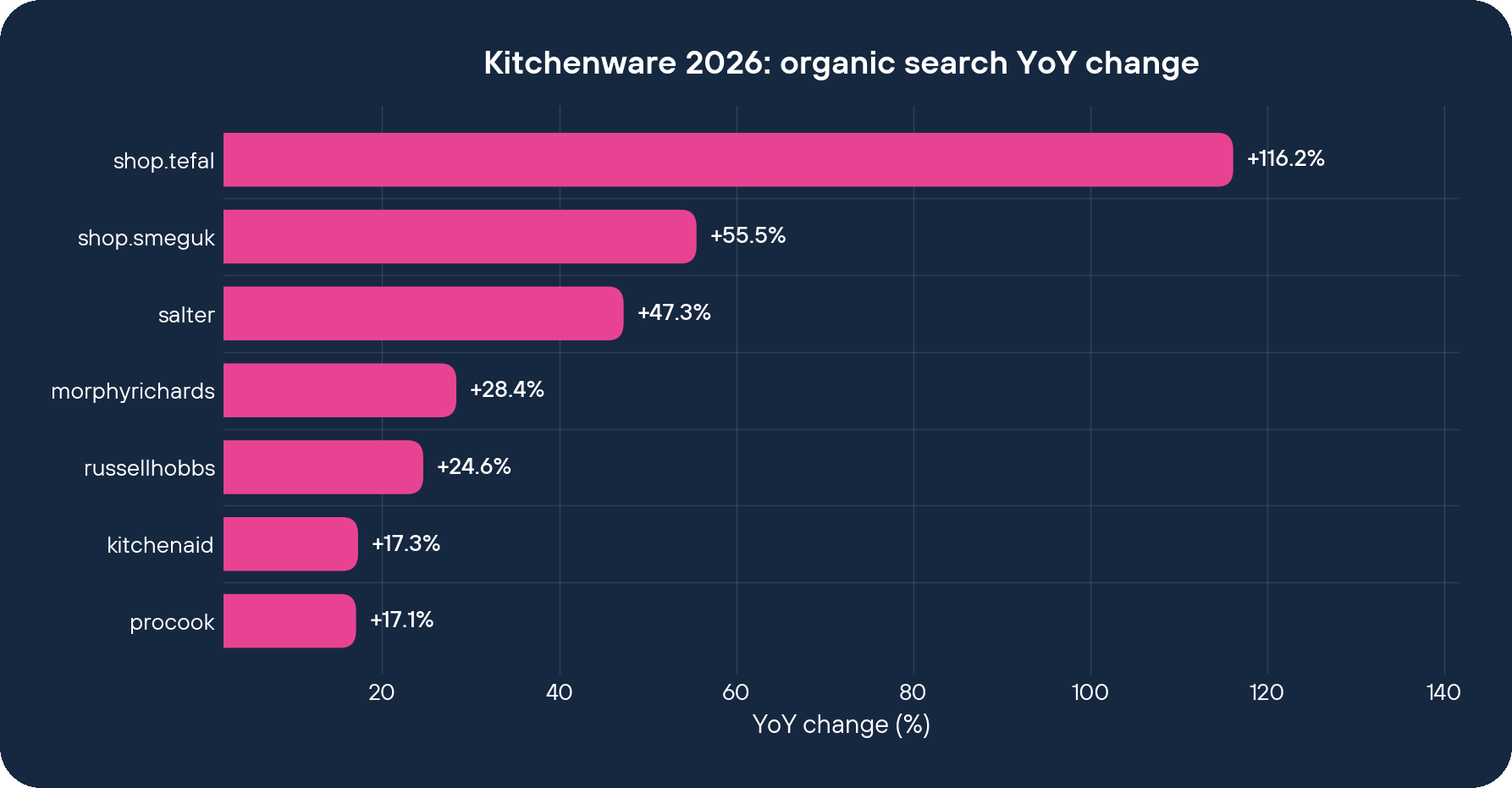
From August 2025 to August 2026, Smeg’s UK shop grew 56% in the Salience Index, from 87K to 136K estimated monthly visits from organic search. It climbed from 9th to 5th. Over the 12 months to July 2026, searches for “smeg uk” fell 14%.
So more people found Smeg while fewer people asked for it. This piece looks at what is on the site, page by page, to see how a shopper who never typed “Smeg” ends up there.
Where Smeg sits
Fifth for estimated monthly traffic, at 136K. Second for owned social score in the Index, at 1,552. Joint first for desktop page speed, at 94. Domain Rating of 59, second of the top 50.
And one figure that does not fit the pattern. Smeg has 387 referring domains, which puts it 34th of the top 50 for links. Zwilling has the most referring domains in the set, at 8,172. Zwilling sits 34th for estimated monthly traffic.
Smeg did not grow by out-linking anybody.
Who is typing
The narrative piece in this report found two shifts in kitchenware search. Appliance makers’ own sites gained a third more estimated traffic while generic appliance searches fell. And shoppers stopped searching for colour-matched kitchenware, while searches for colour on the kettle and toaster held.
Picture the person behind those searches. They have seen a cream kitchen, or a pastel one. They have decided on the colour first. They type “cream kettle and toaster set”, and the brand is still open.
Everything below is what that person meets on shop.smeguk.com. We looked on 2 October 2026.
The set is a page, and the page uses the shopper’s words
Open the Small Appliances menu. The first link is “Breakfast Sets”.
What it gives the shopper: the matched pair they came for is the first thing in the menu, so they do not have to build it from two categories.
The page itself is headed “Breakfast Sets”, which is Smeg’s own phrase. But its title tag, the line Google shows in the results, reads:
“Kettle & Toaster Sets – Full Breakfast Sets | Smeg UK”
What it gives the shopper: the result they see in Google repeats the words they typed. The page meets them in their language, then shows them Smeg’s.
Its meta description says: “Our matching breakfast sets provide cohesive design across your kitchen appliances.”
Site search does the same job. Click into it and, before you type, it offers three “Popular Categories”. The first is “Breakfast Sets”.
The Wayback Machine shows this title tag on the page in August 2025, at the start of Smeg’s growth year. It has stayed the same all year.
Colour comes before the product, on every card
On the Breakfast Sets page, each product card leads with its colours. The product name comes after.
The kettle card reads: “Matte Moonlight, Matte Storm Blue, Cream, Matte Black, +12”. Then “Kettle”. Then “from £159.95”.
Open the kettle and the full list is there. Matte Moonlight, Matte Storm Blue, Cream, Matte Black, Black, Matte Emerald Green, Slate Grey, Navy Blue, Pastel Blue, Pastel Green, Pink, Red, Steel, Matte White, White, Matte Champagne.
That is 16 colours of one kettle.
What it gives the shopper: somebody who decided on the colour first sees the colour first. They can check the shade before they read a single specification.
Most of those names are the words a shopper would type. Cream. Pink. Red. Pastel Blue. Black. A few, such as Matte Champagne and Moonlight, sound more like Smeg’s own palette, and they sit alongside the plain names rather than replacing them.
The page names the colour you picked
The main heading on a Smeg product page carries the colour.
“Kettle in Moonlight”. “Two Slice Toaster in Moonlight”. “Mini Kettle Black”.
What it gives the shopper: the page confirms the exact thing they want. A shopper looking for a black mini kettle reads “Mini Kettle Black” at the top of the page.
The product has a name a person can say
Smeg calls its kettle “Kettle”. The toaster is “2 slice toaster”. The small one is “Mini Kettle”.
The model code is there. On the kettle page it is “KLF03”, in small type above the heading. But nobody needs it to find the product, ask for it or recommend it.
What it gives the shopper: they can say what they want out loud. “The Smeg kettle in cream” is a sentence a person can repeat to a friend, type into Google, or put on a wedding list.
This is the long game. A name that people can say travels further than a code they have to copy. Every time somebody describes the product in their own words, those words point back at a page Smeg already holds.
Every title tag starts with the thing
Smeg’s category title tags start with the product, in the shopper’s words, and end with the brand.
“Kettles – Fast Boiling Stylish Retro Kettles | Smeg UK” “Toasters – 2 Slice & 4 Slice – Designer Retro Toasters | Smeg UK” “Milk Frothers – Electric Foamers | Smeg UK”
What it gives the shopper: the result they see matches what they typed. “milk frothers” is the second most-searched term in the Index’s kitchenware keyword set, at 48K searches a month on average over the 12 months to July 2026. Smeg’s page for it is titled “Milk Frothers”.
The archived copies show these collection titles in place in August 2025 as well.
The product pages changed more recently. In the archive, the kettle page was titled just “Kettle”, followed by the brand, as late as 27 May 2026. Today it reads “Electric kettle 1.7L | Smeg UK”. The toaster went from “2 slice toaster”, followed by the brand, to “2 slice toaster electric | Smeg UK”.
That change is too recent to explain the year’s growth. It does show the same decision moving down from the categories to the products.
The product page answers the next question
Each kettle feature comes with the reason it matters.
“1.7L capacity, enough to prepare 7 cups. Perfect for enjoying alone or with company”
Then, under “Why you’ll love it”:
“Heats water quickly to keep busy mornings moving without delay” “Smooth soft-opening lid helps prevent splashes when refilling” “360° swivel base makes lifting and placing easy from any angle”
What it gives the shopper: they do not have to translate a specification into their own morning. “7 cups” is a measure a household already uses.
The page also answers questions people ask before they buy any kettle, not only this one. Its FAQ includes “What is the most efficient type of kettle?” and “How to safely dispose of your old kettle?”.
What it gives the shopper: the person replacing an old kettle gets an answer to the thing they are actually worried about, on the page where they can buy the new one.
Delivery sits next to the basket button: “Delivery is currently free for all purchases on shop.smeguk.com.” Finance sits at the top: “Spread the cost of your dream kitchen”.
And the matching toaster is one step away. The first product under “You may also like” on the kettle page is the “2 slice toaster”.
The same decision, six times
Read it back as one route.
The menu puts the set first. Google sees the set described in the shopper’s words. The listing shows colour before product. The heading names the colour you chose. The product has a name you can say out loud. The kettle page offers the toaster.
Each of those is small. Together they serve one person: the shopper who chose a colour before a brand. We cannot say which of them moved Smeg from 9th to 5th. We can say they all point the same way.
Smeg is not the only maker doing it
Russell Hobbs grew 25% over the same year, from August 2025 to August 2026. Its menu also carries a “Kettles and Toaster Sets” page, and it sells a set as a single product: “Brontë™ Kettle and Toaster Black 4 Slice”.
A shop that sells many brands is in a different position, and we have written separately about how ProCook overtook Le Creuset and Smeg combined. In the menu of the largest multi-brand shop we checked, kettles and toasters are two separate categories. The shopper builds the set themselves.
What it means for anyone else
If you make appliances, sell the set as a page, and title it the way the shopper searches. “Kettle & Toaster Sets” is a phrase, and it is also a page.
Put the colour in the heading and on the card. If your shoppers choose a colour first, show them the colour first.
Give the product a name people can say. A model code is fine on the spec sheet. The heading is where the name lives.
If you sell many brands, you can do something no single maker can. Put every cream kettle on one page, whatever the brand. Show a cream toaster from a different maker next to it. That is a set only a multi-brand shop can sell.
Where it would not transfer
Smeg’s colour range is a product decision before it is a website decision. A brand that makes its kettle in two colours cannot list sixteen. The set page, the shopper’s words in the title tag and the colour in the heading all transfer. The palette does not.
Smeg’s style is also a big part of its appeal, and that does not come from a title tag. Its own collection page calls the 50s Style range “iconic and instantly recognisable”. A site can make a product easy to find. It cannot make a shopper want it.
One thing that could make it even better
When we looked, the kettle page showed no customer reviews. Smeg’s Trustpilot profile carries 3,343 reviews. Bringing some of that onto the product page would answer the “is it worth it?” question at the moment the shopper is deciding.
The take-home
Smeg builds its pages around the shopper who chose a colour before a brand.
Find the order your buyer decides in, and make your pages ask in that order.
If you want help with this
We do category and product page SEO for retailers, and we do writing product content in the shopper’s words across a full catalogue. If you would like the rest of the sector’s numbers first, they are in the full kitchenware report.
Further reading
- why brand demand now drives organic search, Smeg grew while searches for its name fell, and this piece explains how brand and search interact when people describe a product rather than name it.
- 2026 Home Furnishings Industry Report, kitchenware shoppers who choose a colour before a brand are buying for the same room, so the home furnishings benchmarks sit next door to this market.
- every Salience Index sector report, if you want to compare these kitchenware numbers against other retail sectors, the full set is in one place.