 by Michael
10+ years. UK brand visibility tracked for longer than a lot of agencies have existed. This month, me and Sean Bowkett are pausing everything else to rebuild it from scratch. Here’s the honest version of why.
On this page
01The measurement stopped matching the market
02The messy middle has been dark
03The new Index asks different questions
TL;DR
After 13 years, we’re rebuilding the Salience Index from scratch. Search has changed faster than the measurement around it: two-thirds of searches now end without a click, and decisions form across AI Overviews, shopping, maps and social, not the ranked list. The new Index measures brand presence across the surfaces where consideration actually happens, so a rankings dashboard can’t stay green while the revenue goes quiet.
The measurement stopped matching what the market needs in 2026
The original Index was designed to answer one question: who’s winning in search?
That question made sense when “search” meant Google’s organic results. Rank the page. Track the position. Report the share.
How users search has changed. The measurement hasn’t kept up, including ours.
The clearest evidence is in the click itself. In the first four months of 2026, 68.01% of Google searches ended without a click to the open web, according to SparkToro’s analysis of Similarweb panel data published in June.
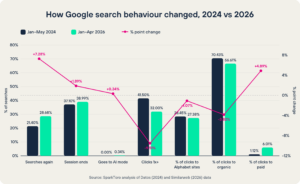
68.01%
of Google searches ended without a click to the open web in early 2026, up from 60.45% in 2024, the fastest acceleration the number has seen in a decade
That is up from 60.45% in 2024, the fastest acceleration the number has seen in a decade. Less than a third of searches now send anyone anywhere.
A big part of that shift is AI Overviews, which now appear on more than a fifth of all searches and cut click-through on the results below them by roughly 60%. The answer arrives before the click does. The impression still counts. The visit never happens.
The answer arrives before the click does. The impression still counts. The visit never happens.
Your customer’s path to a decision now runs across surfaces that didn’t meaningfully exist five years ago. AI Overviews answer the question before a click happens. Shopping carousels pull purchase intent into a completely different visual experience. Maps, images, video, comparison features, each one a place where your customer is forming a view of you, or your competitor, right now.
And dont even get me started on Google now reporting on social in Search Console…
Almost none of that shows up in a rank tracker. A tool built to report position ten on a page of blue links has nothing to say about whether your brand was the one named in the AI Overview, pictured in the carousel, or missing from both.
Fact of the matter is, we’ve not spoken to a single brand or agency connection who actually has all this figured out. Not to be cocksure, but I believe we can bring a truckload of clarity for the niche markets we report on.
The messy middle has been dark
There’s a concept Google documented a few years back called the messy middle. It came out of a multi-year piece of behavioural research, Decoding Decisions, run with The Behavioural Architects. The observation: consumers don’t travel a clean path from awareness to purchase. They cycle between two mental modes, exploration, where they expand their options, and evaluation, where they narrow them down. Search, compare, read, come back, search again, look at a different surface, repeat. The decision forms in that loop, not at the moment of click.
Google’s own framing is worth sitting with, because it maps almost exactly onto the problem with our measurement. Exploration and evaluation don’t happen on one surface. They happen across search engines, social feeds, review sites, aggregators, maps and video, in whatever order the person feels like. That is the terrain where the brand is actually chosen or discarded.
What a decade of building this data has shown us is that most search reporting, including ours, measures the endpoints. Where you rank at the top. Whether they convert at the bottom. The messy middle, the consideration layer where decisions actually form, has been almost completely dark.
The consequence is a familiar and frustrating pattern. Rankings hold. Reported visibility looks stable. Revenue doesn’t follow. The reporting says nothing is wrong because the reporting was never pointed at the part of the journey where the loss happens. When two thirds of searches never produce a click, a rankings dashboard can stay green while the business goes quiet, and nobody can see why from the numbers in front of them.
A rankings dashboard can stay green while the business goes quiet, and nobody can see why from the numbers in front of them.
That’s what we’re rebuilding to illuminate.
The new Index asks different questions
The new Index will ask different questions.
Where do you rank?
→ Where are you visible when someone is actively forming a view of you?
What’s your share of organic search?
→ What’s your presence across the surfaces that feed consideration before purchase?
Are you winning?
→ Are you visible on the surfaces that actually decide it?
In practice that means measuring presence across the surfaces where exploration and evaluation happen, not just the ranked list.
✓
Whether your brand is cited in the AI Overview for a category question.
✓
Whether you show up in product grids, shopping and comparison features.}
✓
Whether the images, video and maps results carry you or hand the moment to a competitor.
Then stitching those into a view of the consideration layer rather than a single position number.
We’re building the measurement framework first. Then the benchmarking layer, so a brand can see not just its own presence but how that presence compares across its closest competitors. It’s slower than updating the existing one. It will take the whole month. (my head rests on the chopping block)
We’re documenting every step publicly, on LinkedIn and right here. The dead ends as well as the wins, because a measurement framework you can’t interrogate is just another dashboard asking for your trust.
If you’re making decisions about where to invest visibility budget, or you’re tired of reporting that tells you your rankings held while your revenue didn’t follow, this is the work that’s relevant to you.
That’s all. Stay human 💜