 by Michael
Every marketing team has spent the last year asking the same thing: “do we show up in LLM search?”
Fair question. But the question that actually matters is the one everyone gets stumped on, what does showing up actually earn us?
Similarweb just answered it with real user data, and the answer is bigger than the AI-search crowd has been claiming.
On this page
01What an AI mention is actually worth
02The blind spot in your dashboard
03What this means for you
TL;DR
Similarweb tracked real user journeys across finance, travel and beauty. People handed a brand by ChatGPT were 2.5x more likely to visit its site within a week. But most of them didn’t arrive as an “AI referral”, 56% came back through search. Your analytics files the visit under branded search or direct, and the AI mention that caused it gets zero credit. AI visibility isn’t a vanity metric. It’s demand your attribution model can’t see.
What an AI mention is actually worth
Start with where AI actually earns its keep.
Similarweb asked people who use both search and AI which one they lean on at each stage of a decision. Right at the top, discovering options, getting initial ideas, AI was the more useful tool for 35% of them, against 13.6% for search engines. By the time it comes to finding where to buy, the two are neck and neck (24.3% versus 22.1%). AI owns the first question. Search catches up at the end.

Then the money question: does that early influence turn into visits? Similarweb tracked thousands of genuine journeys across finance, travel and beauty, users who asked ChatGPT a question and got a specific brand named in the answer. No brand mention in the prompt, no visit to that site in the previous four weeks. Clean new demand. Then they followed those users for seven days.
The people handed a brand by AI were 2.5x more likely to visit that brand’s site than a competitor’s.
2.5x
more likely to visit a brand’s site within seven days when ChatGPT named it, versus a competitor that wasn’t recommended
In travel, when ChatGPT named Kayak, visits ran 12% against Skyscanner’s 3.4%. Flip the recommendation and the traffic flips with it, the effect held symmetrically across all three sectors. Someone is always getting the visit.
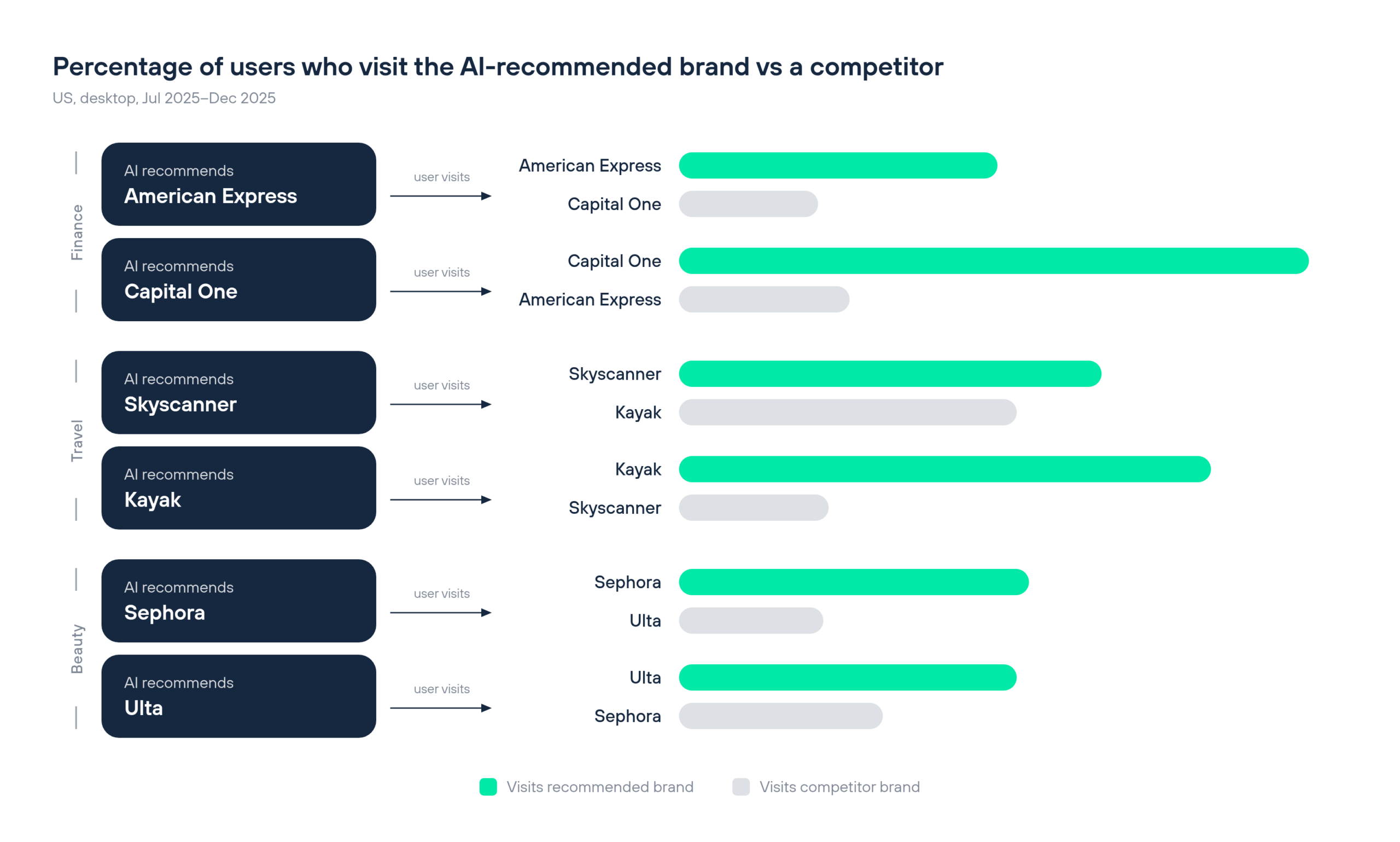
Flip the recommendation and the traffic flips with it. Someone is always getting the visit.
The blind spot in your dashboard
Here’s the part your dashboard gets wrong. Almost none of that traffic arrives as an “AI referral.” The session with ChatGPT ends with no click. Days later the user comes back, and 56% of them arrive via search, against about 40% for an ordinary visit.
They remember the brand and go looking for it.
56%
of AI-influenced visits arrived through search rather than a traceable AI referral, versus around 40% for an ordinary visit, the recommendation does the work, and search takes the credit

So your analytics files the visit under branded search or direct, the AI recommendation that caused it gets no credit, and the channel gets written off as “low referral volume.”
You’re not measuring AI’s impact. You’re measuring the wrong number and concluding it doesn’t matter.
Rand Fishkin, who co-authored the study, put it well: “this is a near-replica of how advertisers measured billboards and TV last century, lift in store visits, not a click to trace.” Whether it’s a poster on the M6 in 1996 or a mention in ChatGPT in 2026, the influence is real. What has to change is how you measure it.
And these aren’t tyre-kickers. AI-influenced visitors landed already convinced. They’d done the research inside the conversation, narrowed the field, picked a brand. It shows: nearly double the pageviews and roughly double the time on site versus a standard visit. AI does the discovery; they arrive to buy.

One honest caveat before you rebuild everything around this: it’s a US desktop panel, tracked July to December 2025, across large, established consumer brands in three categories. How hard the effect holds for smaller or less familiar names is the open question. But the mechanism is now measured, not assumed, and it’s someone else’s data, not ours.
What this means for you
This is the pattern we’ve been pointing at all along, now with independent data behind it. Traffic isn’t disappearing. It’s being redistributed across more surfaces than your report has columns for, and AI is now one of the surfaces that decides who gets the visit before the visit happens.
Three things worth doing about it:

Stop judging AI by referral traffic. The visit lands in search and direct. Referrals will always understate it.
Defend your branded search harder than ever. If more than half of AI-influenced demand comes back through search, that’s where a competitor can buy the customer AI just sent you.
Watch it as a two-sided number. This is close to zero-sum. The only question is whether you’re the brand being recommended, or the one being recommended against.
Being invisible in AI doesn’t mean you miss a mention. It means you hand the visit, the engaged, ready-to-buy one, to whoever got named instead.
If you’d like us to look at where your brand currently stands in AI answers, and whether it’s feeding your search and direct numbers, just reply and we’ll take a look.
That’s all. Stay human 💜
Sources: Similarweb, The Downstream Impact of AI Visibility (data: US desktop panel, July to December 2025; discovery survey Jan 2026). Commentary via SparkToro.