by Sean
Foot Asylum has been selling the same trainers as JD Sports for twenty years, out of a head office in Rochdale, under a founder, David Makin, who co-founded JD Sports two decades before he started it. It floated on AIM in 2017. JD built a stake of just under 19% and bid for the rest in 2019 at around £90m. The Competition and Markets Authority blocked the deal, JD appealed, the CMA reconfirmed the block in 2020 and ordered a divestment, and in March 2022 JD sold the business to Aurelius for £37.5m. It has been privately owned and standalone since, with around sixty UK stores and a multi-brand range that runs from Nike, adidas and New Balance through The North Face and Columbia into Hoodrich, Represent and Carhartt WIP. Click below to access the latest Sportswear market report.
The reason the JD comparison in this article is fair is that it’s already been made. The CMA’s grounds for blocking the merger were that the two retailers compete closely for the same shopper on substantially the same product, at overlapping price points, in overlapping catchments. When these two domains move 43.95% apart in six months, the product mix is not doing the work, which is also the question behind the brand search gap between Schuh and Office.
The other thing worth knowing about Foot Asylum is where its name recognition came from. It spent most of a decade building a YouTube operation rather than a conventional advertising presence, a channel of over two million subscribers running formats like Does The Shoe Fit? and Locked In, presented by Chunkz, Harry Pinero and Elz The Witch, aimed squarely at 16-24s. That is the asset the business is best known for inside the trade, and in this dataset it is the asset that is declining. Foot Asylum’s branded search demand fell 18.22% year on year, from 1,268,000 to 1,037,000 average monthly searches.
The size of the move
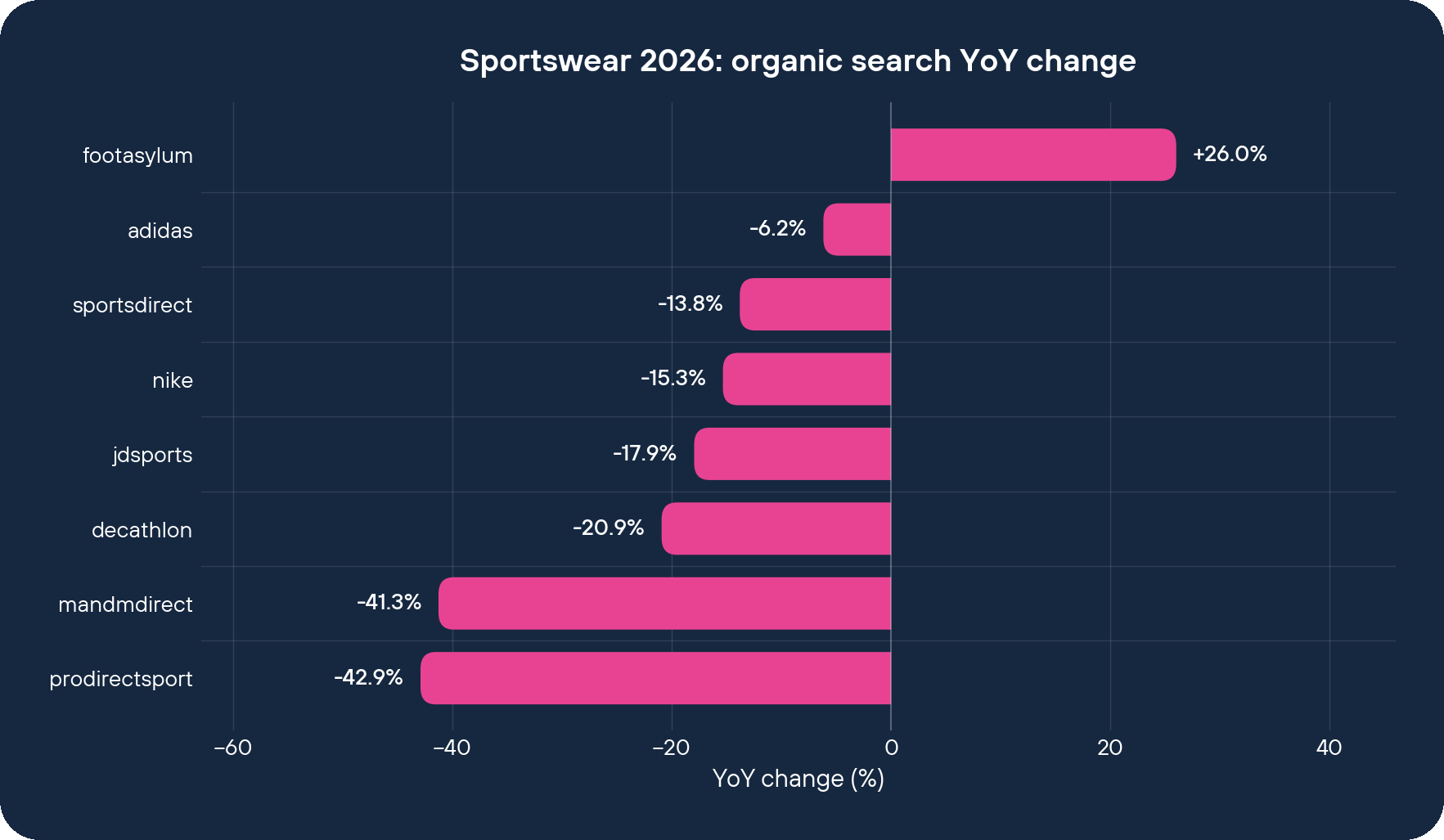
Foot Asylum went from 700,976 visibility points in February 2026 to 883,210 in July 2026. That is +182,234 points, +26.00%, and 39.29% better than the market. It moved from rank 10 to rank 7, and its share of all index visibility went from 2.07% to 3.01%, a gain of 0.94%, the largest share gain anywhere in the 354-brand dataset.
None of that came from a growing market. The index contracted 4,494,145 monthly organic traffic over the same six months, from 33,819,491 to 29,325,346, a fall of 13.29%. Only 18 of the top 100 brands grew visibility at all, adding 373,086 points between them, and Foot Asylum is 182,234 of that total, 48.85%. Every new visit it added came out of somebody else’s loss. Mostly JD’s. JD Sports fell from 4,282,049 to 3,513,237, a loss of 768,812 points and the largest absolute decline in the dataset, with share down from 12.66% to 11.98%.
Foot Asylum holds 883,210 visibility points against 1,037,000 average monthly brand searches, which is 0.85% per search. JD is on 1.57. Gymshark, at 0.92, lost 99,552 points. Lululemon, at 1.15, lost 183,925. By that measure Foot Asylum entered this period more dependent on its own name than JD was, and its name demand fell nearly three times faster, 18.22% against JD’s 6.50% on 2,240,000 searches. It should have been the more exposed of the two. It grew anyway, and it is the largest of six domains in the file whose own name demand fell and whose visibility rose regardless, a group that added 252,666 points between them. Montirex is in the same group: brand demand down 33.04%, from 793,000 to 531,000 searches, visibility up 3.99% and rank 19 to 15.
Where the growth had to come from
If the growth did not come from name recognition, the only place left in this dataset is unbranded query coverage, and the keyword file shows exactly which queries were available to win. The attribute terms grew. ‘brown trainers womens’ carries 12,100 average monthly searches and rose 85.19%, going from 18,900 to 35,000 across the trailing quarter, the largest absolute keyword gain anywhere in the emerging set. ‘leopard print trainers womens’ 1,600, up 53.33%. ‘blue trainers womens’ 2,400, up 16.67%. ‘mens brown trainers’ 5,400, up 13.79%. ‘navy trainers womens’ 6,600, up 6.49%. These are colour, print and audience queries with no manufacturer in them. The same demand with a brand name attached fell hard. ‘ladies white nike trainers’ 12,100, down 28.74%. ‘white adidas trainers womens’ 8,100, down 18.29%. ‘black puma trainers’ 5,400, down 33.66%. ‘converse trainers womens’ 6,600, down 24.63%. ‘womens vans trainers’ 5,400, down 28.23%. Even the unbranded category head terms are falling, ‘mens trainers’ 201,000, down 12.12%; ‘womens trainers’ 135,000, down 7.10%; ‘white trainers’ 49,500, down 18.18%, so the growing attribute terms are a small pocket of expansion inside a category that is shrinking.
The entire emerging group of product queries in this sector carries 79,820 average monthly searches against 1,323,600 in the group that is receding, which is 6.03%. Winning the growing attribute terms will not replace the volume the category has lost. What it does is move share and rank, because almost nobody else is holding those positions while the head terms decline, and holding them comes down to category architecture and faceted navigation for retailers.
Foot Asylum grew visibility while its own name demand fell 18.22% year on year. Putting brand demand back is slower work than winning attribute terms, and earned coverage in publications people already read is one of the few ways to do it, which is what our digital PR to rebuild brand search demand work involves. The full six-month figures for all 354 brands, and the keyword movements behind them, are in the new Sportswear Industry Report.
Further reading
- how Gymshark built search demand against Nike, Gymshark sits in the same visibility-per-search comparison used above, and this piece explains how it grew its own name demand without a conventional advertising presence.
- 2026 UK Footwear Industry Report, Trainers appear in both datasets, so the footwear report shows how the same shoppers behave when the retailer is a shoe specialist rather than a sports retailer.
- 2026 Outdoor Retailers Industry Report, Foot Asylum’s range runs into The North Face and Columbia, and this report covers how those brands and the shops that stock them are performing in search.