by Sean
The name grew and the visibility fell
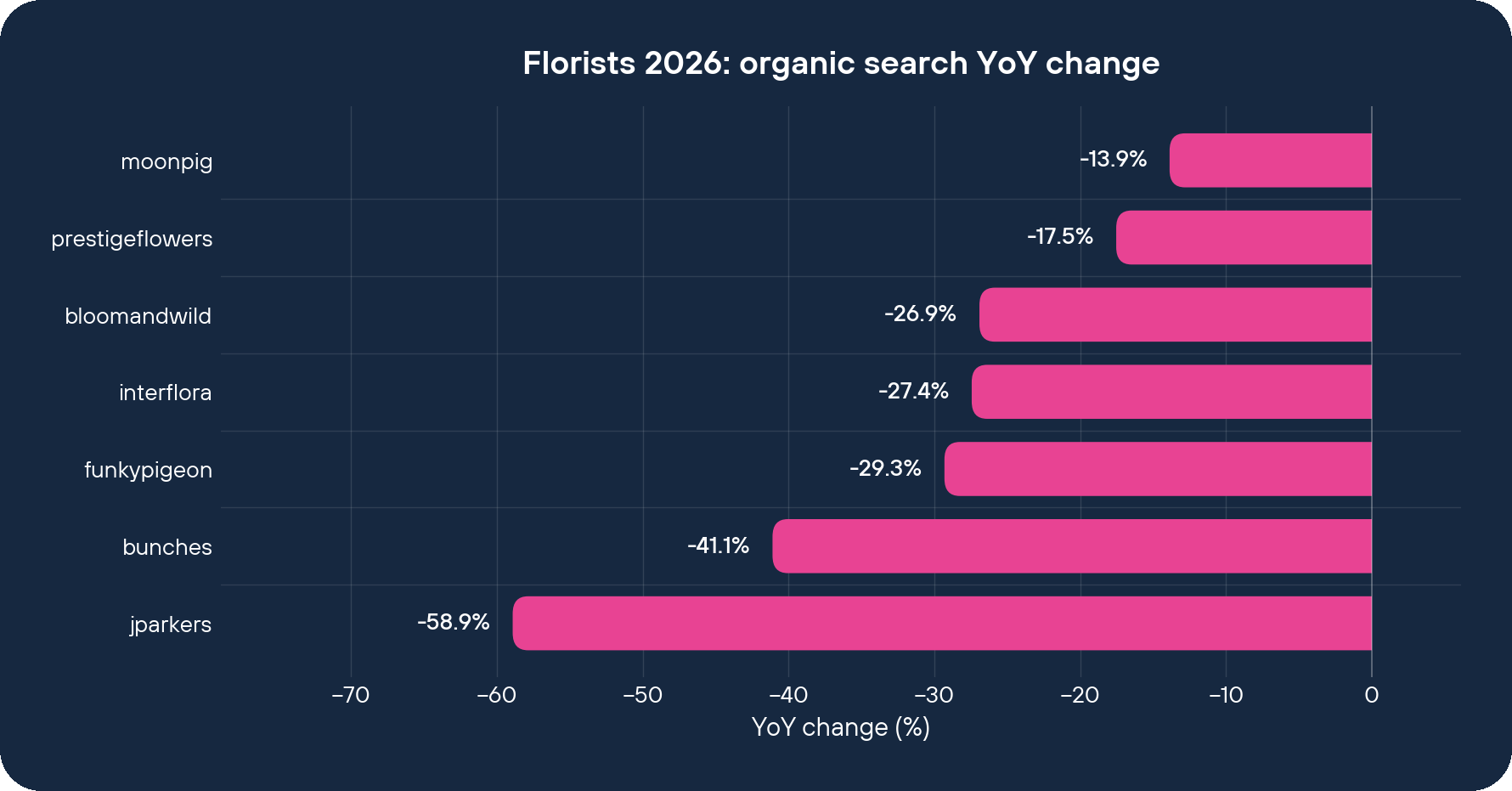
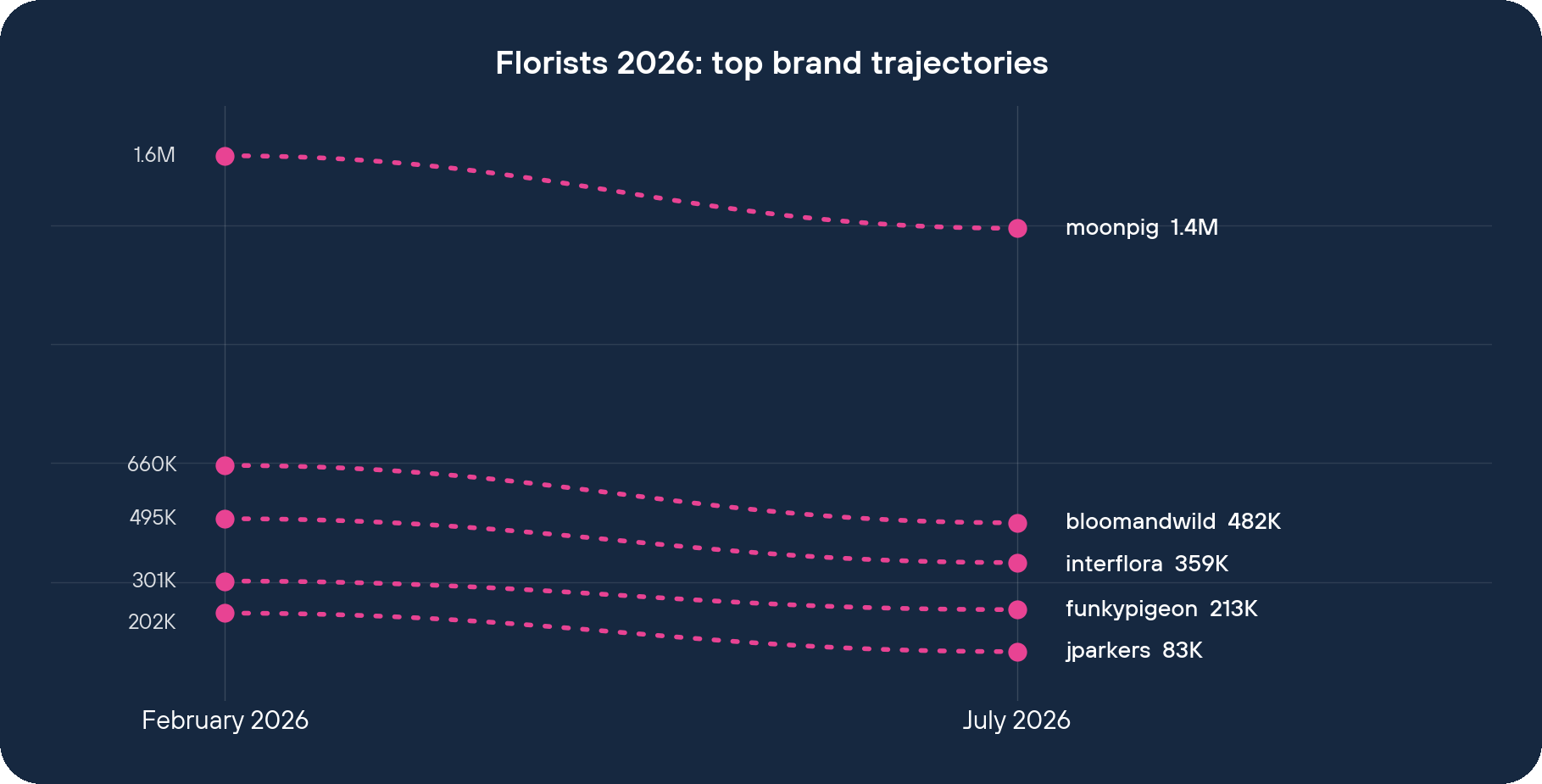
Bloom & Wild ended July 2026 as the second largest domain in the UK florist index, on 482,100 visibility units against Moonpig’s 1,394,287. It also recorded the second largest decline: 177,514 units gone since February 2026, 26.91% of where it started, finishing 7.41% below a market that fell 19.50% across 390 brands. Share of the index moved from 13.09% to 11.88%, and Moonpig now holds 2.89 times its visibility, up from 2.45 in February 2026. One brand carries 18.07% of the whole sector’s six-month decline.
Across the same six months, searches for the brand name rose 7.41% to 165,000 a month. That is the second largest name demand in the sector after Moonpig, and it is the same monthly volume as “flower delivery”, the biggest generic term in the category, which fell 18.52% over the period.
What Bloom & Wild has been buying
Bloom & Wild has been a brand-marketing business since Aron Gelbard and Ben Stanway founded it in 2013 around letterbox delivery. It runs no relay network of member florists, which is the thing Interflora sells (how Interflora leads digital floristry), and it sits inside no card-and-gifting parent, which is what Funky Pigeon has in WHSmith. It raised $102m in a January 2021 Series D led by General Catalyst at around a $500m valuation, took a further £50m that July, and spent it buying bloomon in the Netherlands and Bergamotte in France. Its most copied marketing decision, the Thoughtful Marketing Movement in 2019, let customers opt out of Mother’s Day email and pulled several hundred other companies in behind it.
More recently the company promoted Charlotte Langley from chief customer officer to its first CMO in late 2024, and told Marketing Week it was increasing marketing spend after several years of prioritising retention over acquisition through the cost of living squeeze. A new brand campaign on the Care Wildly platform launched at the end of January 2026, replacing an ad that had run since the pandemic. That campaign went live in the last week of the February 2026 reading and ran through the entire measurement window.
There is therefore a documented, dated reason for name demand rising 7.41%. There is nothing in that list of decisions that earns non-brand positions. Television, out-of-home and email do not rank a page for “next day flowers” or “birthday flowers”. Put the two together and 482,100 units against 165,000 monthly brand searches gives 2.92 units of visibility for every monthly search of the name. My Florist, which took 13,866 units on 40 monthly brand searches, runs at 346.65. That comparison flatters a very small domain with a tiny denominator, so treat the direction as the useful part.
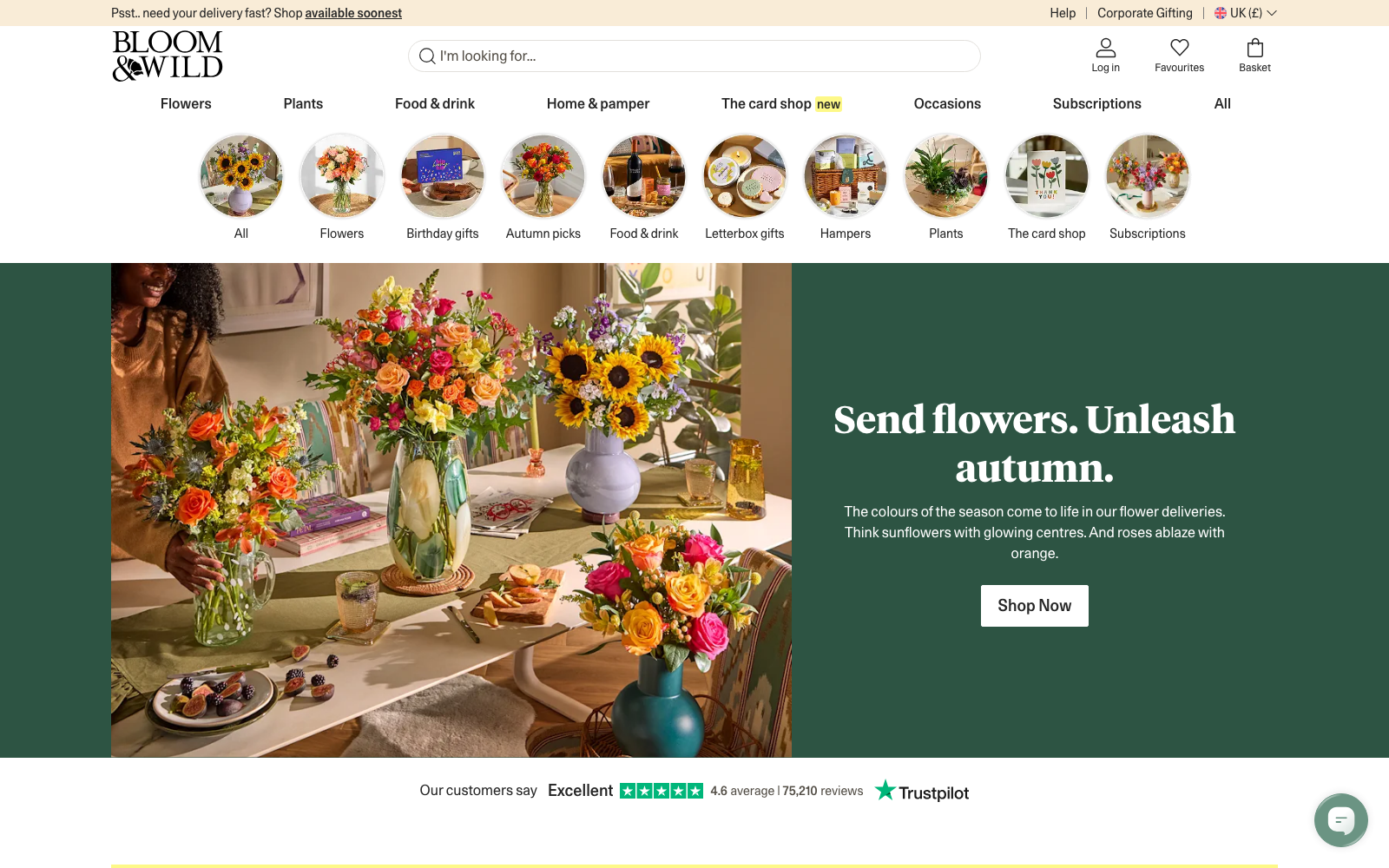
One thing worth recording without drawing a conclusion from it: a plain fetch of the Bloom & Wild homepage returned a single line, the title “Bloom & Wild Flower Delivery | Flowers & Gifts”, with no body copy, navigation or category links. The same method pulled nine occasion routes and three delivery routes off Interflora, a full category and partner list off Moonpig, and 12 named bouquets with prices off Prestige Flowers. A plain fetch is not Googlebot and Google renders JavaScript, so treat that as an observation about one request and nothing more, and as something for technical SEO and indexation services to check properly.
The other things moving these numbers
February holds Valentine’s Day and July holds nothing comparable. Valentine’s flower demand came in at 60,500 in February 2026, itself down 18.24% after sitting at exactly 74,000 in each of the three prior Februarys. Every occasion-led gifting brand in this index loses visibility on a February-to-July reading, and that is most of why the sector total fell 19.50%. The relative figure is the one to read, and Moonpig, at least as exposed to Valentine’s, finished 5.63% above market and took share from 32.13% to 34.37%.
Underlying demand also contracted. The ten generic delivery terms carry 286,100 monthly searches between them and every one fell, from “send flowers by post” at -6.85% to “online florist delivery” at -42.25%. “Flower delivery” alone lost 75,000 quarterly searches. A brand holding identical ranking positions on those terms still records fewer units in July.
Cost is the third candidate. The group reported its first profit for 2024, roughly $5.6m of adjusted EBITDA on about $150m of revenue, a swing of some $12m achieved on tighter spending. Whether content and technical SEO sat inside that tightening is not public, and I will not assert it. What is public is that the UK business grew revenue 10% in the year to March 2025 and 21% in the first half of the year to March 2026. The trading business grew while non-brand organic visibility fell, which is worth holding onto: this index measures one channel.
Haute Florist bought the other asset
Haute Florist took the largest single gain in the index, 28,327 units, moving from 51,954 to 80,281, up 54.52% and 74.02% above market, climbing from rank 17 to rank 13. It did that on 3,600 monthly brand searches, 2.18% of Bloom & Wild’s, with its own name demand down 6.48%. Every unit came from non-brand coverage, and the homepage reads accordingly: named bouquets with prices from £30, “Need them tomorrow? Send Next Day Flowers”, and nine occasion routes from Birthday through Graduation to With Sympathy. Haute Florist sits inside Prestige Gifting Limited in Halifax alongside Prestige Flowers, 1.97% above market, and Prestige Hampers, 26.21% above it.
Where that leaves a brand-led florist
Bloom & Wild holds the harder of the two assets. Name demand of 165,000 a month, rising, second only to Moonpig, takes years and serious money to build, and Haute Florist cannot buy it this year at any price. Haute Florist holds the easier one and added 28,327 units of it in six months using named products, prices and delivery promises on pages a crawler can read, which is what ecommerce category and product page SEO does. For most of the past decade those two assets moved together, because a brand enough people wanted also tended to rank for the category terms. Across these six months they moved apart inside one company, and Bloom & Wild is the clearest instance of that in the index.
If you want to know whether name demand and non-brand visibility came apart in your own category, every Salience Index sector report measures the same two things across the rest of the index.
Further reading
- our analysis of Moonpig’s visibility change, Moonpig is the benchmark in every comparison above, so the detail behind its own numbers gives you the other half of the picture.
- 2026 Greeting Cards Industry Report, Moonpig and Funky Pigeon compete in cards as well as flowers, so the card and gifting numbers show where the same brands stand in their other category.