by Sean
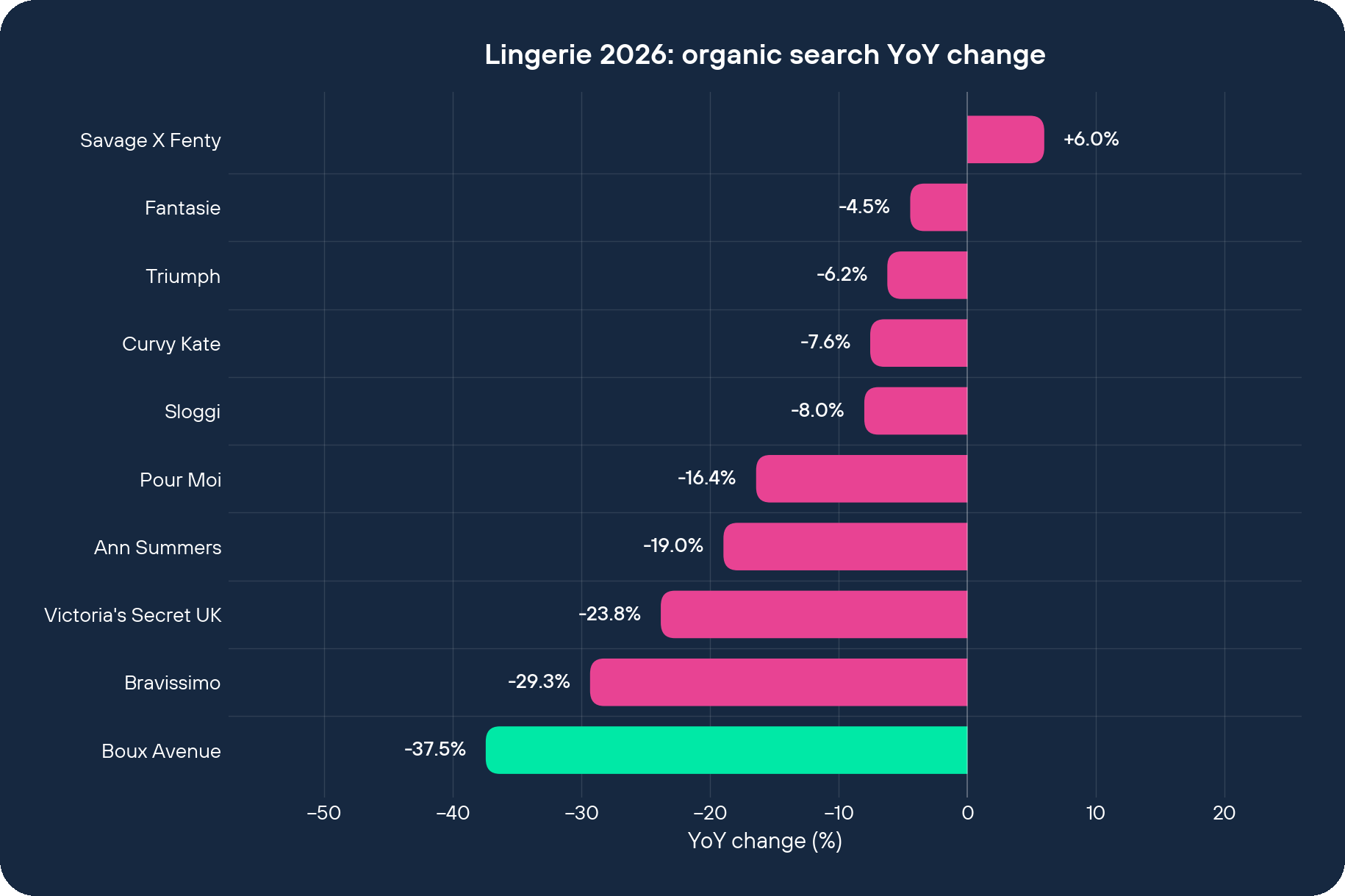
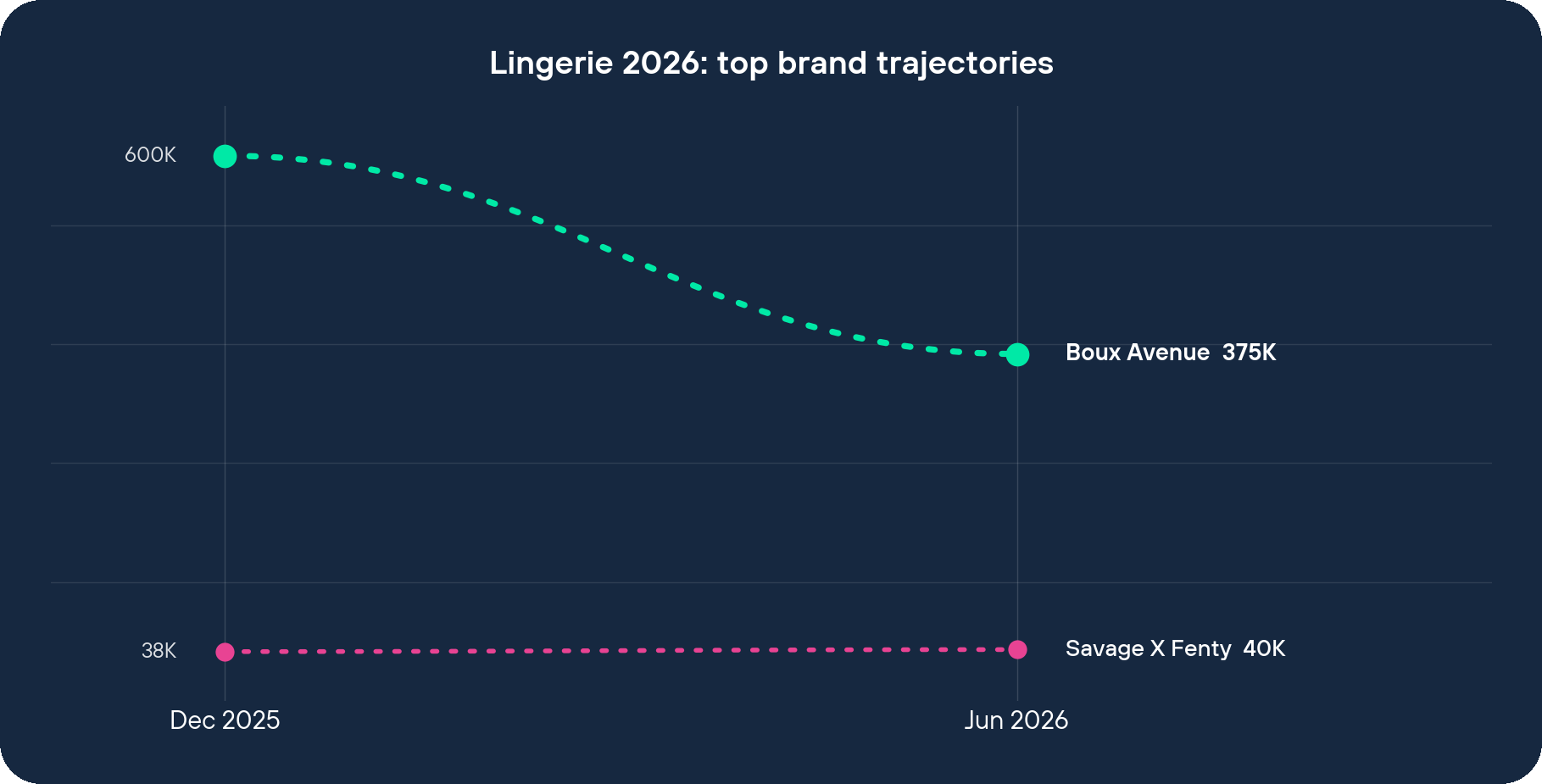
In December 2025, bouxavenue.com held 600,082 visibility points, the largest organic presence among the 184 brands in this index, and roughly 290 times the 2,069-point median baseline of the brands that grew this period. At the visibility june, 26 measurement it holds 375,375. That is a loss of 224,707 points, a -37.45% decline in a market that fell -23.67%, leaving it 13.78 points behind an already grim average. It also gave up first place. Ann Summers fell -18.97% to 388,267 and now ranks first, 12,892 points ahead, with Boux Avenue second, Ann Summers overtook it while itself declining, because losing at half the rate was enough. Click below to access the latest Lingerie market report.
The decline is worse than the market’s, and worse than its peers’
Every one of the five biggest sites in the index fell. Victoria’s Secret UK declined -23.84% to 283,106 (rank 3), Bravissimo -29.34% to 202,745 (rank 5), Pour Moi -16.43% to 203,866 (rank 4). Between them, the top five went from 1,981,817 points to 1,453,359, a -26.67% aggregate decline that supplied 69.39% of the entire 761,574-point net loss across the top 100. Boux Avenue is the single largest component of that figure.
The comparison gets less flattering the tighter you draw it. Not one brand that started December above a 40,000-point baseline grew. The nine brands that started above 50,000 fell a combined -26.48%, and Boux Avenue underperformed even that cohort by nearly 11 percentage points. At the other end of the same table, the 45 smallest ranked brands grew +7.01% between them, a net gain of +6,459 points, which means Boux Avenue’s single-site loss is about 35 times the entire collective gain of the market’s growers. Whatever repriced organic search in lingerie over these six months charged the biggest site the highest price, and charged Boux Avenue more than the other giants.
The site is organised around exactly the queries that stopped paying
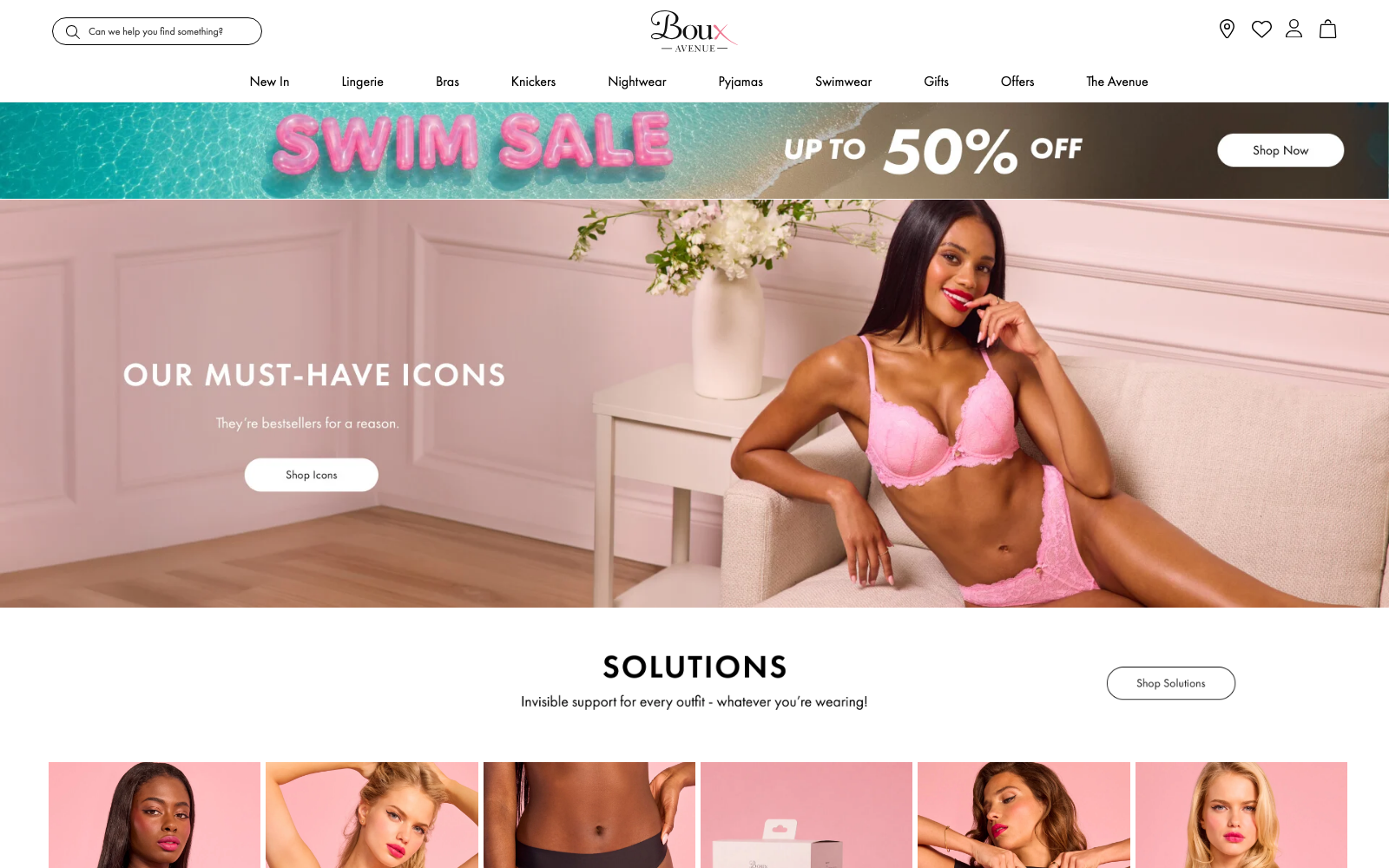
Boux Avenue’s homepage title is ‘Find Perfect Lingerie For Your Shape & Style’, written for unbranded queries, with the brand name doing no work in it. The main navigation runs the full taxonomy of generic category demand: Nightwear, Pyjamas, Satin Nightwear, Black Nightwear, Bridal Nightwear, Seamless Underwear, DD+ Swimwear. Each of those is a PLP built to rank for a head or mid-tail commercial term containing no brand name, built the way ecommerce category and product page SEO has been done for years. The Avenue, the on-site blog, extends the same coverage into informational queries, ‘Best Bras for Larger Busts’, ‘Best Swimwear for Small Boobs’, ‘Best Swimwear for Big Busts’, ‘The Best Wedding Lingerie’, and a programmatic gift section scales it into the long tail: ‘Gifts under £10’, ‘Gifts under £20’, ‘Gifts under £35’, ‘Gifts under £50’, ‘Gifts for Mums’, ‘Gifts For Girlfriends & Wives’.
For a decade this was the correct strategy, and Boux Avenue should not be caricatured for it. Theo Paphitis founded the chain in 2011 inside his retail group alongside Ryman and Robert Dyas, positioned it mid-market, and built the store offer around a free fitting service in boudoir-styled shops. Online, it faced Ann Summers, a household name with decades of high-street presence, and could never close that recognition gap quickly. So it closed the visibility gap instead: out-build everyone on unbranded demand, own ‘satin nightwear’ and ‘best bras for larger busts’ rather than wait for shoppers to type ‘Boux Avenue’. It worked. That is how a mid-market chain ended up with the biggest organic presence in UK lingerie.
The problem is what those query classes now pay. Informational listicles are precisely where AI Overviews answer inside the results page: someone asking Google for the best bras for a larger bust now gets a synthesised list with citations, and the blue link ranking underneath it earns a fraction of its former CTR. Generic commercial head terms, ‘satin nightwear’, ‘bridal nightwear’, increasingly resolve to product grids and AI-organised results that spread clicks across dozens of retailers. When 600,082 points are concentrated in those two query classes, the SERP can reprice most of a site’s traffic without its ranking positions moving much at all.
What the data can and cannot settle
Several things moved Boux Avenue’s number, and honesty about them matters more in a decline this large. The comparison window does some of the work: December is lingerie’s peak trading month, party season plus Christmas gifting, and Boux Avenue carries more gift-specific URLs than almost anything else in this index, so a December-to-June measurement mechanically strips out demand that will return in Q4. ‘Gifts under £20’ earns most of its annual traffic in one quarter. But all 184 brands are measured across the same two endpoints, and the market’s -23.67% already contains the season. Seasonality explains why nearly everyone fell; it has to work much harder to explain why Boux Avenue fell 13.78 points further than average, especially when June sits at the peak of demand for the DD+ Swimwear range in its main navigation.
Other drivers are invisible here entirely. Paid search mix, promotional cadence, store trading, stock decisions, any template or platform changes, none of it shows in this dataset, and Theo Paphitis Retail Group does not publish channel-level figures for the brand. Some portion of the decline may have causes this table cannot show.
But the in-table evidence keeps lining up behind one explanation. Within the top five, the two brands that beat the market, Ann Summers at +4.70 points versus market and Pour Moi at +7.24, are the two with the strongest name-driven demand. Further down, the best performers among the big sites are manufacturer labels whose organic queries tend to carry their own names, because shoppers search for them by brand and product line: Fantasie fell just -4.45% (rank 7), Triumph -6.23% (rank 12), Curvy Kate -7.56% (rank 13), Sloggi -8.02% (rank 14), all of them 15 to 19 points better than the market. Branded demand is no guarantee on its own, lounge.com, a DTC label with a large social following, still fell -29.29%, and we have written elsewhere about how Lounge grew as a lingerie challenger, but the sites whose visibility is built from queries containing their own names consistently held up, and the site whose visibility is built from generic category terms fell hardest of all.
Savage X Fenty, tenth-largest and the only riser in the top ten
savagex.co.uk grew from 37,901 to 40,163, +5.97%, which is 29.63 points ahead of the market, and it is the only site in the current top ten that grew at all. Its homepage carries almost none of the SEO furniture that covers Boux Avenue’s. What it merchandises, top to bottom, is the brand and its membership: a style quiz that unlocks ‘60% OFF SITEWIDE + 2 BRAS FOR £29’ for new Rewards Members, member-only pricing, ‘MEMBER CREDITS = MORE SAVINGS’, with Rihanna’s name in the logo lockup itself, ‘SAVAGE X FENTY: By Rihanna’. This is a business whose search demand arrives already knowing where it is going: queries containing the brand’s own name and its product lines, the navigational and branded intent that AI Overviews rarely intercept and that the repriced SERP still pays in full. The two cases differ most in what their visibility is made of, and the one made of branded demand grew.
What Boux Avenue still holds, and what to watch
Boux Avenue remains the second-largest organic presence in UK lingerie at 375,375 points, and most of the rankings that produced its December figure still exist. What has fallen is the traffic each generic ranking delivers.
The rebuilding assets are real and specific to this brand. It has a national store estate whose founding proposition was fitting, and fit expertise is the one thing lingerie buyers still need a trusted source for, band and cup precision is why Bravissimo, Curvy Kate and Panache exist as businesses. That expertise currently reaches search as listicles formatted identically to a hundred affiliate pages, which makes it easy for AI Overviews to absorb and gives nobody a reason to click through. Rebuilt as citable authority, named fitters, first-party fit data from the store estate, structured product-level guidance with proper schema markup, the same knowledge could earn AIO citations and the residual clicks that follow them, and could give shoppers a reason to search for Boux Avenue’s fitting service by name rather than for ‘best bras for larger busts’ generically.
The next measurement will partly flatter everyone: a December 2026 read restores seasonal gift demand, and the programmatic gift pages will recover with it. The figure to watch is the informational and head-term traffic, because nothing seasonal is coming to rescue it. If The Avenue’s listicles and the generic category PLPs are still losing traffic at the next read, the repricing has further to run, and Boux Avenue’s remaining 375,375 points represent the sector’s single largest exposure to it.
If most of your organic visibility sits in generic category pages and informational guides, the same repricing applies to your site, and the work of turning genuine expertise into pages Google is willing to quote is where the recovery starts. We help retailers with content strategy for AI Overview citations, from first-party data and named expertise through to the structured markup that supports it. You can also request the full six-month lingerie data to see where your own site sits against the 184 brands measured here.
Further reading
- Gifting Industry Report 2025, Boux Avenue’s programmatic gift pages carry a lot of its December figure, and this report shows how organic visibility moves across the gifting category those pages compete in.
- 2026 Sexual Wellness industry report, Ann Summers and Lovehoney trade across both categories, so the neighbouring sector data shows whether the same search repricing reached them there.
- Last year’s wider lingerie industry analysis, it sets out market size projections and lingerie buying habits, giving the demand-side context behind the visibility movements measured in this index.