by Sean
Second by visibility, and the only one of the three to grow
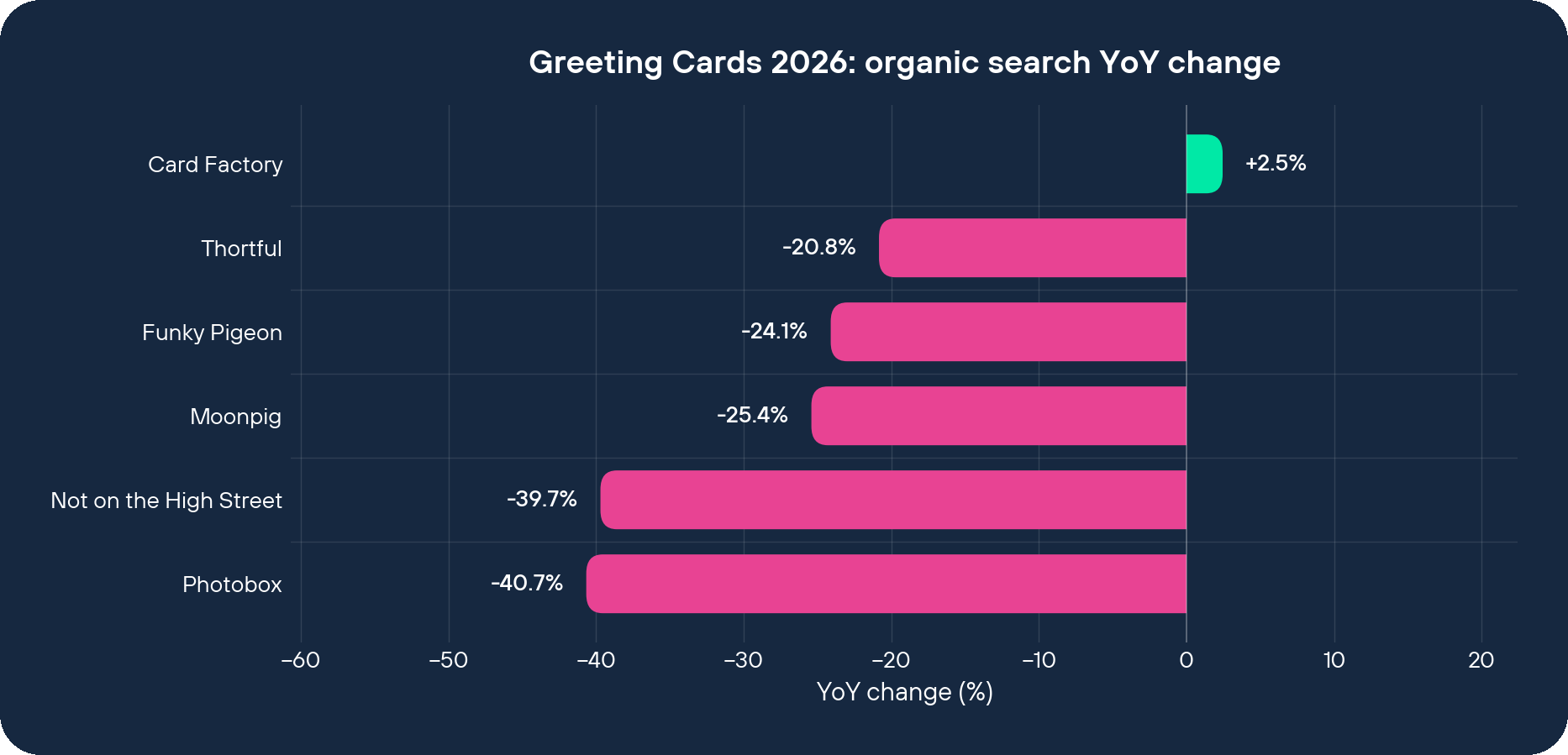
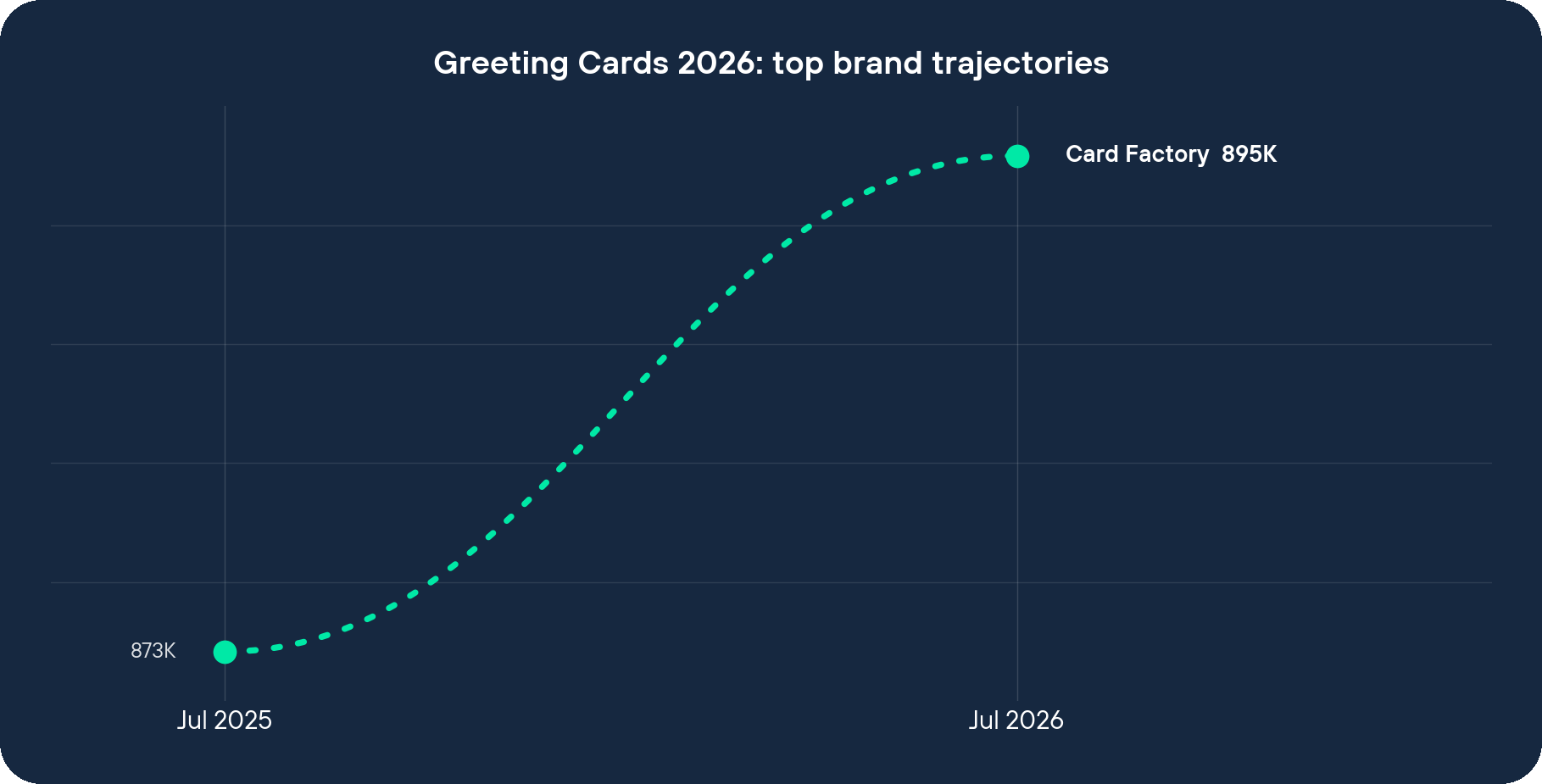
Card Factory grew its organic search visibility by +2.45% year on year, from 873,311 points in July 2025 to 894,708 in July 2026. In an ordinary year that is a rounding error and nobody writes about it. This was not an ordinary year. The greeting-cards market as a whole fell -21.00% over the same period, and the six largest platforms lost a combined 1,126,887 visibility points between them. Measured against that, Card Factory’s near-flat number is a +23.45-point outperformance of the market, and it is the only brand in the category’s top three by visibility to have grown at all. Card Factory now sits second, at 894,708 points, behind only Moonpig, which fell -25.41%. Above and around them, Not on the High Street fell -39.70%, Photobox -40.66%, Thortful -20.83% and Funky Pigeon -24.10%. Click below to access the latest Greeting Cards market report.
The cleanest way to see what happened is the gap to the leader. In July 2025 Moonpig’s visibility lead over Card Factory was 792,198 points. A year later it was 347,562. Card Factory more than halved the distance to the category leader in twelve months, and it did so without any dramatic move in its own traffic. Moonpig came back towards Card Factory far more than Card Factory climbed towards Moonpig. That distinction matters, and I’ll come back to why it is the honest way to read this.
What the homepage is built to do
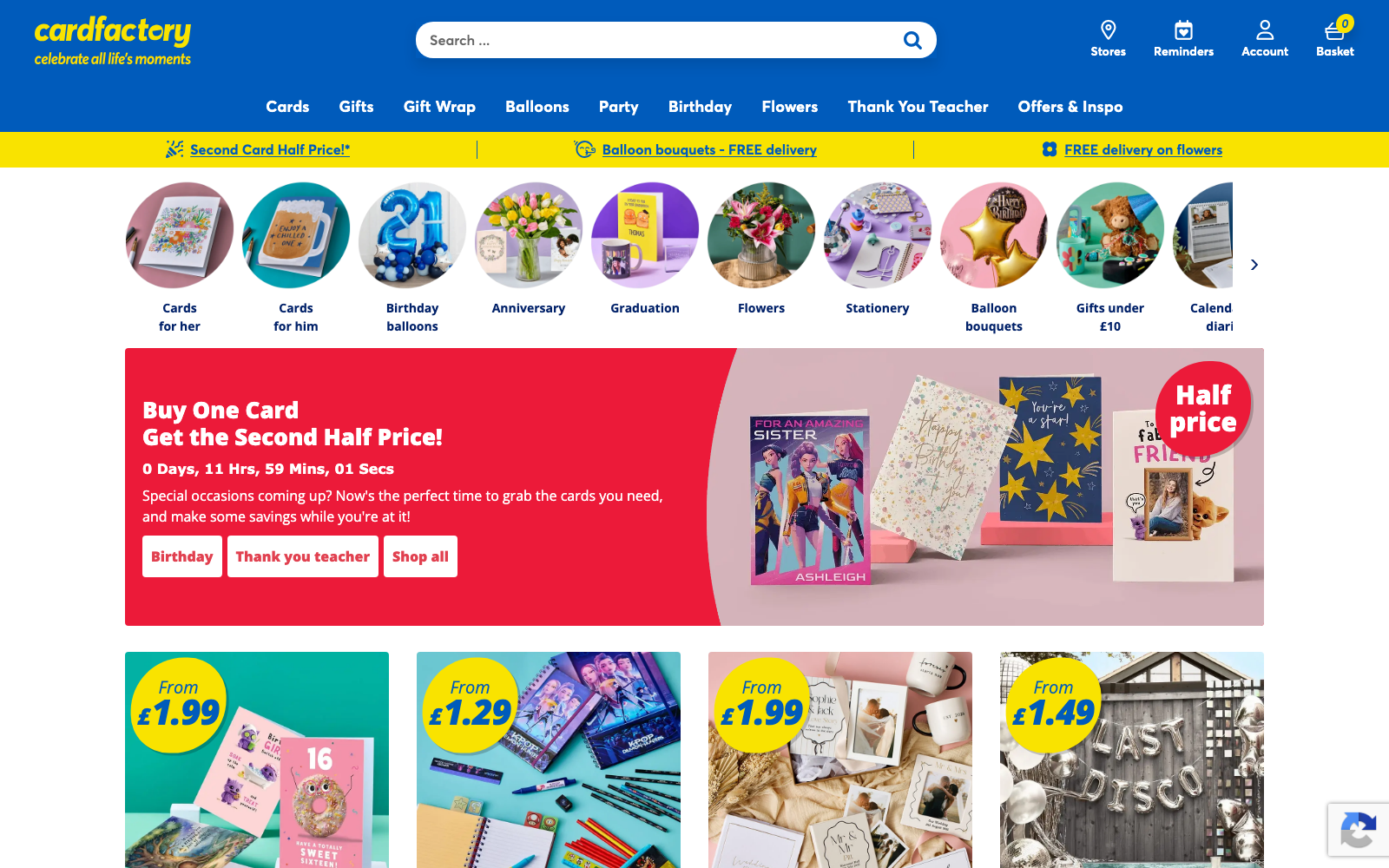
The homepage makes the strategy legible in its first screen. The lead elements are “Find a store”, cards priced “From £1.29, £1.99”, and “Buy One Card Get the Second Half Price.” There is no hero unit engineered to catch generic query intent, no “shop birthday cards” module built to rank for the searches Moonpig and Funky Pigeon spent a decade fighting over. The most valuable space on the page sends you to a physical shop.
That reflects the business behind it. Card Factory runs roughly 1,000 stores across the UK and Ireland and has been opening net new ones while much of specialist high-street retail has been closing. It is also vertically integrated in a way almost nobody else in this category is: it designs cards in-house and prints a large share of its own range through its own printing operation, which is what allows it to sell a card for as little as £1.29 and still make money on it. Its online personalised-gifting ambitions have largely lived on a separate site, gettingpersonal.co.uk, which means cardfactory.co.uk itself was never the personalised-card search battleground in the first place.
The basket around the card is physical too. The homepage merchandises balloon bouquets “DELIVERED INFLATED”, helium canisters, free-delivery flowers, party supplies and calendars, occasion-adjacent goods that widen the transaction without leaning on card search traffic. The value tiers are stated openly: £1.29 stationery, £1.49 hen-party ranges, £1.99 wedding. This is a shop that captures demand through price and a physical estate, and it treats the website as one more till rather than as its primary way of being discovered.
Why its search visibility held up
The tempting version of this story is that Card Factory’s value model “won” the year. I’d be more careful than that. A +2.45% move is close to flat, and flat is the actual story here. Card Factory’s visibility barely moved while the personalised and photo-card platforms fell 20% to 40%. Several things plausibly explain why, and most of them cannot be isolated in this dataset:
- A large share of “card factory” search is navigational and local, people looking for the brand itself and the nearest shop (“card factory near me”, opening times), demand generated by around 1,000 physical stores and reinforced by putting “Find a store” first on the homepage. Card Factory carries 550,000 monthly branded searches, which places it fourth in the category on the Brand Reach Score. Branded and local queries held up far better this year than generic ones like “birthday card” or “personalised card”, which is exactly the discovery space where Google’s AI overviews and its own shopping units have absorbed the most clicks.
- Card Factory had very little of that generic personalised-card visibility to lose in the first place, because it never built the site to chase it. The declines that hit Moonpig, Funky Pigeon, Thortful and Photobox were concentrated in precisely the personalised and photo-card discovery Card Factory largely sits out.
- Its diversification into balloons, flowers, party and calendars adds category pages that rank for non-card queries, spreading its visibility across terms that were not in the firing line this year.
- And the boring possibilities I genuinely cannot rule out from this data: net new store openings lapping into more branded search, paid brand campaigns lifting branded query volume, or simply a softer comparison period a year ago. Any of those would move the organic number without a single SEO decision sitting behind it.
So the honest read is insulation. Card Factory grew because the part of search it depends on, people who already know the brand and want the shop or the value, is the part that held, while the part it never competed hard in is the part that collapsed. Its own reviews are consistent with a business whose strength lives offline: cardfactory.co.uk carries 9,988 reviews at 3.3 stars, the lowest rating among the twenty most-reviewed sites in the category, and a fraction of Moonpig’s 565,110 reviews at 4.2. Its transactional website is not where the brand is strongest, and it doesn’t need to be.
How Moonpig spent the same year
Moonpig still owns the demand. It carries 1,000,000 monthly brand searches, more than any brand in the category, and ranks second on the Brand Reach Score. Its difficulty is what it built the site to capture. Organic visibility fell -25.41%, a loss of 423,239 points and the single biggest decline in the sector (Moonpig’s search visibility decline explained), and the homepage now reads like a company widening its offer under pressure. It bolts on third-party gifting from Hotel Chocolat, LEGO, Lanson and Laurent Perrier, a flowers range from £24.99, a Moonpig Plus subscription and a Moonpig for Business arm, and it runs “30% off 2 cards or more” with a discount code on the front page. That is a great deal of breadth added around a personalised-card proposition whose generic discovery is the exact thing that lost ground this year.
What this does and doesn’t prove
The year proves one thing cleanly: a value-led, store-anchored model was insulated from the collapse in generic open-web discovery, and that insulation was worth a +23.45-point swing against the market. Card Factory grew without ever relying on the organic route that emptied out for everyone else.
It does not prove Card Factory has cracked online growth. Its 3.3-star review rating, the smallest online review base of any large player in the category, and a homepage that spends its best space directing people to a store finder all point to a business whose website numbers are steadied by offline demand far more than by online performance. The +2.45% is a byproduct of a store estate and a brand that people search for by name, not the result of Card Factory beating anyone on the search terms that used to matter in this category.
Which leaves the real question for the next twelve months. Card Factory’s visibility held because branded and local search held. If that demand ever softens the way generic card search just did, if fewer people search the brand name, or if store openings slow, the same insulation that protected it this year offers very little to fall back on, because there is no strong generic-search position underneath it. The number to watch is not its total visibility. It is whether that 550,000 branded searches a month keeps growing with the store estate, or starts to flatten.
Plenty of brands are seeing the same thing in their own numbers this year: branded and local search holding up while generic discovery falls away. If that sounds familiar, organic search strategy support can map where your visibility actually comes from before you decide what is worth defending, and content built for AI Overview visibility can help you earn back the open-web queries that AI overviews have been absorbing.
Further reading
- the full Greeting Cards sector analysis, It gives the reader the wider view of how the whole greeting-cards market moved, setting the context for Card Factory’s outperformance.
- how the wider gifting market performed, Personalised gifting is the discovery space these brands fought over, so the gifting report shows the reader the neighbouring category driving much of this competition.
- the 2026 UK florist market report, Card Factory and Moonpig both merchandise flowers around the card, so the florist report covers the occasion-adjacent category this article keeps referencing.