by Sean
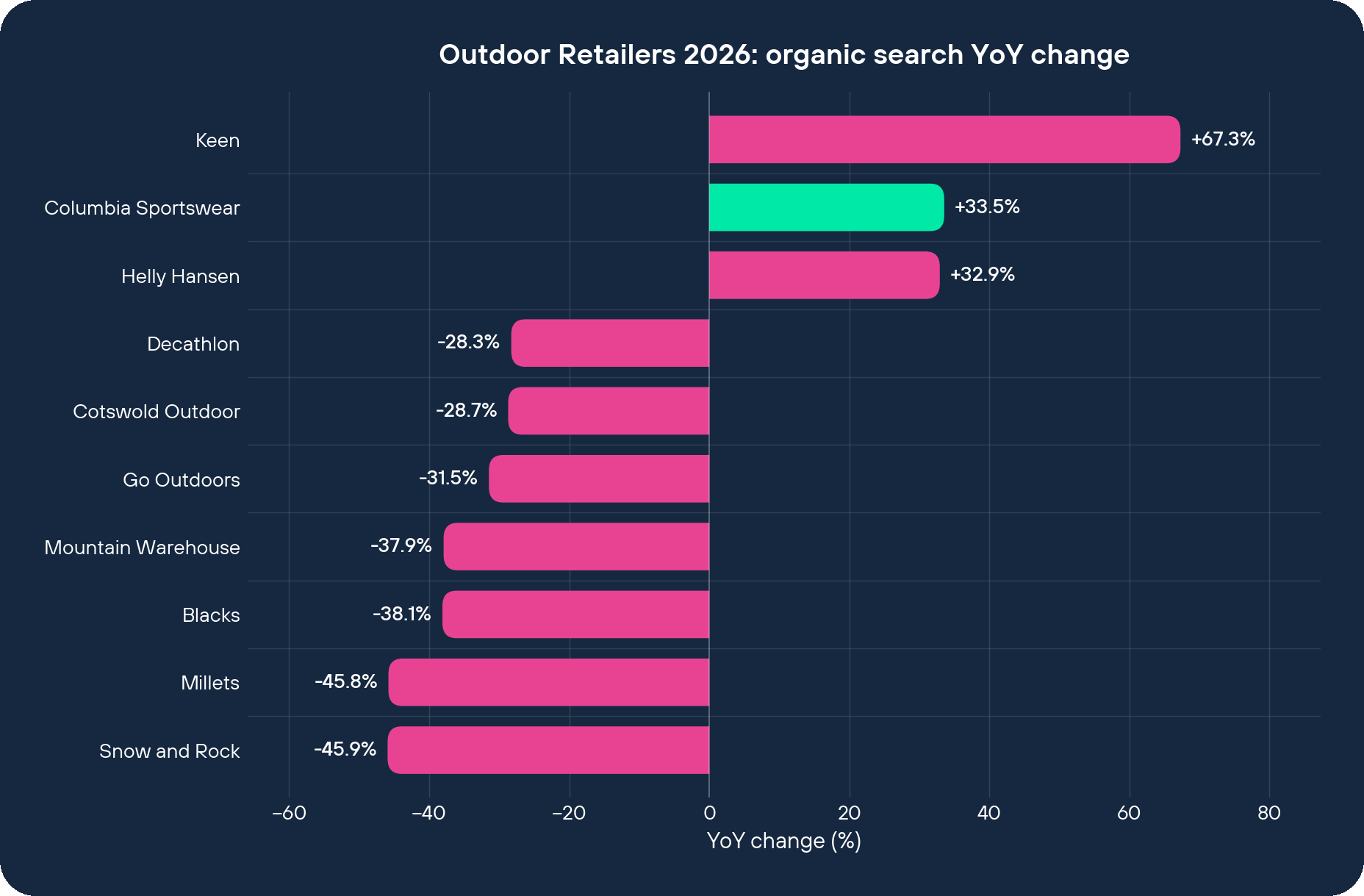
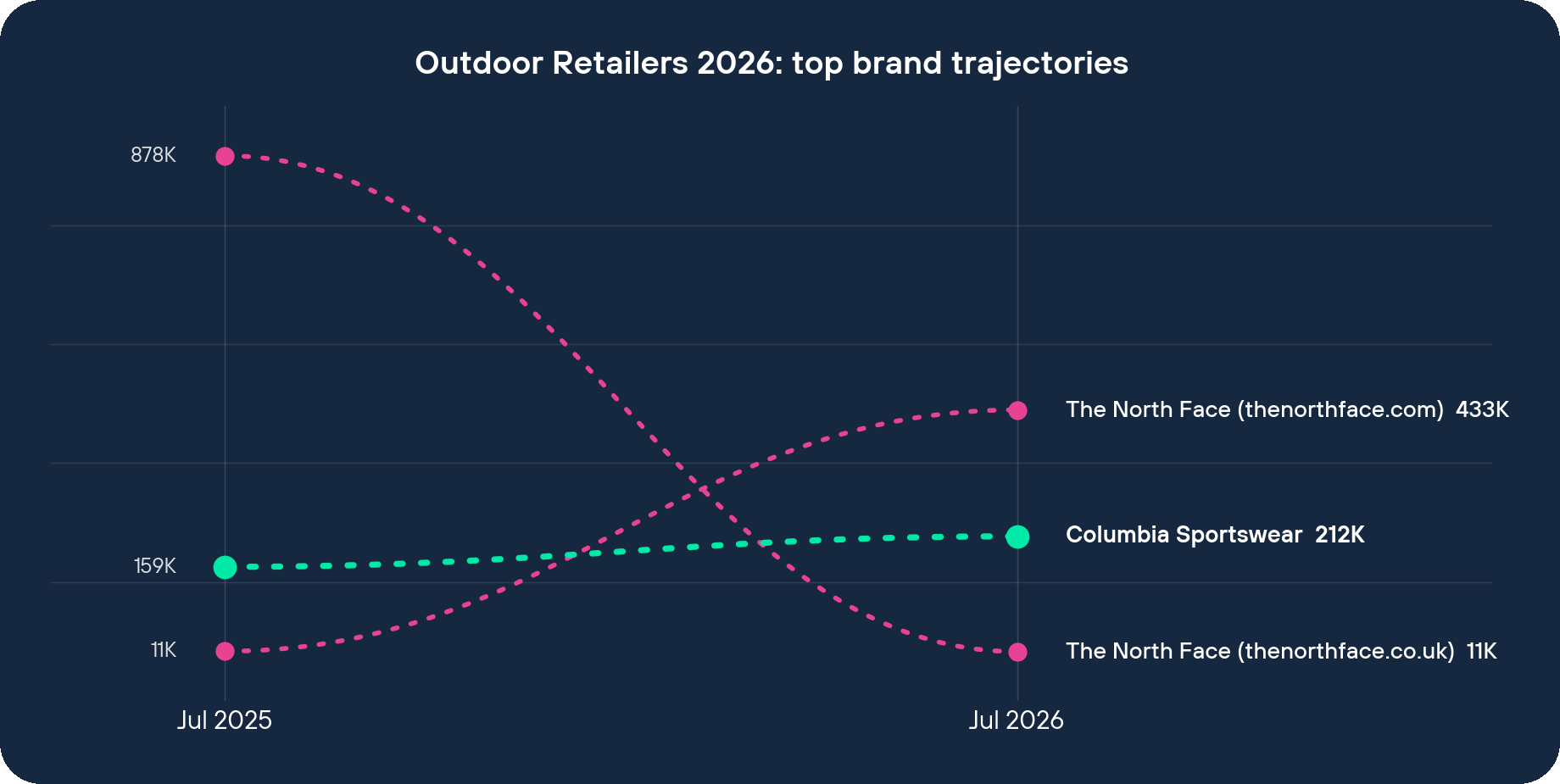
Every large shop that sells Columbia gear in the UK lost organic visibility between July 2025 and July 2026. Go Outdoors fell 31.47%, Blacks 38.11%, Millets 45.82%, Cotswold Outdoor 28.72%, Snow and Rock 45.94%. Columbia’s own site went the other way and added 53,300, a rise of 33.55% from 158,856 to 212,156. For a brand that barely 5,400 people search by name each month, that is worth stopping on, because almost none of that increase can be coming from people typing “Columbia” into Google. Click below to access the latest Outdoor Retailers market report.
Who Columbia actually is
Columbia Sportswear is an American company, listed on the NASDAQ as COLM, founded in Portland in 1938 and still controlled by the founding Boyle family, the same family whose late matriarch Gert Boyle fronted the long-running “One Tough Mother” advertising, and whose son Tim Boyle runs the business today. It sells accessible technical kit built around its own patented fabric technologies: Omni-Heat reflective lining, Omni-Tech waterproofing, Omni-Shade sun protection, Omni-Freeze cooling. In the market this index covers, that places it in the middle of the pricing ladder, above value ranges such as Regatta, Trespass and Mountain Warehouse’s own lines, and below the technical-premium names, Arc’teryx, Patagonia, and fashion-outdoor crossovers like Moncler, that command the highest branded demand.
The brand-reach table sharpens the picture in a way most people would not guess. Columbia ranks third of the fifty brands on social score alone, at 5,631.97, behind only The North Face and Moncler. Yet it ranks twentieth on the combined brand-reach measure, and the reason is its branded search volume: 5,400 name searches a month, about one two-hundredth of the million that Go Outdoors and Decathlon each draw. People follow Columbia and see Columbia; very few of them go to a search engine and type the word.
What the numbers actually say
Against that backdrop the visibility gain reads differently. Columbia added 53,300 to reach 212,156, which is the ninth-highest visibility of the 360 brands in the index, and it is one of the very few brands anywhere near the top of the table to post a gain rather than a loss. The three largest retailers moved the opposite way and by far larger amounts: Decathlon down 28.28%, Go Outdoors down 31.47%, Mountain Warehouse down 37.94%, a combined loss of 1,409,426, from 4,430,865 to 3,021,439, or 31.81%. The market as a whole fell 18%. So Columbia grew in absolute terms while the field shrank around it, which is a stronger result than merely declining more slowly than the average.
It is not alone. Keen added 67.29% on just 1,300 branded searches a month, Helly Hansen 32.92%, Scarpa 28.71%, Grisport 26.04%. The brands gaining share are the ones with small branded-search footprints and a single, coherent range. The brands losing it are the ones with the largest names and the widest catalogues, a divide our outdoor clothing organic search analysis traces across the market. Because Columbia’s own name drives so little of its search, that 33.55% almost has to be coming from non-branded queries, “women’s fleece”, “waterproof walking jacket”, “insulated boots”, the generic product and category terms that the multi-brand retailers used to win.
What the site is built to capture
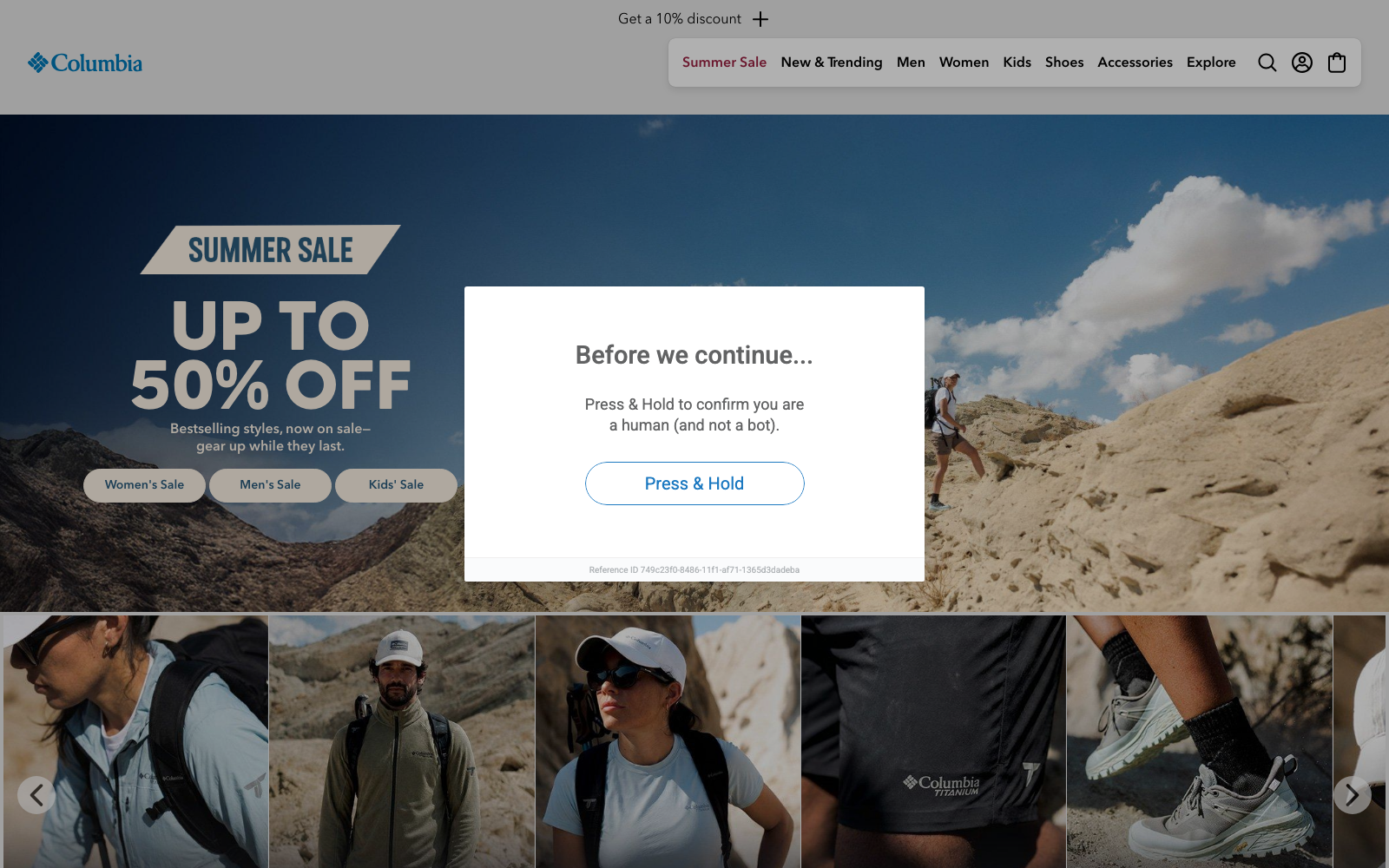
The site is set up to do something specific with that traffic. The navigation is six product groups and nothing else: Jackets, Fleeces & Hoodies, Tops, Bottoms, Footwear, Equipment & Accessories. There is no brand directory, no A-Z of labels, no “shop by brand”, every category page and every product page belongs to one brand, so the internal linking, the page titles and the schema markup all point at Columbia’s own products rather than splitting that authority across a hundred competing labels. That is the practical difference between a single-brand PLP and a reseller’s, and it is the gap that ecommerce SEO for category and product pages exists to close for a multi-brand retailer. When Google decides which page best answers “men’s Omni-Heat jacket”, a page that is unambiguously about that product, on the manufacturer’s own domain, is a cleaner match than the same jacket sitting on a category page next to forty rivals.
The rest of the storefront is built to turn captured traffic into a first-party audience the resellers cannot reach, which is what conversion rate optimisation and UX are for. There is a newsletter sign-up offering 10% off a first full-price order over £120, a members programme with members-only benefits and free shipping for members or on orders from £70, and the standard direct-to-consumer conversion tools you would expect, Klarna and PayPal pay-in-three, 30-day free returns. Around it sits brand-led seasonal merchandising rather than pure price aggregation: a Summer Sale headed “up to 50% off” and campaign lines such as “gear that makes Mother Nature think twice”. This is a company collecting its own customers’ email addresses and order histories, which a reseller listing the same jacket alongside a dozen others cannot do.
Being honest about what moved the numbers
None of that, on its own, explains a 33.55% rise, and it would be dishonest to hand Columbia’s single-brand focus the whole gain. Organic visibility moves for reasons this dataset cannot see, and the clearest one is sitting in the same table: the retailers that rank for “Columbia [product]” terms all lost ground at the same time. Blacks fell 38.11%, Millets 45.82%, Cotswold Outdoor 28.72%, Ellis Brigham 18.48%, Snow and Rock 45.94%, and The North Face’s UK site, thenorthface.co.uk, effectively disappeared, down 98.80% from 877,974 to 10,523 as its traffic moved to the global thenorthface.com domain, which rose from 11,223 to 433,401. When that many established pages lose ranking positions on generic outdoor queries in the same window, the results reshuffle, and a well-structured single-brand site is a natural beneficiary of the gaps, whether or not it changed anything itself.
There are drivers I cannot rule out and neither can you from this data. Columbia may have increased paid search or run brand campaigns that lifted non-branded rankings indirectly; it may have invested in SEO content or technical fixes; it may be lapping a weak July 2025 comparison; and it has a listed American parent able to fund any of that in a way a UK reseller cannot. The visibility figures are modelled estimates, not logged sessions. What the data actually supports is narrower than “focus won”: Columbia was positioned to catch demand the resellers were losing, and it caught a measurable amount of it.
What Decathlon chose instead
Decathlon is the clean inverse and shows why the positioning matters. It has roughly a million branded searches a month, spans every sport, and sells through dozens of its own sub-brands, Quechua for camping, Forclaz for hiking, Simond for climbing, Van Rysel for road cycling, across tens of thousands of SKUs, with review density to match (6,553 reviews on a single hiking backpack, on the homepage alone). That breadth is exactly what search engines used to reward, and Decathlon still lost 28.28%, a fall of 514,336, the largest genuine decline in the dataset once you set aside The North Face’s domain move. Its aggregate rating, 3.7 stars across 46,066 reviews, is the lowest of the twenty most-reviewed sites, a reminder that review volume does not guarantee review quality. The same catalogue breadth that once made Decathlon findable for every query now means no single Decathlon page is the strongest answer to any one of them, and the ranking advantage it used to carry has gone.
Where the growth is borrowed, and what to watch
There is a limit to how far Columbia has pressed its own advantage, and it shows up in the review data. Columbia does not appear in the top twenty sites by review volume at all, while Go Outdoors carries 261,294 reviews at 4.6 stars and even Millets holds 100,864 at 4.6. The first-party audience Columbia is set up to build, the email list, the members programme, the on-site reviews that feed rich results and reassure a first-time buyer, is still thin next to the resellers it is taking traffic from. The mechanics are in place; the accumulated proof is not yet there.
So the honest read is that Columbia’s growth is real, measurable and partly its own doing, and partly borrowed from resellers losing ground it happened to be well placed to pick up. The question worth carrying into the next two reporting periods is whether Columbia converts that borrowed traffic into the owned audience and reviews that would make the position durable, or whether the resellers stabilise and take the generic-query rankings back.
The same brand-versus-retailer split runs through other markets too. You can compare organic visibility trends across every Salience Index sector report to see how far it runs.
Further reading
- Our 2025 Sportswear Market Report, Sportswear overlaps heavily with outdoor and shows how the same brand-versus-retailer split plays out in an adjacent sector.