by Sean
Fourteen sports before any frames
Most eyewear sites open with a wall of frames and ask you to pick a face shape. Click below to access the latest Eyewear market report.
RxSport opens with a list of fourteen sports.
Cricket. Cycling. Fishing. Football. Golf. Motorcycle. Mountaineering. MTB. Running. Sailing. Shooting. Snow. Swimming. Tennis.
That is the first thing in the navigation. Before brand. Before shape. Before price. And in a year when UK eyewear search demand fell 13.7%, that decision is worth 51% growth and fifteen places up the index.
Rank 31 to rank 16
Start with the boring bit, because the boring bit is the proof.
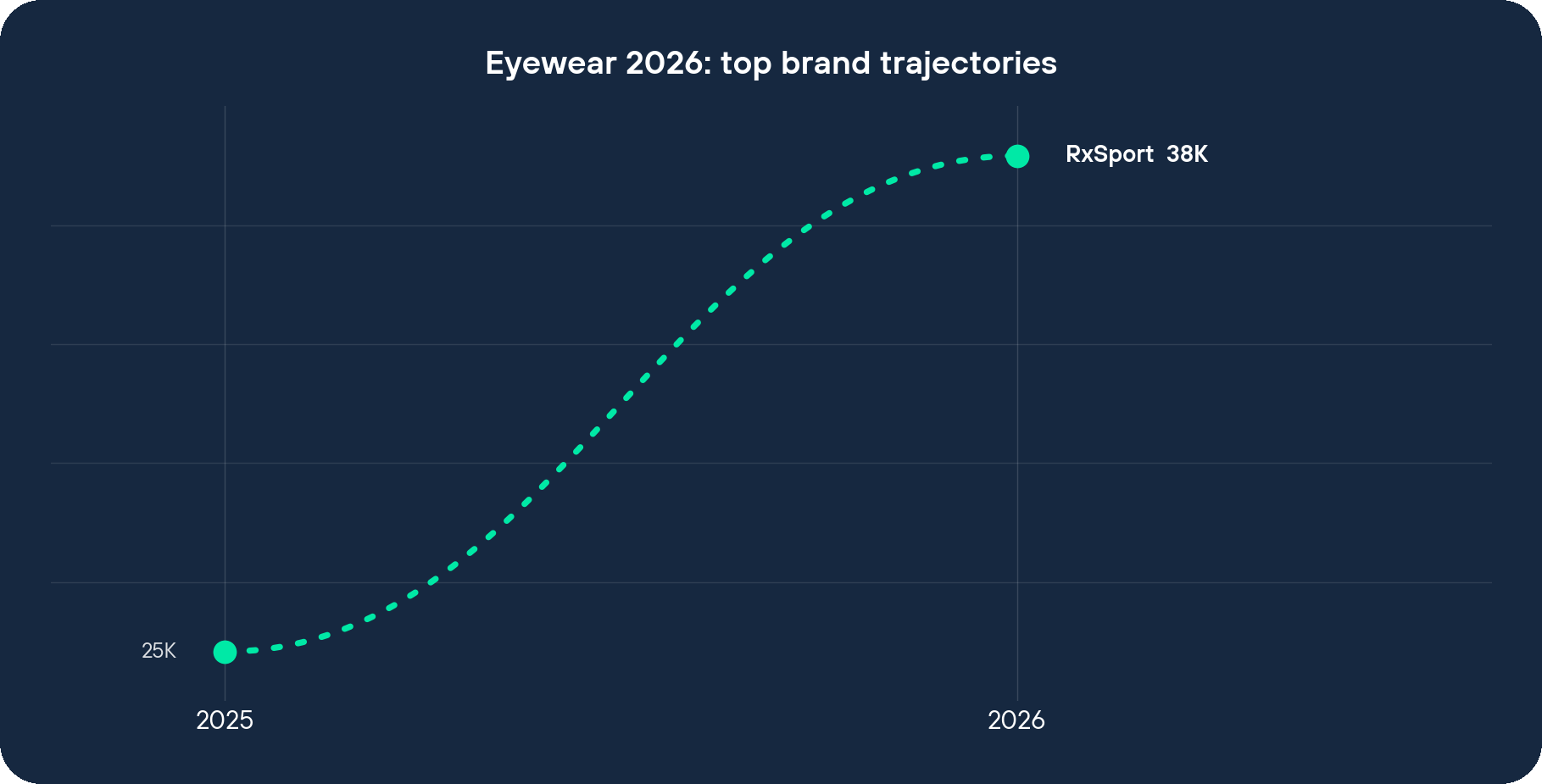
In the 2026 Eyewear Salience Index, RxSport’s traffic score went from 25,396 to 38,446. That is a 51% rise, and a climb from rank 31 to rank 16. It is the largest rank movement inside the top 20 of the index.
They did it without the assets you would normally credit for it. RxSport sits 16th on visibility and 42nd on domain authority, at a score of 32. On referring domains they are 39th, with 263. The report flags them as one of five sites with high visibility and low authority, which is another way of saying they are ranking above what their link profile should buy them.
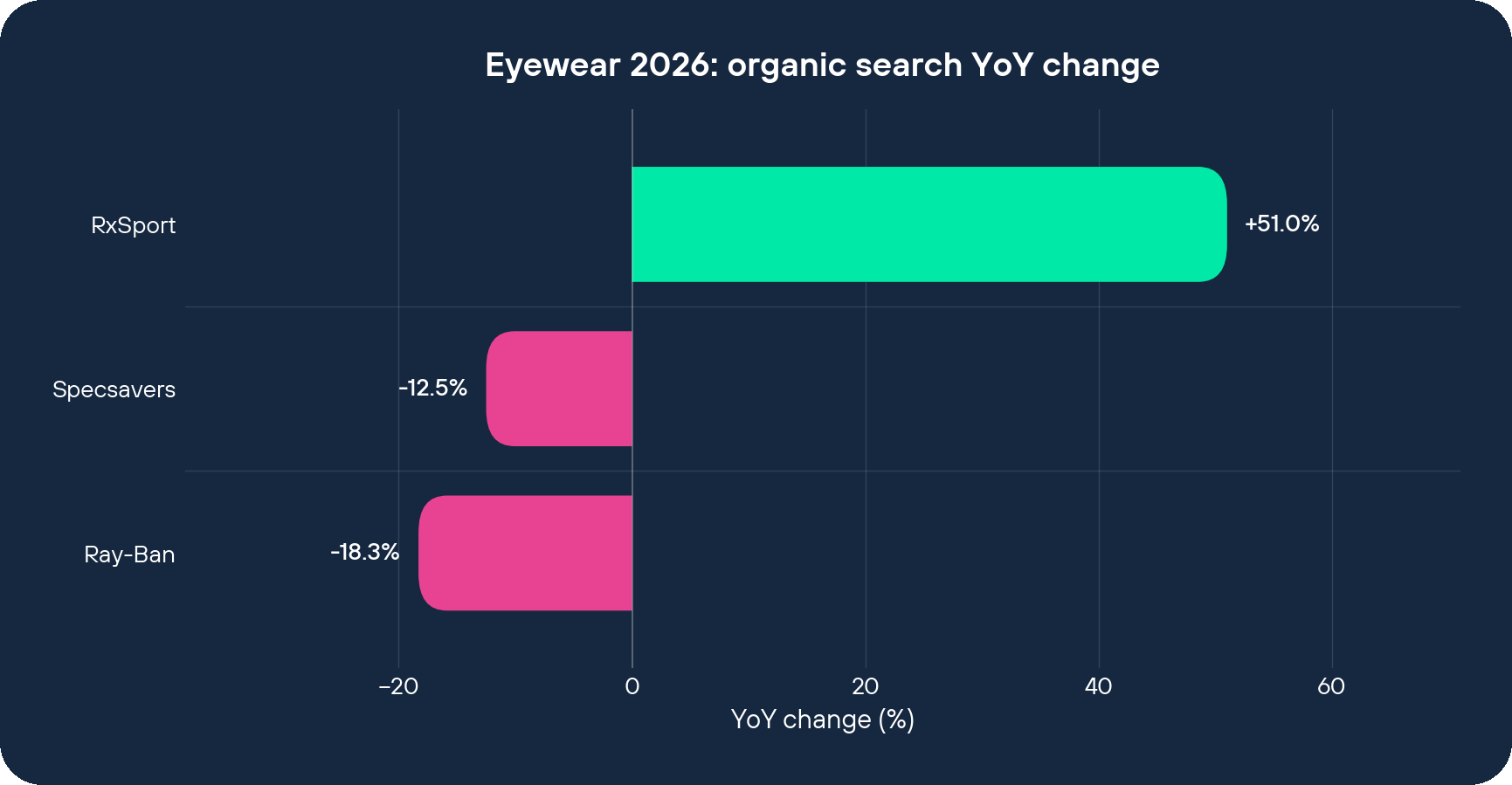
Brand search is small and moving the right way. RxSport draws 2,400 brand searches a month, up 6% year on year, and the report lists them as an emerging brand while Ray-Ban brand search fell 18.3% and Specsavers fell 12.5% over the same period.
Trust is the other half. RxSport is 12th in the review table on 16,528 reviews at an average of 4.9. For context, Vision Express leads that table on 353,195 reviews at 4.6, and Specsavers sits third on 185,419 at 4.5. RxSport has a fraction of the volume and the highest score of any site in the top fifteen.
Now the demand they are sitting on. “Running sunglasses” up 8.7%. “Running glasses” up 8.3%. “Running sunglasses women” up 14.3%. “Running sunglasses for men” up 8.3%. “Prescription running sunglasses” up 26.2%. “Hiking sunglasses” up 48.9%. “Shield sunglasses” up 52.8%. Every one of those is a query that names a sport or a lens constraint.
One decision most retailers avoid
RxSport made one decision that most eyewear retailers avoid, because it makes merchandising harder.
They decided the sport is the category and the sunglasses are the attribute.
That sounds like a small inversion. It is not. It means every product has to be classified by what it is for rather than only by what it is, which is slower to set up, harder to maintain and impossible to copy from a supplier feed. It also means the shop answers the question the customer actually arrived with.
Look at how they say it themselves: “We are the experts in complex wraparound lenses, prescription inserts and finding the best lens for your activity. We achieve solutions you simply cannot find on the high street.” That is a constraint pitch. There is no mention of style, no mention of price, and no mention of a designer name.
How the site is built
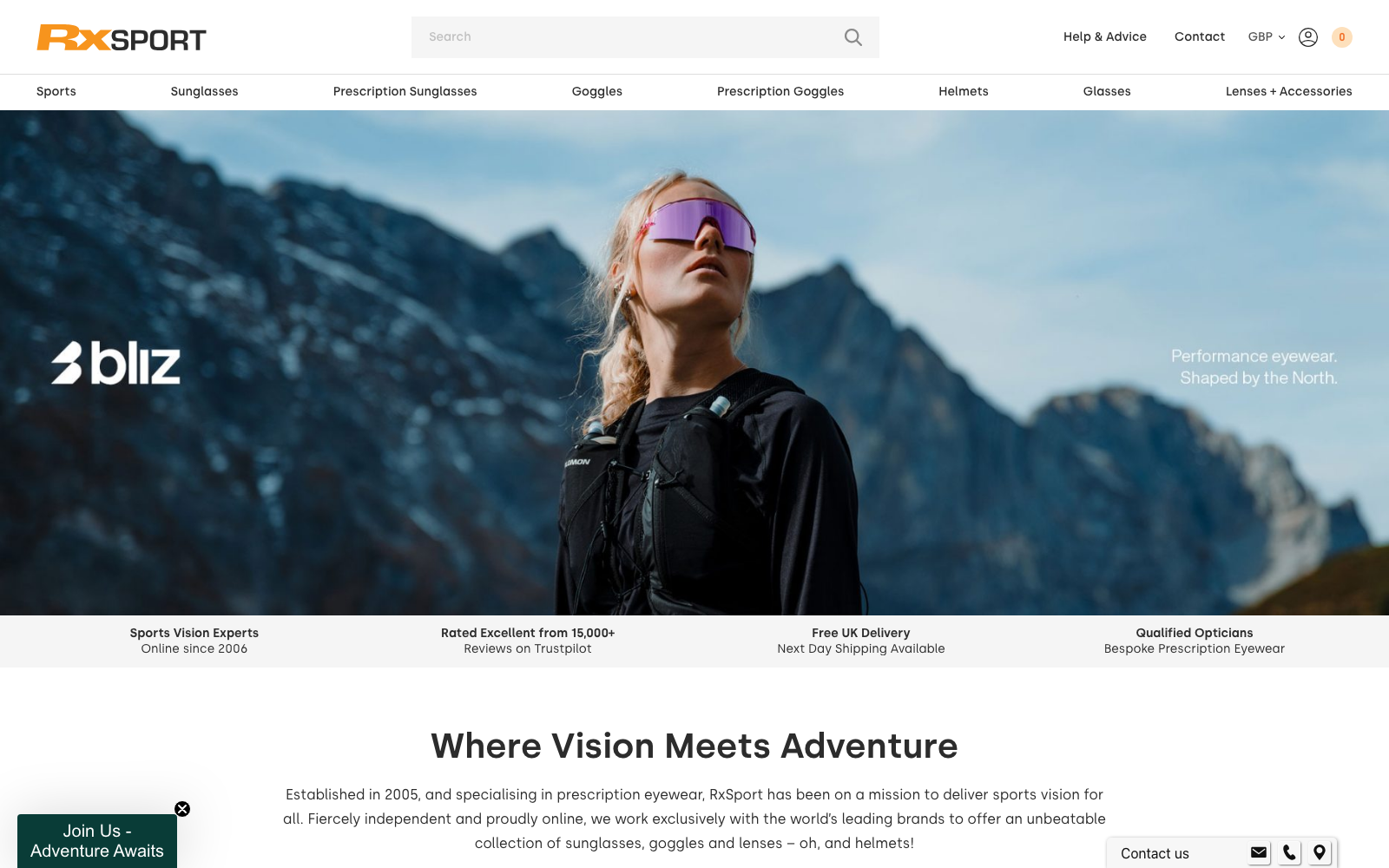
Open rxsport.co.uk and the philosophy is visible before you read a word of copy.
The primary navigation is Sports, and under it sit fourteen activities. Gender, brand and New In all come later. Fourteen sports, each with its own route into the catalogue.
Then look at what happens one level down, because this is the clever part. The URLs run as a matrix. There is a running category. Inside it there is a running sunglasses page. Next to that there is a running prescription sunglasses page. The same pattern repeats for cycling, for snow and for tennis: cycling sunglasses and cycling prescription sunglasses, ski sunglasses and prescription ski sunglasses, tennis sunglasses and tennis prescription sunglasses.
So the site has a page for “running sunglasses” and a separate page for “prescription running sunglasses”. Those are two different queries in the trend data, growing at 8.7% and 26.2%. Most retailers have one page, and it is called Sunglasses.
The prescription layer runs all the way through rather than sitting at checkout. There is a prescription sunglasses tree with its own brand splits. There is a prescription lenses section. There are prescription sunglasses inserts, prescription goggle inserts, prescription ski goggles and prescription MTB goggles. Inserts alone are a product line built entirely around one constraint: my prescription will not fit a wraparound, so give me a frame behind the lens.
Now the shape navigation, which quietly tracks the trend data. Their Shop by Shape options are Wraparound, Full Frame, Half Rim, Lifestyle and Shield. In our keyword set, “shield sunglasses” rose 52.8% and the wraparound cluster held almost flat at a fall of 0.4% while the whole market fell 13.7%. Meanwhile the shapes most eyewear sites lead with, round and square, fell 22.3% and 25.3%.
Then look at the reassurance layer, because high-consideration eyewear lives or dies on doubt. There is a seven-day home trial. There is the RxPromise, which offers a remake, an exchange or a full refund within thirty days if the vision in your prescription eyewear is not right. There is a Sunglasses Guide, a Prescription Guide, a Varifocal Guide, a Goggle Guide and a Prescription Goggle Guide. The homepage carries “Qualified Opticians”, “Sports Vision Experts”, “Online since 2006” and “Rated Excellent from 15,000+ reviews on Trustpilot” above the fold.
Each of those answers a specific objection. Will the lens be right for my sport. Will a wraparound even take my prescription. What happens if the vision is wrong. Who is behind this, and have they done it before.
One more detail worth stealing. Their designer glasses range links out to a separate site, tortoiseandblack.com. They have taken the part of the market that is falling fastest, the designer and fashion end, and moved it off the main domain. That fall is part of a wider move away from the big designer labels, which we looked at in more detail when we asked why shoppers pick independent eyewear brands. Whatever the commercial reason, the effect is a site that says one thing.
What this means for everyone else
If RxSport is winning for these reasons, the implication for everyone else is annoying, because more content will not fix it.
The answer is that your category tree is the deliverable. Filters are not a substitute for it. A filter called “Sport” inside a Sunglasses page does not rank, does not get linked, and does not exist as far as search is concerned. A page called Running Prescription Sunglasses does all three. Deciding which of those exist as pages is the work in ecommerce category architecture and faceted navigation.
It also resets what counts as a content brief. Guides, inserts, prescription pathways, activity hubs and lens explainers are the content here. The blog is optional. The taxonomy is not.
And it makes prescription a front-door decision rather than a checkout step. The fastest growing queries in this sector all carry a prescription or a fit constraint in them. If a customer has to browse your whole frame range before you address the only thing they came to ask, you have put your merchandising ahead of their question.
What the data cannot prove
Two things are true at once here.
First, traffic score is a modelled metric built from rankings and search volume with click-through assumptions. It is not analytics data, and RxSport’s 51% is a rise in estimated organic traffic rather than a rise in revenue we can see.
Second, nothing in this dataset proves the sport-led navigation caused the growth. We cannot map keywords to brands in this report, so the connection between the rising activity queries and RxSport’s rise is consistent rather than proven. What we can say is that a site built entirely around activity and prescription grew 51% in a year when demand for the category nouns fell 13.7%, and that the sites named after the category rather than the constraint fell 58.9% as a group.
The meeting line version is this. RxSport built a shop for people who already knew what they were doing on Saturday. Everybody else built a shop for people choosing a frame.
RxSport is 16th in the 2026 Eyewear Salience Index. See the full table, free, no email gate. If you want to know whether activity-led navigation pays off outside eyewear, you can compare the same scoring across every Salience Index sector report.
Further reading
- 2026 Cycling Industry Report, Cycling is one of RxSport’s fourteen sports, so the cycling index shows who else is competing for the same activity-led demand.
- 2026 Outdoor Retailers Industry Report, Hiking sunglasses search rose 48.9%, and the outdoor report shows which retailers hold that audience today.
- how product images affect traffic and conversions, Frame and lens choice is a visual decision, and this explains how to optimise product imagery for both search and the shopper who is still unsure.