by Sean
The biggest single move in the whole dataset
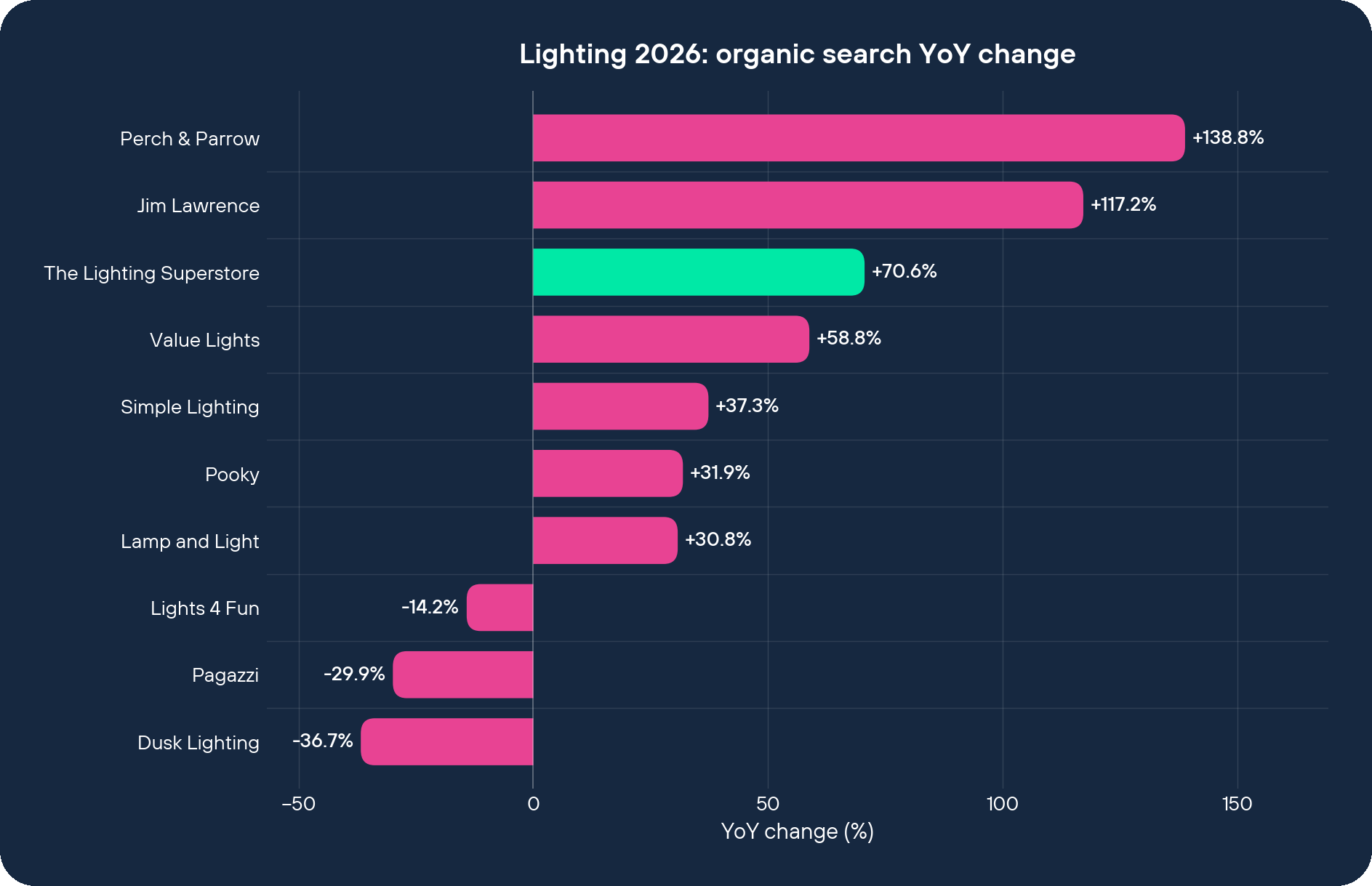
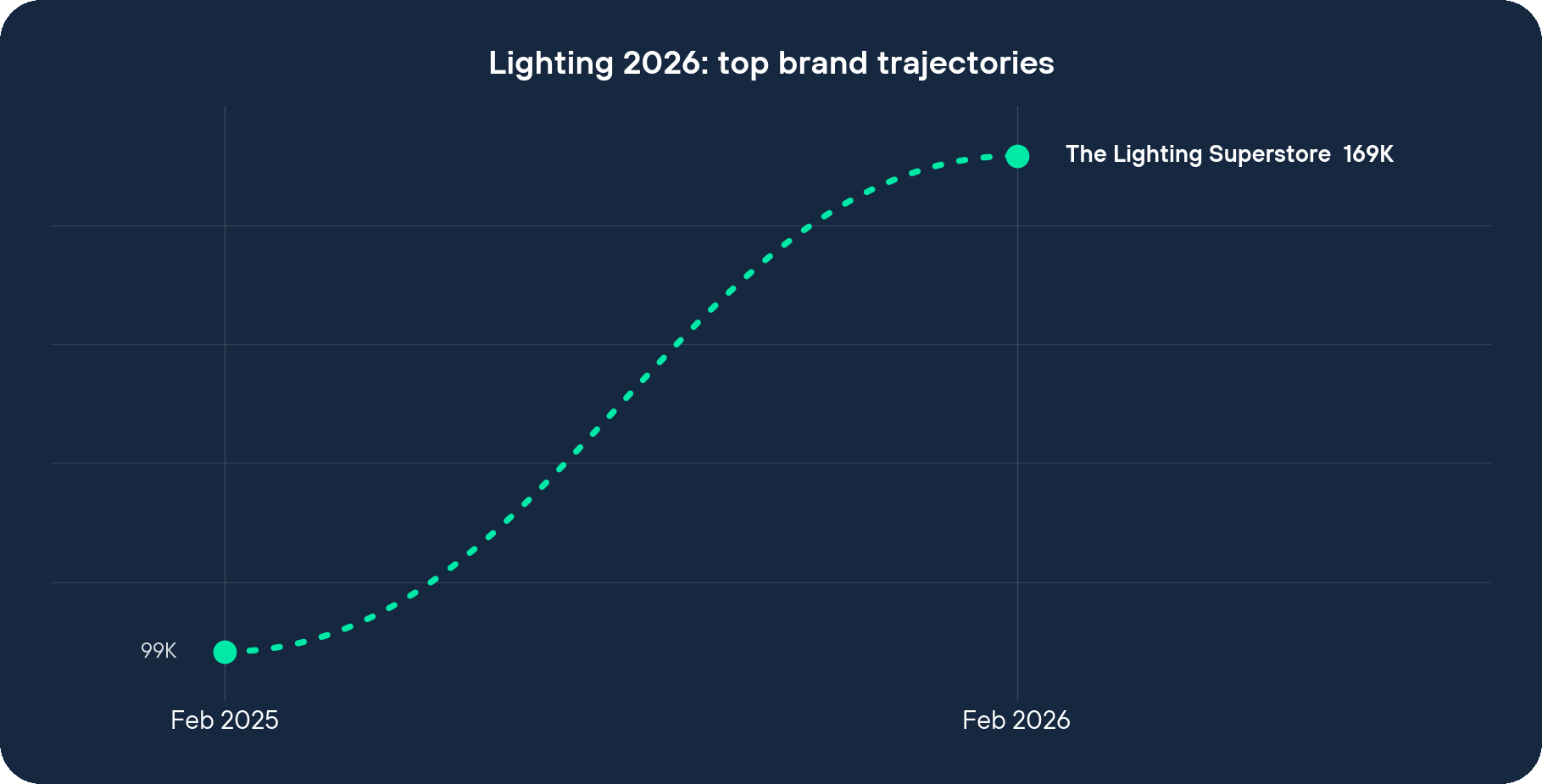
Between February 2025 and February 2026, The Lighting Superstore went from 98,896 to 168,677 in estimated organic visibility, a gain of +69,781 and +70.56% year on year. That is the largest absolute increase of any brand in this dataset of 245, and it was enough to carry the site to the top of the table, the single most-visible lighting brand in the UK, ahead of Lights 4 Fun on 161,411 and Value Lights on 149,511. In a market that grew +11.0% overall, The Lighting Superstore grew at roughly 6.4 times the category rate, finishing +59.56 percentage points ahead of the market. Click below to access the latest Lighting market report.
A jump that size normally has one of two sources: a lot more people started searching for the brand by name, or the catalogue started ranking for a lot more of the generic, non-branded searches that make up most of the demand in lighting. The Brand Reach data tells you which one this was, and the answer is unusually clear.
It reached number one without much of a brand
On the Brand Reach score, branded search volume combined with social presence, The Lighting Superstore ranks 40th of the 50 brands measured, on roughly 880 branded searches a month and a social score of 6.919 that places it 35th on social alone. For scale, Lights 4 Fun sits 6th on Brand Reach with about 14,800 monthly branded searches, and Pooky sits 4th with 22,200. So the brand now sitting at the very top of the visibility table is one that, on the evidence here, almost nobody is actively looking for by name.
First in organic visibility and 40th in brand demand points straight at where the +69,781 came from. Since hardly anyone searches for the retailer by name, the growth is coming from the non-branded category and product searches that dominate this category: queries of the kind “bathroom ceiling lights”, “flush ceiling light”, “LED spotlights” and “outdoor wall light”, where the buyer has a clear intent and no brand in mind. Those are exactly the searches a broad catalogue with well-structured category pages can win, whether or not the shopper has ever heard of the shop.
What the site is built to do
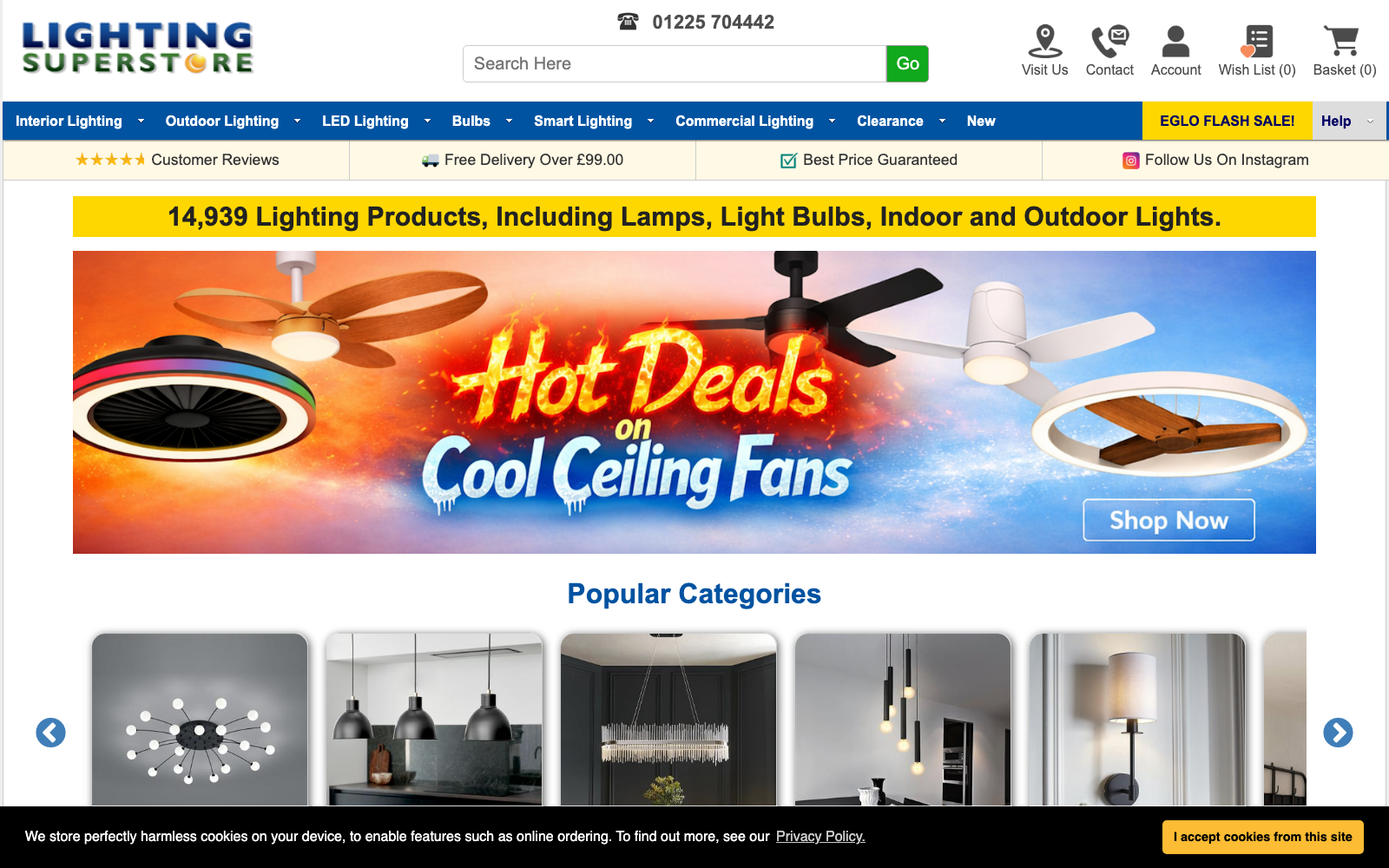
The site is organised the way a catalogue retailer organises when this is the traffic it wants. Navigation is split by product type, ceiling lights, wall lights, table and floor lamps, outdoor and bathroom lighting, LED bulbs, and again by room, with each type broken down into the sub-categories people actually type: flush and semi-flush ceiling lights, pendants, chandeliers, spotlights. The effect is a dedicated, indexable page matching most category-level queries, which is what lets the domain rank across a very wide spread of non-branded intent rather than concentrating on a handful of hero terms, the same approach we take to ecommerce SEO for category and product pages.
The range itself is built on the wholesale trade brands that broad-range UK lighting retailers all draw from, Dar Lighting, Endon, Searchlight, Franklite, carried at scale rather than as an own-design collection, which means the retailer competes on breadth and price on products that dozens of other sites also list. A price promise and a free-delivery threshold sit on top. Put together, this is the value end of the market doing the thing the value end does well: stock nearly everything, structure it for search, and rank for a shopper who is describing a product rather than naming a shop.
The whole value end moved together, and so did the design end
The Lighting Superstore is the biggest mover, but it is not a lone outlier, and that is what makes this look structural rather than lucky. Value Lights, third in the table, added +55,362 (+58%); Simple Lighting rose +37.31% (+11) and Lamp and Light +30% (+17). Four value-positioned retailers climbing together in the same twelve months reads as demand being reallocated, not as one brand having a good year.
What happened at the opposite end sharpens the picture further, because the design-led names grew just as hard: Jim Lawrence +117.15% (+36,212), Perch & Parrow +138.82% (+17,024), Pooky +25,420 (+31.87%). They got there by a different route, though, and the Brand Reach data shows it, Pooky ranks 4th on brand reach with 22,200 monthly searches, Jim Lawrence 10th with 12,100 and a 4.9-star profile across 2,558 reviews. Those brands are attracting searches for their own name and their own designs. The Lighting Superstore is attracting searches for the product. Both ends of the market grew inside a +11.0% year, which means the growth had to come out of the middle.
It did. Pagazzi fell -33,984 (-29.91%), Dusk Lighting -26,736 (-36.74%) and Lighting Direct -20,220 (-13.57%), mid-priced decorative generalists without either a rock-bottom price position or a design identity people seek out by name. Add the rest of that cluster and the middle of the table gave up something like 134,000 in visibility over the year, Lights 4 Fun included.
What this data can and can’t tell you
Before crediting all of this to a clever approach to category pages, it is worth being straight about what a visibility figure captures and what it doesn’t. Estimated organic visibility of this kind moves for reasons that never appear in the number. A brand can jump because it replatformed or restructured its site and Google re-crawled and re-indexed a catalogue that had been under-ranking. It can jump because it expanded its range and now has thousands more product pages competing for position. It can jump simply because the comparison month a year earlier was soft, so a return to normal reads as growth. It can jump on the back of heavy paid search or a brand campaign lifting branded queries, though that last one is hard to sustain here, since branded search is precisely what The Lighting Superstore hasn’t got. Paid spend itself is invisible in this table; this is organic visibility only.
So the honest version is this. The data cannot tell you which of those drivers did the work, and it is almost certainly more than one of them working at once. What it can tell you, and tell you clearly, is the character of the growth: it is non-branded. Whatever combination of replatforming, range expansion, an easy comparison or genuine search investment produced the +69,781, it produced it by ranking for category and product searches, not by making the brand more famous, because on the Brand Reach numbers the brand is barely more searched-for than the retailers ranked in the 40s. That is a narrower, more defensible claim than “their strategy is working”, which this dataset on its own can’t support.
What Lights 4 Fun shows by comparison
Lights 4 Fun is the useful counter-example, because it has the brand The Lighting Superstore lacks and the trend The Lighting Superstore reversed, we have written before about how Lights 4 Fun built its lighting brand. It ranks 6th on Brand Reach with around 14,800 monthly branded searches and 4,886 reviews at 4.5 stars, and its homepage is unmistakably its own: festoons, TruGlow® flameless candles, the Brixham leather-handle lantern range, fairy lights, garden solar stakes, a decorative, seasonal identity that customers return to by name. On the dashboard its year looks survivable, down only -14.19% and still second in the entire table at 161,411. But that -14.19% is -26,693 in lost visibility against a market that grew +11.0%, which works out at -25.19% relative to the category: a genuine loss of share that a headline percentage makes look like a mild dip. Lights 4 Fun held on to its brand and its decorative niche and still surrendered ground on non-branded category search, and it is that same non-branded category search, the shopper describing a product, not naming a shop, that The Lighting Superstore captured on its way to the number one position with almost no brand demand of its own.
The full picture behind these numbers is in the complete lighting market report, which shows where all 245 brands landed over the year. If your own range could be ranking for more of the non-branded product searches that carried The Lighting Superstore to the top, or if a replatform or a slow re-index is holding your catalogue back, our organic search and technical SEO support covers both the ranking work and the technical health behind it.
Further reading
- our 2025 lighting industry analysis, It gives the wider view of the UK lighting market that sits behind this single brand’s rise to the top.
- our 2026 home furnishings report, Lighting buyers are usually furnishing rooms, so this adjacent report shows how the same non-branded demand plays out across home interiors.
- our curtains and blinds market report, This covers another decorative home category where value retailers and design-led brands compete for the same shoppers.