by Sophia
Organic search is still where the revenue is. In our own client data, Google organic still brings in far more revenue than AI assistants do.
So it’s no surprise that most new clients come to us wanting to rank for the biggest keyword in their market. It’s an understandable goal, but for most sites, it’s the wrong place to start.
Want more from organic search? See our SEO services.
In short
- Start with what the business wants to sell, then filter keywords against it.
- Judge each keyword on intent, value, how realistic page one is, and whether a page can own it.
- Give each keyword group one URL, and fix cannibalisation before writing anything new.
- Park the keywords you drop, and review them every quarter.
A high-volume term is usually the hardest one to win. The sites already on page one have years of links and authority behind them. Chase it too early, and you spend months on a page that never gets past page three.
Meanwhile, smaller keywords that could be bringing in leads sit untouched. And if two or more of your own pages target the same search, they compete with each other, so even well-chosen keywords rank lower than they should.
Below is the process we use on our SEO retainers to decide which keywords earn a URL, which can wait, and which we leave out. You can see more on why Google organic still matters in an AI search world.
We start with commercial priorities, then the keyword tool
Before any data is pulled, we map the client’s commercial priorities: which services or ranges earn the best margins, which have capacity to grow, and which customer segments are worth acquiring.
That map becomes the filter. A keyword only qualifies if the searcher could plausibly become one of those customers, judged against the site’s real conversion point. For lead generation, that’s a booked call or a form fill. For retail, it’s an order from an in-stock range with a healthy margin.
What types of keywords are there?
With the filter applied, we classify what’s left by intent type, because each type maps to a different page template. Volumes are UK monthly searches from Ahrefs, November 2026 (estimates).
| Type | Example keyword | Monthly searches | Page it usually needs |
|---|---|---|---|
| Service | keyword research services | 700 | Service page |
| Local | seo chester | 300 | Service page with clear location details |
| Long tail | how to find long tail keywords | 250 | Section within a guide |
| Question | what is keyword mapping | 150 | Guide or article |
| Brand | [brand name] seo | Varies | Homepage or brand pages |
How do you know a keyword is worth chasing?
Each remaining keyword is then assessed on four criteria.
1. What does the searcher want?
The wording of a keyword only tells you so much. To understand what someone wants, we look at what Google already shows for it.
For each keyword, we check page one and note what kind of pages rank there (service pages, guides, category pages, or tools) and which search features appear. If most of the results are guides, Google sees the search as a request for information. A service page will struggle to rank there, however good it is.
2. What’s a visit worth?
Volume is a proxy for demand. Cost per click is often the better signal of commercial worth, because it reflects what advertisers are willing to pay for that traffic. A low-volume, high-CPC term will frequently outperform a high-volume term nobody bids on.
We also weigh funnel position. In the UK, ‘walk in shower’ (around 18,000 searches a month) comes mostly from people shopping for one. ‘How to clean shower glass’ (around 12,000) is more often from people who already have one.
Both have value, but they should be measured against different KPIs. For the first, it’s sales. For the second, it’s the authority the page passes to product pages through internal links.
3. Can we realistically get onto page one?
We look at the individual pages that rank, as well as the strength of the websites behind them.
For each result on page one, we check how many other websites link to that page, how closely its title matches the search, and whether any smaller sites have made it into the top ten. If one or two weaker sites are ranking well, there’s room to compete.
We also account for SERP layout. Once ads, AI Overviews, and shopping or comparison modules have taken their share, the first organic result can sit well below the fold. A position three may deliver far less click-through than you’d expect.
So, we build up. We win the specific, commercial terms first, use those pages to earn links and authority, and target the head term once the site can support it. The big keyword stays on the plan, just not at the top of it.
4. Is there a page that can own it?
Every keyword we keep needs one clear home on the site. If two URLs are already picking up impressions for the same search, there’s a cannibalisation problem to fix before anything new is written.
If a suitable page exists that serves the intent, the keyword goes there. If not, we either plan a new page or let the keyword go.
What does keyword cannibalisation look like, and how do you fix it?
Cannibalisation is one of the most common problems we find when we audit a site. It happens when two or more of your own pages target the same search, so Google has to choose between them. The ranking URL often switches back and forth, and neither page builds enough strength to hold a top position.
It usually creeps in. A blog post written to support a service page starts targeting the same commercial term, a location page repeats the main service page with a different town name, or a site migration leaves the old and new versions of a page both live.
The fix depends on the pages involved. Where two pages cover the same thing, we merge them into the stronger one and 301 redirect the other.
Where both deserve to exist, we re-target the weaker page at a different keyword group and point internal links at the page that should rank. Either way, the aim is one clear page for each search term.
The keywords we ignore, and why
Deciding what to leave out matters just as much as deciding what to keep. In our experience, the keywords we drop tend to fall into one of two groups.
Big terms with too many meanings
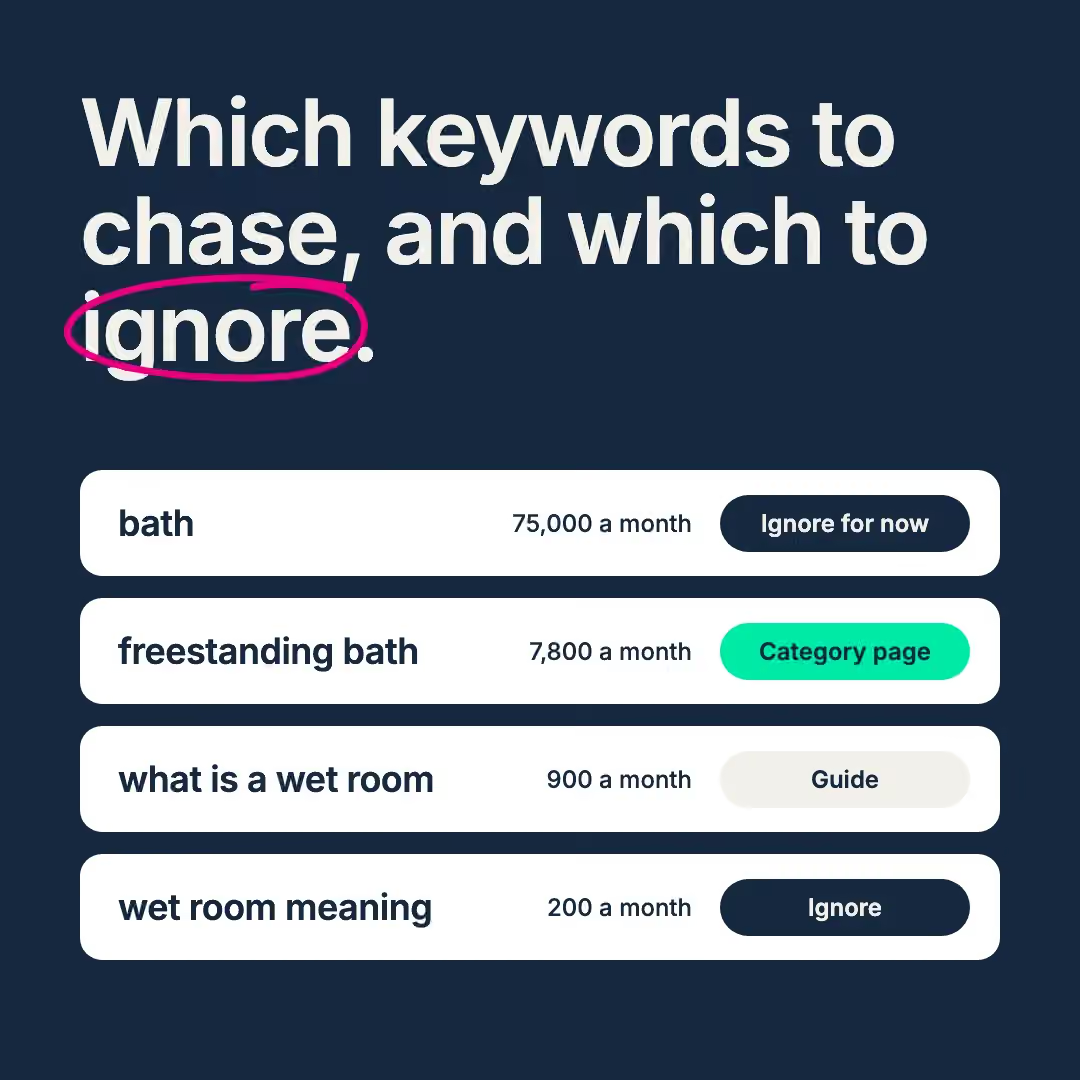
Take ‘bath’. In the UK it gets around 75,000 searches a month, which makes it look like an obvious target for a bathroom retailer. The problem is that the people searching could want the city, a bathtub, or bath products.
The more specific terms are far smaller, but they’re much clearer. ‘Freestanding bath’ gets around 7,800 searches a month, and ‘p shaped bath’ gets around 2,700. In both cases, you know exactly what the searcher is after.
Questions with no route to a product or service
Definition searches are a different problem. ‘Wet room meaning’ gets around 200 searches a month, and the people searching usually want a one-line answer before they leave.
‘What is a wet room’ (around 900) looks similar, but it tends to come from people planning one. It can lead naturally into a guide that links to wet room products. We cover the second and skip the first.
None of this is permanent. We keep dropped keywords on a parked list and look at it again every quarter. As a site builds authority, it can start to win terms that were out of reach a year earlier.
A worked example: a bathroom retailer
To show how this plays out, here are some keywords a UK bathroom retailer might consider, and where each one would land after the four checks. Volumes are UK monthly searches from Ahrefs, November 2026 (estimates).
| Keyword | Monthly searches | What the searcher wants | Our decision |
|---|---|---|---|
| bath | 75,000 | Unclear: the city, a bathtub, or bath products | Ignore (for now) |
| bathroom suites | 10,000 | To buy a full suite | Category page |
| freestanding bath | 7,800 | To buy a specific type of bath | Category page |
| walk in shower ideas | 4,000 | Inspiration before buying | Guide linking to products |
| p shaped bath | 2,700 | To buy a specific bath shape | Category page |
| walk in shower enclosure | 1,500 | To buy | Category page |
| what is a wet room | 900 | To understand before planning one | Guide linking to products |
| wet room meaning | 200 | A quick definition | Ignore |
How to do SEO keyword mapping with your own keyword list
If you want to try keyword mapping on your own site, you don’t need any special tools to get started. A keyword export and an honest look at page one will get you most of the way.
- Write down the services or ranges you most want to grow, and the customers behind them.
- Remove any keyword that couldn’t lead to one of those customers.
- Search each remaining keyword and note what type of page Google shows.
- Rank what’s left by value and by how realistic page one is, with volume as one input.
- Group keywords with the same intent and give each group one URL.
- Park the rest and review the list every quarter.
If you would like a second opinion on your keyword list, or would rather we run the whole process for you, talk to us. If you suspect your site has deeper problems, a free SEO audit is often the better place to start.
SEO keywords: common questions
How many keywords should one page target?
Ideally, one main keyword group, plus the close variations that bring up the same results. If two groups show different types of pages on Google, that’s usually a sign they need different pages on your site too.
Is search volume still worth looking at?
Yes, as one input among several. Volume figures from keyword tools are estimates. On their own, they tell you nothing about what a searcher wants or whether you can realistically rank.
How long does it take to rank for a new keyword?
It depends on how competitive the search is and how much authority your site already has. Ahrefs research found the average page ranking first on Google is around five years old (2023 data). Competitive terms usually take a long time to win. Specific, less competitive keywords on an established site can move much faster.
Do keywords still matter with AI search?
Yes. AI Overviews and AI assistants still respond to what people type or ask, so the words your customers use still shape where you appear.
What has changed is the value of simple informational searches. Ahrefs found that when an AI Overview appears, the click-through rate for the top-ranking page falls by around 58% (estimate, December 2025 data, published May 2026). So we give more weight to commercial and comparison searches than to quick definitions.

Talk it through with Owen.
Book a free discovery call. We’ll look at your site together and show you what we’d check first.