by Sophia
Every year, someone declares SEO dead. Every year, organic search keeps paying the bills. Between Google organic and AI assistants, Google organic took 98.1% of the attributed purchase revenue across our client portfolio, October 2025 to September 2026.
Want more from organic search? See our SEO services.
In short
- The basics still do most of the work: crawling, intent, titles, structure, speed, links, and local.
- Google says SEO best practices apply to AI Overviews and AI Mode, with no extra requirements.
- The newer work is about the whole results page: SERP features, answers AI can cite, brand signals, and better measurement.
- Fix what Google can see first, then what people read, then where else you appear.
What has changed most is the results page. AI Overviews, product grids, and comparison modules now sit beside, and often above, the blue links.
So which SEO best practices still deserve your time? This guide covers the basics that still work, the newer strategies that matter just as much, and how to turn both into a plan.
Is SEO still relevant in 2026?
Yes. As long as people search, SEO matters. From October 2025 to September 2026, Google organic sent our clients 38.6 million sessions. AI assistants sent 463,211, about 1.2% of that.
AI is growing fast from a small base. AI assistant sessions grew 4.4 times year on year, January to September.
Google’s own guidance settles the rest. It says SEO best practices remain relevant for AI Overviews and AI Mode. There are no extra requirements to appear in either.
SEO in 2026 is the same job, played across more surfaces. Do it well, and you show up on all of them.
The SEO basics that still work in 2026
These are the best SEO practices that stay worth your time. Google uses the same foundations for its AI features as for search overall. Skip them, and nothing newer will save you.
1. Make sure Google can crawl and index your pages
If Google can’t index a page, it can’t rank it. It can’t cite it in an AI Overview either. Google says a page must be indexed and eligible for a snippet to appear in AI features.
Start with the checks Google lists. Allow crawling in robots.txt and on your CDN. Keep important content in HTML text, not locked in images. Link to key pages so they are easy to find.
Then check your sitemap and canonical tags. Verify your site in Search Console to spot problems early.
Planning a replatform? Map your redirects before launch. That is how Schöffel Country protected its rankings through a migration weeks before peak trading. Organic revenue rose 127%.
2. Match search intent before you write a word
Every search has a job to do. Some people want to learn. Some want to compare. Some are ready to buy. Your page has to match that intent.
Look at what already ranks before you brief a page. Then use the words your customers use.
Le Chameau’s organic revenue went from a 13% decline to 58% growth after we named boots the way customers search for them. In our Salience Index, Porcelain Superstore grew 60% by turning its keyword set into the shop itself.
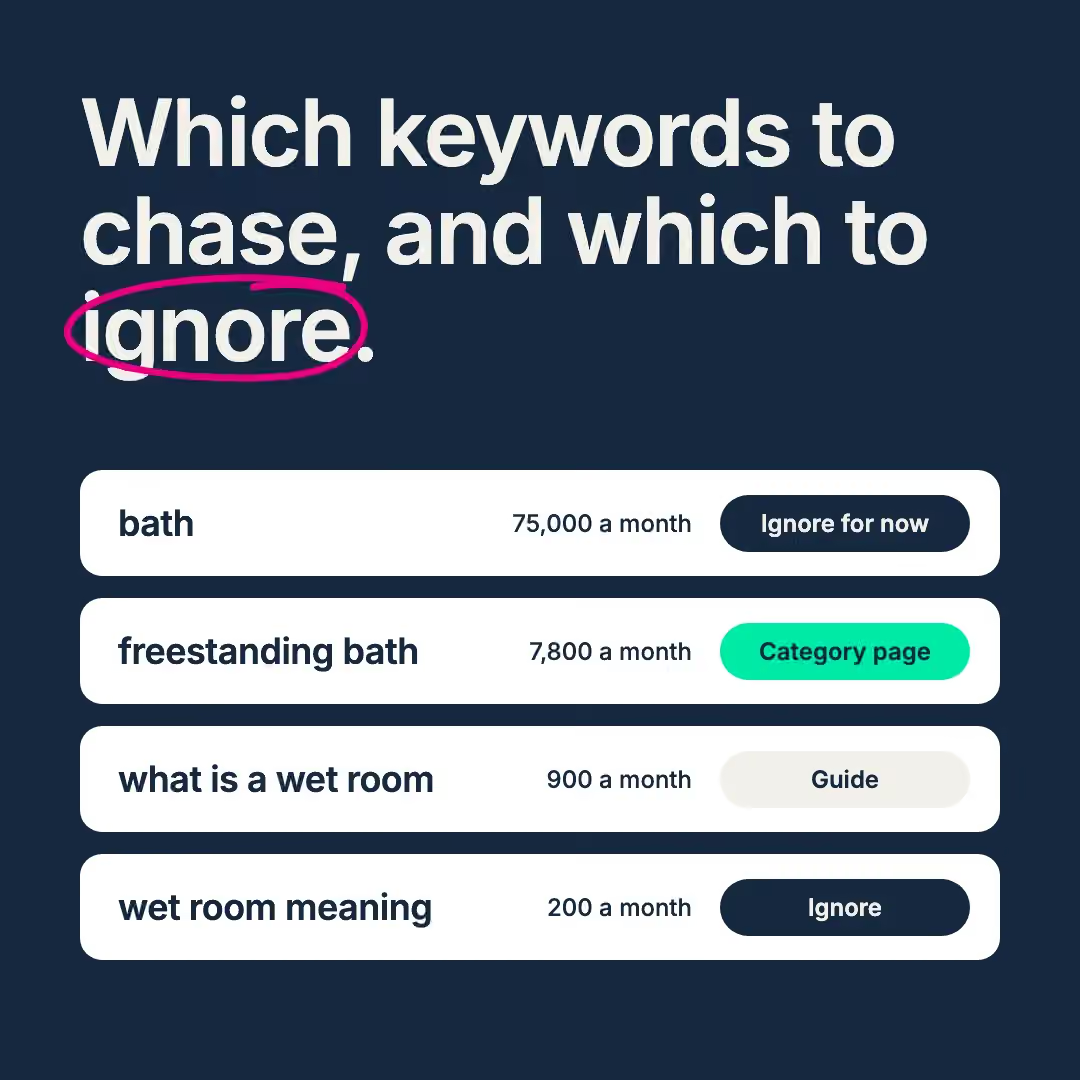
Want the full method? Read how we choose the keywords worth chasing.
3. Get titles, headings, and descriptions right
Your title tag is still the first thing a searcher reads. Keep it to roughly 50 to 60 characters and lead with the term people search for.
Meta descriptions don’t rank you directly. They do shape whether people click. Around 155 to 160 characters suit desktop.
Give each page a single H1. Let your H2s and H3s break the topic into the questions your reader is asking. Use your keywords where they read naturally, so Google understands how the page fits together.
4. Build a site structure and internal links that make sense
Internal links tell Google which pages matter and how they relate. Google lists crawlable internal links as an SEO fundamental for AI features too.
Write anchor text that tells people where the link goes. Skip the generic “click here”. Then check how deep your key pages sit. The fewer clicks from the homepage, the better.
Group related content into topic clusters. Link each supporting article back to the page it supports. Our content marketing team builds every editorial plan this way.
5. Keep pages fast and stable
Speed and stability still count through Google’s Core Web Vitals. The targets are simple to remember:
| Metric | What it measures | Good |
|---|---|---|
| Largest Contentful Paint (LCP) | Loading speed | 2.5 seconds or less |
| Interaction to Next Paint (INP) | Responsiveness | 200 milliseconds or less |
| Cumulative Layout Shift (CLS) | Visual stability | 0.1 or less |
Test on mobile first. Google has indexed sites with its smartphone crawler since July 2024.
6. Earn links people click
One link from a respected, relevant site in your sector is worth more than a pile of low-quality ones. Bought links and keyword-stuffed anchor text can still get you penalised.
The links worth having come from stories journalists want to write. Original data, expert commentary, and useful tools all earn them.
Our digital PR work for Just My Look earned 164 coverage pieces and 119 backlinks at an average DR of 70, July to August 2023.
7. Look after local search
If you serve a place, your Google Business Profile is your shop window. Google tells site owners to keep it up to date.
Google ranks local results on relevance, distance, and prominence. Keep your name, address, and phone number identical everywhere they appear. Add your services, photos, and regular posts too.
The newer SEO strategies that matter just as much now
These are the SEO trends that have moved from optional to essential. Each builds on the basics above. None replaces them.
8. Measure your share of the whole results page
Rank tracking alone no longer tells the full story. In one retail market, the first organic result’s average position improved from 1.66 to 1.43. Organic share of page one fell from 81% to 75% in the same year.
We looked at eight UK keyword universes across six sectors in July 2026. Organic share of page one fell in every market, by 3.6% to 10.4%. Product grids fired on 89% to 94% of commercial searches. AI Overviews fired on 40% to 100% of research queries, depending on the market.
Track which features fire in your market and how often you appear in each. That thinking is why we rebuilt the Salience Index around the surfaces that shape demand.
9. Write so AI can find, lift, and cite your answers
AI Overviews and AI Mode may run several related searches across subtopics to build one answer. Google calls this “query fan-out”. Pages that clearly answer each sub-question give it more to cite.
Write every section so it still makes sense when lifted into an AI answer. Open with the answer. Frame headings as the questions people type. Lists, tables, and short definitions are easy for AI systems to pick up and quote.
Skip the tricks. Generative engine optimisation (GEO) tactics such as an llms.txt file are not worth your time for Google. GEO done properly is good SEO, structured for answers.
10. Show real experience and expertise
E-E-A-T stands for Experience, Expertise, Authoritativeness, and Trustworthiness. Google doesn’t treat it as a single ranking factor, but its systems still look for the signals behind it.
Google’s core advice hasn’t moved. Create helpful, reliable, people-first content. A specific answer for a named audience beats another generic overview.
Show your working. Put a real name and real credentials on every article. Add what you’ve seen first-hand and what your own data shows. Say something no other page says, and get the facts right. That gives AI a reason to cite you.
Your own data is the easiest win, because nobody else has it. That is why we publish free sector reports.
11. Build your brand beyond your own website
AI answers draw on far more than brand websites. In our pet food research queries, Reddit appeared in 27% of AI Overviews. Forums, marketplaces, and comparison engines now hold many retail surfaces.
Get your brand talked about off-site too: press coverage, podcast guest spots, video, and the directories your sector trusts.
Brand demand is measurable. Bloom & Wild’s name is now searched as often as “flower delivery”.
12. Fix your measurement before you change anything
You can’t improve what you can’t see. In our data, only 22% of AI assistant sessions carry a referral medium. A report that filters on referral traffic misses more than three-quarters of them.
Clicks from AI Overviews and AI Mode count within Search Console’s Web performance data. Since 31 August 2026, Search Console also has a generative AI performance report for all sites. It shows impressions only, with no clicks or queries.
Check what your GA4 is recording. Then review the numbers monthly.
Rankings are only part of the picture. Report on organic conversions and revenue too. For lead generation sites, that means qualified leads and the pages that produce them.
13. Use AI tools for speed, and people for judgement
When people ask for the best AI SEO tools 2026 has to offer, we start with measurement.
| Tool | What it shows | Watch out for |
|---|---|---|
| Google Search Console | Clicks and impressions, including AI Overviews and AI Mode | AI features aren’t split out in the main report |
| Search Console generative AI report | AI feature impressions by page, country, and device | Impressions only, no clicks or queries |
| GA4 | Sessions and conversions from AI assistants | Most AI sessions aren’t tagged as referrals |
| Ahrefs Brand Radar | Brand mentions in AI answers, with custom prompt tracking | Paid add-on to an Ahrefs plan |
Be careful with AI-written content. Google says AI is useful for research and adding structure. Using it to produce many pages without adding value may breach its scaled content abuse policy. Google also says to fact-check and review all AI-generated content by hand before publishing.
Let AI take the repetitive work. Keep strategy and judgement with your team.
How to turn these SEO tips into actions for your business
If you’re asking how to rank in SEO in 2026, work in this order. Fix what Google can see, then what people read, then where else you appear. Here is your 2026 SEO plan, step by step.
| Stage | Action | Why it matters |
|---|---|---|
| Fix | Check Search Console for indexing and crawl errors. Run your key templates through PageSpeed Insights. | Google can only rank or cite pages it has indexed. |
| Fix | Make sure GA4 records AI assistant sessions and your key conversions. | Most AI sessions arrive without a referral tag. |
| Fix | Ask Google AI Mode, ChatGPT, and Gemini the questions your customers ask. | You’ll see who gets named today, and whether it’s you. |
| Rewrite | Give every keyword group one target page. Rework titles, H1s, and openings around what the searcher wants. | Pages that match intent earn the click. |
| Rewrite | Rework your top pages so every section opens with its answer. | AI features pull from many related searches, so each clear answer is another chance to be cited. |
| Rewrite | Give every article a named author, a short bio, and Person schema. | Real names and credentials show the expertise behind the content. |
| Build | Group supporting articles into clusters that link back to your commercial pages. | Clusters show search engines how your content fits together. |
| Build | Publish your own data and build digital PR around it. | Original data gives journalists a story and AI a source. |
| Track | Report on SERP features and your share of each, alongside rankings. | In one market, a single feature went from 0% to 77.7% of searches in twelve months. |
One last rule for your 2026 SEO strategy: review it every quarter.
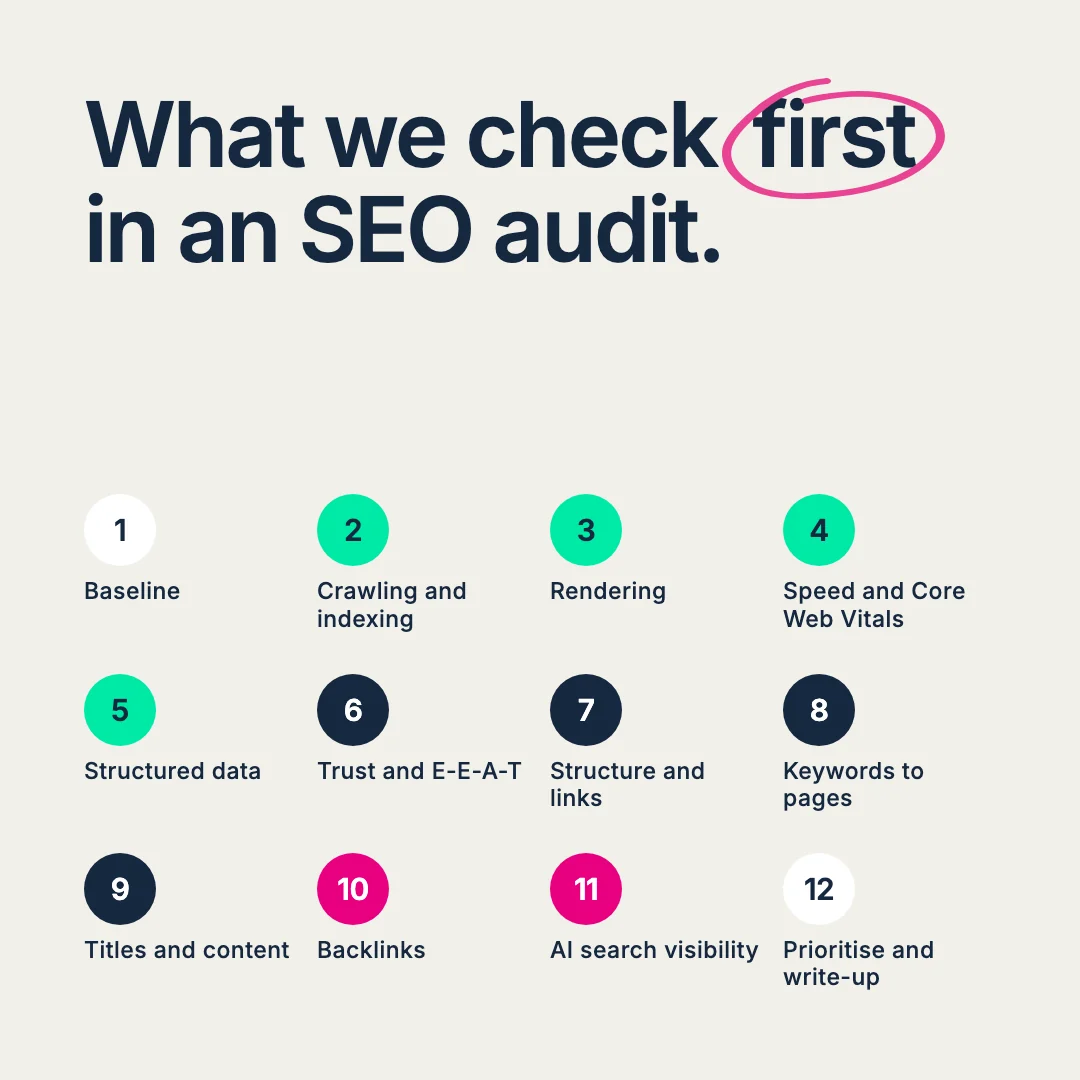
Not sure where to start? Our SEO audit guide walks through the checks in order.
How Salience keeps you ahead of every SEO change
Search changes every few months. Your strategy shouldn’t lurch with it. Here’s how we keep clients on the right side of each shift.
We test the advice against real data. When the industry debated whether GEO was a distraction, we checked the claims against our own client GA4 data. Every change to SEO best practices gets the same treatment.
We measure the whole page. Our SERP research tracks every feature across full keyword universes, beyond the blue links.
We join the channels. SEO, GEO, digital PR, content, analytics, and CRO all sit under one roof. For retailers, our ecommerce SEO team adds product and category expertise.
We have the results to show for it. We won European Search Awards in 2023, 2025, and 2026. We ranked 123rd in the Prolific North Top 150 Agencies 2026. You’ll find more in our work.
We share what we learn. Our Friday email covers what is shifting in search, with the numbers behind it.

Talk it through with Owen.
Book a free discovery call. We’ll look at your site together and show you what we’d check first.
FAQs about 2026 SEO trends
What are the biggest SEO trends in 2026?
Three stand out. AI features now fill more of the results page. AI assistant traffic is growing fast from a small base. Brand signals beyond your own site now shape who gets cited.
Have SEO best practices changed?
Very little. Google says its SEO best practices apply to AI Overviews and AI Mode too. What has changed is how you structure answers and how you measure visibility.
Do I need a separate GEO strategy?
You need GEO measurement built into your SEO plan. Google says no special optimisations are needed for its AI features. Track how often AI Overviews fire in your category and how often you’re cited.
Do I need an llms.txt file or special schema for AI search?
Not for Google. It says you don’t need new machine-readable files, AI text files, or special schema to appear in AI Overviews or AI Mode. Your structured data should match the visible text on the page.
Can I use AI to write SEO content?
Yes, with a person in the loop. Google sees value in AI for research and adding structure. Mass-producing pages that add nothing for users is the risk. Add your own expertise and data, then check every fact before publishing.
The bottom line
The basics still do the heavy lifting. Around them, the results page keeps changing. Get the foundations right, structure your answers, and measure where you appear.
The people searching haven’t changed. They still want an answer they can trust. Write for them first.