 by Michael
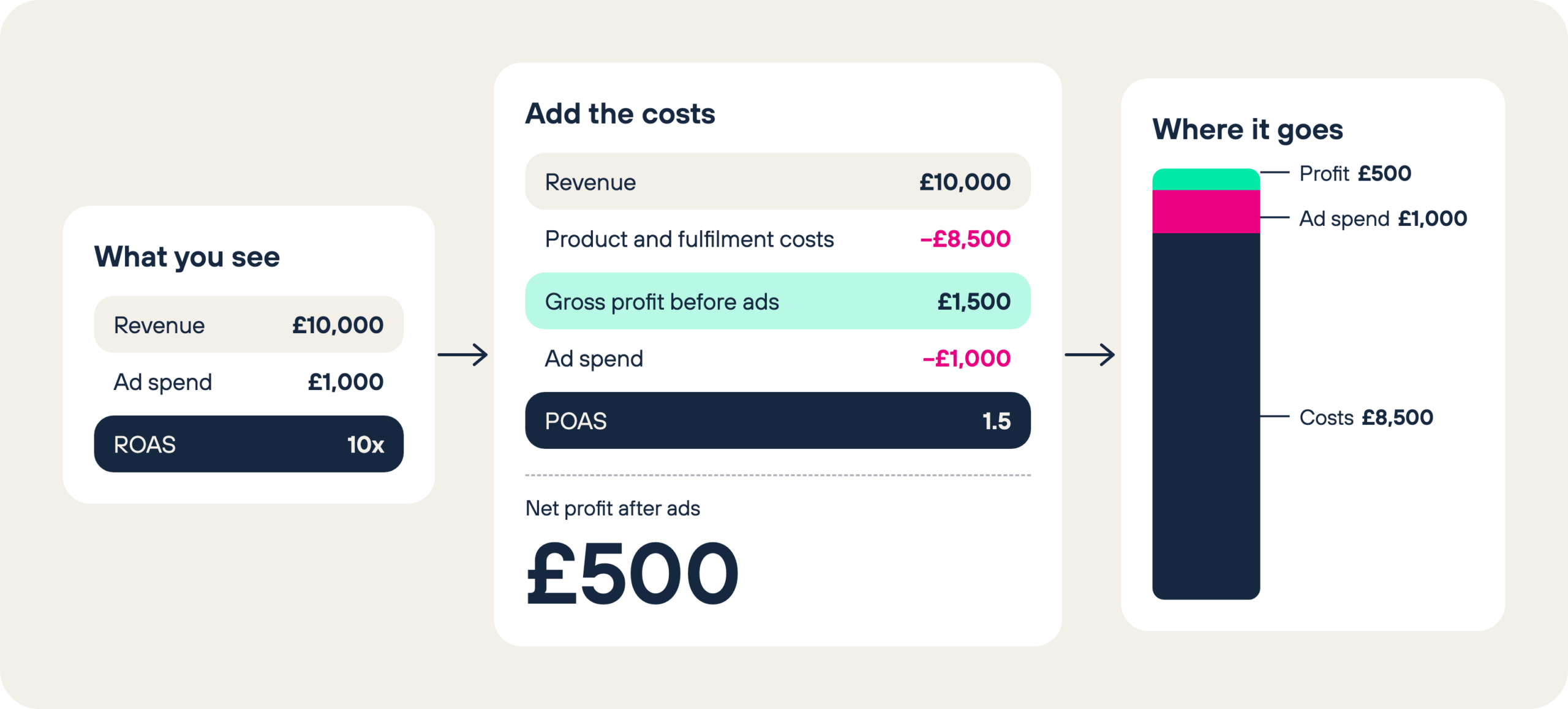
Spend £1,000 on Google Ads and bring in £10,000 of revenue. That is a 10x ROAS, the kind of number that wins a campaign more budget. Now take off the cost of the products, the packing, the delivery and the payment fees. About £1,500 of gross profit is left before ad spend. Take off the £1,000 you paid Google and you keep roughly £500.
Most marketers now accept that ROAS is not profit. We heard it on almost every sales call this summer. Far fewer have changed what their bidding chases. The campaigns still optimise for revenue, the reports still lead with ROAS, and the budget conversation still starts from a ROAS floor.
This post covers that move. It keeps the definition short and spends most of its time on what holds teams back: the data you need, the changes in Google Ads, and how to get finance to agree to a new target.
TL;DR
A 10x ROAS on a 15% margin leaves about £500 for every £1,000 of ad spend. Most teams now agree ROAS is not profit, but their bidding still chases revenue because of default settings, a finance ROAS floor and margin data nobody owns. Close the data gaps, send profit as the conversion value, run POAS beside ROAS for one cycle, then agree a profit floor with finance.
On this page
01 Everyone agrees ROAS isn’t profit. It is still the target
02 One number, defined once: what we mean by POAS
03 Before you switch: the three data gaps that stall most teams
04 Moving Google Ads to profit-based bidding
Everyone agrees ROAS isn’t profit. It is still the target
We had 52 sales calls with 34 ecommerce and retail businesses between June and September 2026. Paid dependency came up in more than half of them. Buyers described spending more each month and getting less back. Very few argued that ROAS was a good measure of profit. They kept using it for three practical reasons.
Smart bidding optimises revenue by default
Google’s value-based bidding maximises whatever number you send it as the conversion value. For most ecommerce accounts, that number is order revenue, because revenue is what the checkout tag passes by default. So a target ROAS strategy does exactly what it is told. It finds the most revenue for the money. It has no idea that a £200 order of low-margin stock is worth less to you than a £120 order of high-margin stock.
The PPC lead at a national online and bricks-and-mortar retailer told us they want to stop smart bidding chasing total gross revenue. They also want to stop the habit of seeing a campaign at 13x and adding budget because the number looks good. That habit is the default setting doing its job.
Finance still signs off on a ROAS floor
At some point, someone in finance asked for a simple rule to control paid spend. A ROAS floor is easy to set and easy to check. Over time it becomes the panic stat: the single number that triggers a meeting when it dips.
The same retailer gave us a clear example. Its finance team gets uneasy when ROAS falls below about 12 or 13, and anything below 8 causes alarm. Nobody we spoke to could say where those numbers came from or whether they still matched the margin mix.
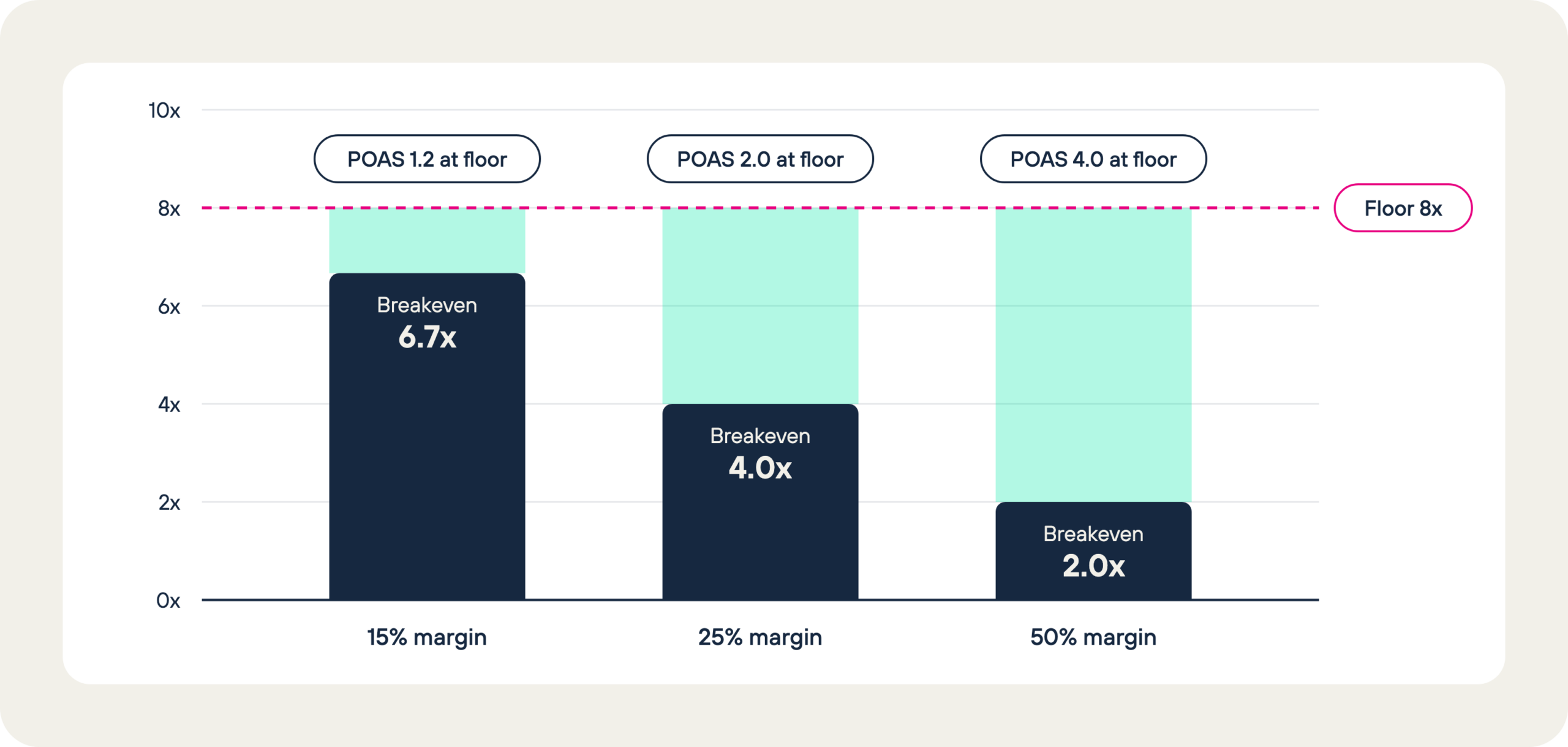
A ROAS floor feels safe, but it can sit well above or well below breakeven, depending on what you sell. At a 15% margin, breakeven ROAS is about 6.7x. At a 50% margin, it is 2x. A single floor across a mixed catalogue will starve some profitable products and overfund some loss-makers at the same time.
Marketing isn’t close enough to margins
Margin data usually sits in finance or merchandising. Delivery costs sit with operations. Returns sit with customer service. Marketing owns the ad account and the revenue tag, and that is often all it owns. So the team with the bidding controls is the team with the least cost information.
For the longer case against ROAS as a target, see why ROAS is killing your business. The rest of this post assumes you already agree and want to do something about it.
One number, defined once: what we mean by POAS
POAS = gross profit after costs ÷ ad spend. 1.0 is breakeven
We use one definition, and we use it everywhere:
POAS = gross profit after product and fulfilment costs ÷ ad spend
Gross profit here means revenue minus the cost of the goods, delivery, packaging, payment fees, discounts and the expected cost of returns. Ad spend is not taken off before the division. At 1.0 the ads paid for themselves and nothing more.
The 10x example, rerun through POAS
Go back to the opening example:
- Ad spend: £1,000
- Revenue: £10,000
- ROAS: 10x
- Gross profit before ad spend: about £1,500
- POAS: 1.5
- Net profit after ad spend: about £500
A POAS of 1.5 means every £1 of ad spend returned £1.50 of gross profit, so 50p of real profit. That is a healthy campaign. It is also a very different story from “10x”, and it tells you how much room you have before the campaign starts to lose money.
Where POAS, contribution margin and breakeven ROAS fit
These three terms describe the same economics from different angles:
- Breakeven ROAS is 1 ÷ your margin. At a 15% margin it is about 6.7x. It is useful when you have to keep reporting ROAS but want a floor that means something.
- POAS shows how much gross profit each pound of ad spend brought in.
- Contribution margin is the money left after ad spend and the other variable costs. In the example, it is the £500.
Our POAS meaning guide goes through each hidden cost type in more detail.
Before you switch: the three data gaps that stall most teams
Most teams that stall on POAS stall here, not inside Google Ads. On our calls, the problem was almost never the bidding settings. It was getting the inputs.
SKU-level margin, and who signs it off
You need a margin figure for each product, or at least for each product group. One retailer we spoke to did not know whether SKU-level margin data existed anywhere in the business. That is common, and you do not need a perfect answer to begin.
Start with margin bands. Ask finance or merchandising to put every product into one of three to five bands, such as under 20%, 20 to 35%, and over 35%. Agree who signs those bands off and how often they are reviewed. Quarterly is enough for most catalogues. Seasonal or promotional ranges may need a monthly check.
Ownership matters more than precision. If nobody signs off the margin numbers, nobody will trust the POAS report built on them.
Costs that live outside marketing: shipping, returns, fees
The cost of goods is only part of the picture. Delivery, packaging, payment fees and returns can take a large share of what looks like margin. An online pharmacy we spoke to described margins of roughly 25 to 28% on general products and 40 to 60% on prescriptions. They also said that everyone in their market loses money on postage. Leave postage out of the calculation and the bidding will favour the very orders that cost the most to fulfil.
A book retailer we spoke to still cannot report POAS. They know how to calculate it. The problem is that the cost data sits in other departments and is hard to get. If that sounds familiar, start with averages. Use an average delivery cost per order, an average payment fee as a percentage, and a returns rate per category. Refine them later. A reasonable estimate beats leaving the cost out entirely.
Conversion tracking clean enough to trust
Profit-based bidding needs reliable conversion data. Several businesses we spoke to could trace only part of their revenue to a source. A fine wine retailer put the figure at about 50%. If half your sales are not attributed, swapping revenue for profit in the tag will not fix the bigger problem.
Before you switch, check three things:
 Purchase conversions fire once per order, with the correct order ID.
Conversion values match your ecommerce platform within a few per cent.
Enhanced conversions or server-side tagging are in place where consent allows.
Our guide on how to set up POAS tracking covers the mechanics step by step.
Moving Google Ads to profit-based bidding
When the inputs are good enough, the change in Google Ads takes five steps.
1. Send profit, not revenue, as the conversion value
There are several ways to do this. Choose the one that matches the data you have.
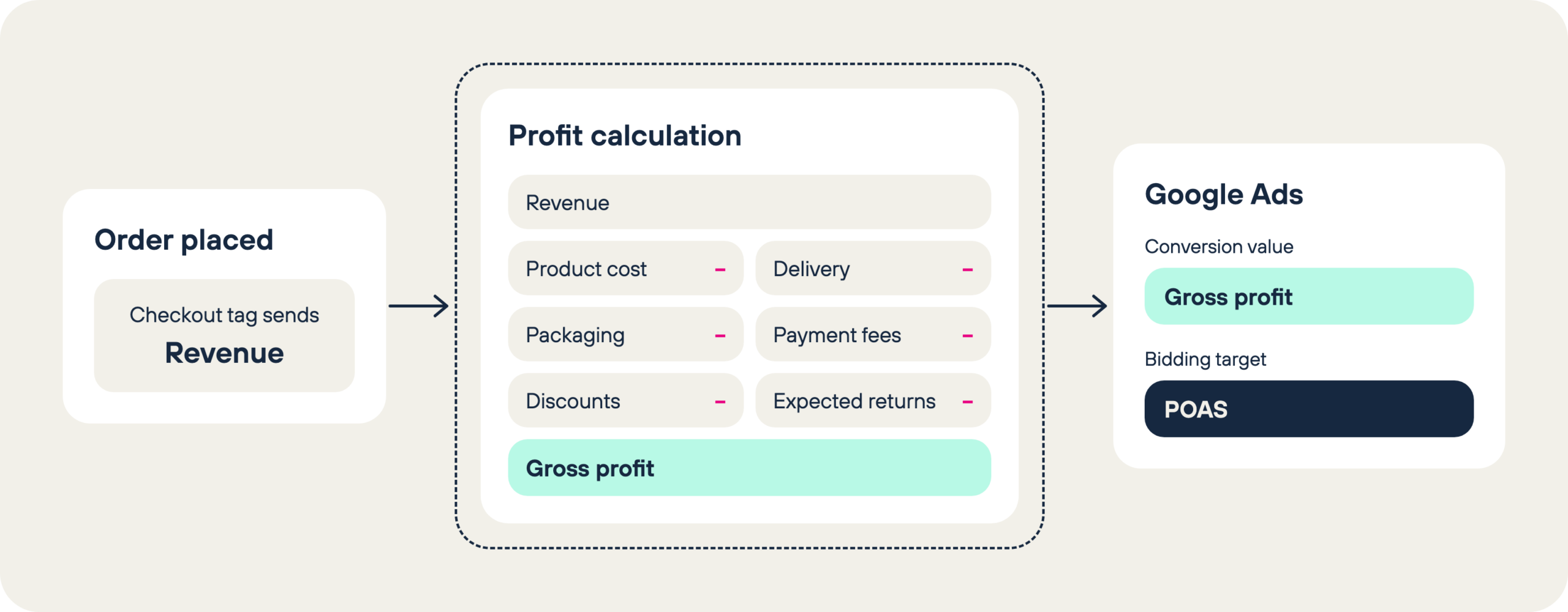
- Cost of goods in the product feed. Add the cost_of_goods_sold attribute to your Merchant Center feed and turn on conversions with cart data. Google can then report gross profit by product. In accounts where Google offers its gross profit optimisation setting, it can also bid towards that profit. Check your own account, because the setting has been released to selected advertisers and not to everyone.
- Profit in the conversion tag. Calculate gross profit for each order on your server or in your tag manager and pass that as the conversion value in place of revenue. This gives you the most control, because you can include delivery, fees and returns. Tools such as ProfitMetrics do this calculation and send the profit value to Google Ads for you.
- Value multipliers by margin band. If you cannot share exact costs, you can still push bidding towards better margins. Conversion value rules adjust values by audience, location or device. Google’s newer product-level value controls, in beta for Performance Max and Shopping since September 2026, let you apply multipliers to product groups such as a high-margin custom label. This is a lighter approach and less exact, but it is quick to set up.
For businesses with a data warehouse, offline conversion imports from BigQuery or a similar tool are another option. Most retailers do not need to start there.
One warning: when the conversion value changes from revenue to profit, the target must change too. A 10x revenue target on a 15% margin becomes roughly 150% on profit. If you keep the old target, the campaign will either stop spending or chase volume you cannot afford.
2. Regroup campaigns by margin band
Use custom labels in the product feed to tag each product with its margin band. Then split Shopping and Performance Max campaigns, or their asset groups, by band. This lets you set a different profit target for products at 18% margin and products at 45% margin. It also shows you clearly which bands make the money.
Do not split so far that each campaign has too little data. Three to five bands is usually right. Smart bidding needs enough conversions in each campaign to learn.
3. Run POAS alongside ROAS for one cycle
Do not switch everything overnight. For one full trading cycle, usually four to six weeks, report POAS and ROAS side by side. If you can, test profit bidding on part of the account first and keep the rest on revenue bidding as a control.
Keep revenue in the account as a secondary conversion so you can still see it. This also gives finance a bridge between the old report and the new one.
4. Replace the ROAS floor with a profit floor
Once you have a cycle of data, agree a profit floor with finance. This is a minimum POAS per campaign or margin band. For example, every campaign must stay above 1.2, and brand campaigns must stay above 2.0. It replaces the single blanket ROAS number.
A profit floor can be written as a breakeven ROAS for each band if finance prefers to keep ROAS language. What matters is that each floor is tied to the margin of the products it covers.
5. Re-check budgets so profitable campaigns are not starved
Revenue bidding often leaves the most profitable campaigns limited by budget, because their ROAS looked average. After the switch, look for campaigns with a high POAS and a “limited by budget” status. Move money towards them, and away from campaigns that sit near or below a POAS of 1.0.
This is often where the quickest gains come from. You are not finding new customers. You are moving money you already spend.
Hancocks grew conversions 436% by breaking its reliance on brand search.
A B2B confectionery wholesaler selling to corner shops and online sweet retailers. We rebuilt non-brand search around Dynamic Search Ads to work like Shopping inside Search, and turned an unreliable setup into a scalable acquisition engine.

Getting finance to sign off
Most finance directors like POAS once they see it, because it is a profit figure and profit is what they report on. The hard part is that ROAS has become a habit, and the first POAS report can look like a step down.
Show one month in ROAS and in POAS, side by side
Take one recent month. Show each campaign’s ROAS, then its gross profit and POAS next to it. In most accounts, the order changes. Some campaigns with a strong ROAS turn out to be breaking even. Some campaigns with an average ROAS turn out to be the best earners.
That one page usually does more than any explanation. It uses numbers finance already owns, the margins, and shows what the ads did with them.
Explain it in their terms, not agency terms
Talk in gross profit, contribution and cash. Avoid acronyms where you can. The PPC lead at the national retailer said they want the case put to finance without the agency talk, as a colleague on the same side, not as a pitch. They also need their commercial teams to understand profit against ROAS by category, because those teams decide what goes on promotion.
In practice, that means:
- Start with the finance team’s own margin figures.
- Show breakeven ROAS for each category so they can see why one floor does not fit all.
- Agree the profit floor together, and write it down.
Agree that spending less can be a win
Moving to profit often means spending less on the campaigns that were only buying revenue. That can look like a cut in ambition. It is better framed as a cut in waste.
The same national retailer believes it could spend about £10m of a £12m allocation and still grow both revenue and profit. A bathroom retailer we spoke to grew revenue by 4% year on year while spending 46% less on paid. Both show how much spend can sit in campaigns that add revenue without adding profit.
Agree in advance that lower spend with higher profit counts as success. Otherwise the first month of lower spend will trigger the old panic stat.
When ROAS is still fine
POAS is the better target for most retailers. It is not the only sensible one. There are cases where ROAS, set correctly, does the job.
A single-margin catalogue
If every product carries roughly the same margin, ROAS and POAS move together. A breakeven ROAS based on that margin will steer bidding almost as well as a full profit setup, with far less data work. Recheck it when the range or the cost base changes.
Short tests and launches
For a new product, a new market or a short test, you may not have reliable cost data yet. A ROAS target is fine for a few weeks while you learn. Set an end date and move to profit once the costs are known.
Owner-run businesses that need a cash-on-cash floor
Some businesses cannot wait for lifetime value or a long payback. A family-run drinks retailer told us they want at least a cash-on-cash return from paid, and they pushed back on agencies setting 8 to 10x ROAS targets with no link to their margins. For them, a simple floor makes sense: every campaign must return more cash than it costs within the month. That is a profit test in its own right, and a breakeven ROAS based on real margin is a fair way to express it.
What a profit-first agency should show you
If an agency manages your paid search, its reporting should include:
Profit floors agreed with you and written into the plan.
POAS by campaign, not only by account.
Contribution margin by category, so commercial teams can see where profit comes from.
Breakeven alerts when a campaign falls close to or below a POAS of 1.0.
Your ownership of the ad account, the data and the strategy documents.
Our blueprint for agency accountability sets out what good reporting looks like. Our PPC agency page explains how we work to profit floors, and why clients can leave if we miss the target for a month.
ROAS looks good. Profit feels good.
Get our thinking on search, every Friday.
Campaign breakdowns, what is actually shifting in search, and the numbers behind the work. One email each Friday, and one click to leave.