Marketing
Experience
Strategy

Invite Us To Pitch
This is where you get your problem fixed. Save your team 12 months of guesswork.
This is where you get your problem fixed. Save your team 12 months of guesswork.

Seasonal Trends

Visibility Vs Authority

Link Acquisition

Content Performance
✅ Free Fitness Equipment Industry Report.
Used by over 9,000 fitness equipment marketers to benchmark performance, spot trends, and guide their SEO strategy.




 10 minutes
Reading time
10 minutes
Reading time
 100+
Brands ranked
100+
Brands ranked
Report Updated March 2026
"I am massively grateful for this report and there aren't many other useful ones I have found for online flower services."
- Arena Flowers, Data Scientist, Aaron Grove
"The report it was very interesting as has been the case in previous years."
- BOX, Marketing Manager, Mike Hart
"Really impressed with the work done behind the research, really well done to the team and Salience"
- Funding Options, , Head of Organic, Sonia Morrison
Visibility across the sector is up 16% year on year, yet four of the top 10 brands are in decline and the gap between winners and laggards is getting wider. This report breaks down the key signals shaping online performance across the category.
What stands out first is how uneven growth has become. The old idea that this is just a rising category no longer holds. Search is rewarding brands that combine breadth, trust and recognisable brand presence, while exposing those still relying on legacy visibility.
That fits the wider shift Salience talks about across its report ecosystem: search is becoming harder to win through rankings alone, and easier to win when your brand is already known, trusted and useful.
The landing page leans into that same point. It frames the market as one where brands need to know who is really lifting the most online, not just who looks established from the outside. That matters in fitness equipment because shopper journeys are rarely short. Buyers compare specs, price points, room size, goals, training style and long-term value. In that sort of market, the brands that keep showing up across generic, branded and research-led searches tend to build the strongest momentum.
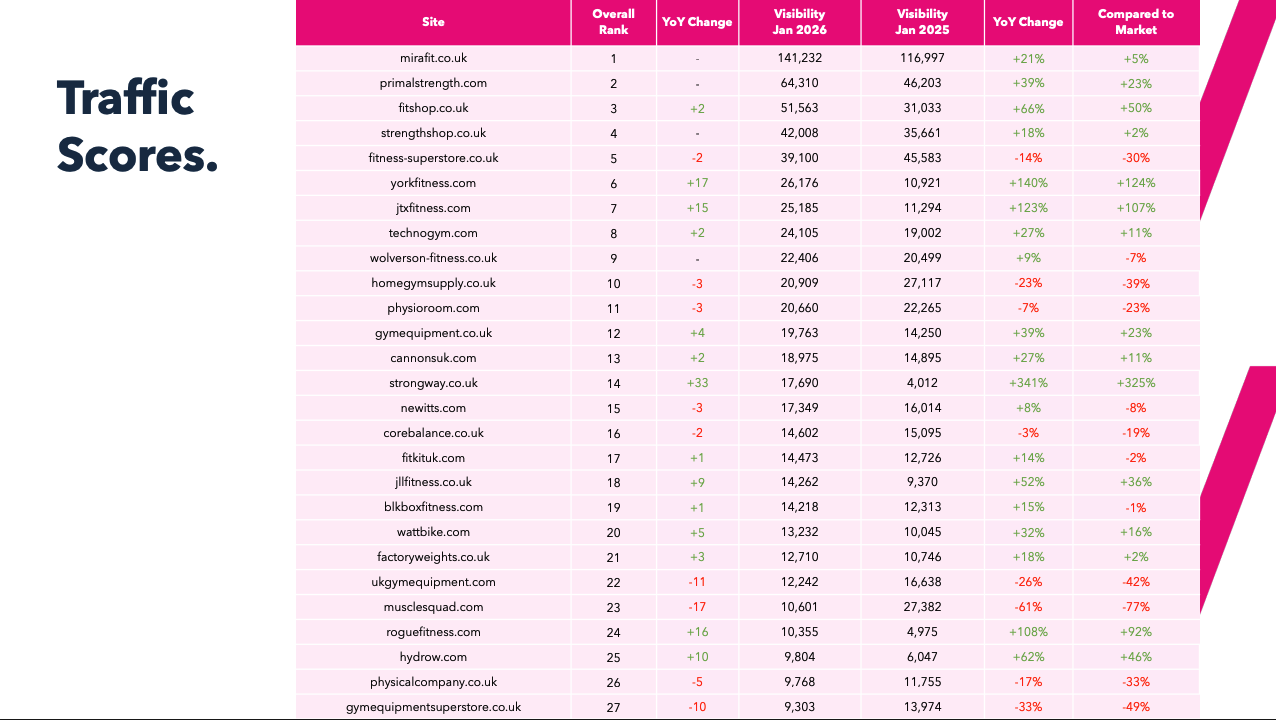
Organic visibility snapshot
| Brand | 2026 visibility | YoY change | Rank movement |
|---|---|---|---|
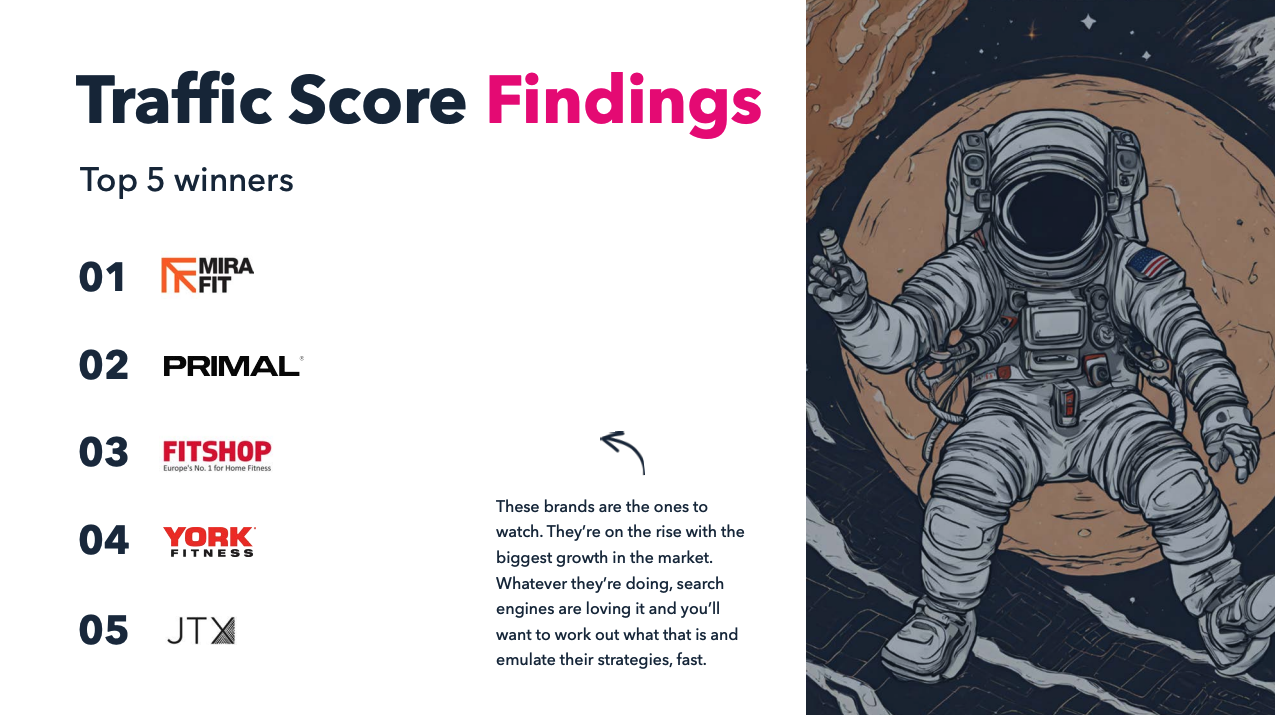
| Mirafit | 141,232 | +21% | 1 |
| Primal Strength | 64,310 | +39% | 2 |
| Fitshop | 51,563 | +66% | +2 |
| Strength Shop | 42,008 | +18% | 4 |
| Fitness Superstore | 39,100 | -14% | -2 |
| York Fitness | 26,176 | +140% | +17 |
| JTX Fitness | 25,185 | +123% | +15 |
| Technogym | 24,105 | +27% | +2 |
| Wolverson Fitness | 22,406 | +9% | 9 |
| Home Gym Supply | 20,909 | -23% | -3 |
What the table shows: Organic visibility is still the clearest read on who is commanding attention at scale. At the top of the market, the leaders are not just ranking well. They are creating distance.
The headline number is Mirafit. On 141,232 in visibility, it is nearly 2.2 times larger than Primal Strength, the nearest challenger. That is not a marginal lead. It is market-shaping. Below that, there is a second cluster where Primal Strength, Fitshop, Strength Shop and Fitness Superstore are all operating at meaningful scale, but with very different trajectories. Fitshop is growing fast and climbing, while Fitness Superstore is still top five but going backwards.
Why it matters: Search demand still exists, but it is no longer distributing evenly across familiar names. The strongest gains are showing up where brands are matching broad product relevance with site depth and clearer search journeys.
In fitness equipment, shoppers move between category-level queries, problem-led research and brand reassurance. Brands that meet all three stages look stronger. Brands that only win in one stage look exposed.
Fastest-rising brands by visibility growth
| Brand | 2026 visibility | 2025 visibility | YoY change |
|---|---|---|---|
| Reebok Fitness Equipment | 2,721 | 37 | +7,254% |
| Equipped Gym | 2,675 | 684 | +291% |
| Solo Fitness | 2,635 | 744 | +254% |
| York Fitness | 26,176 | 10,921 | +140% |
| Gravity Fitness | 8,037 | 3,354 | +140% |
| Cerberus Strength | 6,485 | 2,835 | +129% |
| JTX Fitness | 25,185 | 11,294 | +123% |
| Proform Fitness | 6,185 | 2,776 | +123% |
| KEFL | 5,890 | 2,661 | +121% |
| Jordan Fitness | 3,281 | 1,552 | +111% |
A few of these brands are coming from a low base, so the percentage swings need context. Even so, the pattern is clear. Mid-market and challenger brands are not waiting patiently for the leaders to make mistakes. They are taking share.
York Fitness, JTX Fitness and Gravity Fitness stand out because their gains are large in percentage terms and meaningful in absolute visibility too.
Key insight: Change is happening below the very top tier first. Search behaviour in this category is practical and fragmented, which creates openings for brands with sharper category structures and more useful supporting content.
Consumers search by goal, room, budget, product type, brand and training method. That creates openings for brands with sharper category structures and more useful supporting content. It also means legacy strength is no guarantee. Growth can come quickly when a brand becomes more discoverable across those different entry points.
Fastest-falling brands by visibility decline
| Brand | 2026 visibility | 2025 visibility | YoY change |
|---|---|---|---|
| NordicTrack | 3,113 | 12,673 | -75% |
| Pinnacle Fitness | 3,475 | 9,842 | -65% |
| Concept2 | 3,017 | 7,724 | -61% |
| Gym Gear | 6,394 | 15,612 | -59% |
| Sport and Leisure UK | 1,800 | 4,401 | -59% |
| Gym Kit UK | 1,657 | 2,812 | -41% |
| Home Fitness Code | 2,986 | 4,875 | -39% |
| Workout For Less | 6,219 | 7,893 | -21% |
| Origin Fitness | 4,521 | 5,715 | -21% |
| Home Gym Supply | 20,909 | 27,117 | -23% |
The striking point here is that several declining brands are still recognisable names. That suggests the issue is not only awareness. It may be discoverability across evolving search journeys.
Search is moving further towards usefulness, authority and brand trust signals. If your site architecture, content depth or category coverage lags behind those shifts, familiarity alone does not protect you.
Why it matters: During the home-workout boom, some brands benefited from compressed demand and simpler product intent. That environment has gone. People are searching with more nuance now.
They want equipment that fits a training goal, a living space, a budget and a long-term routine. Brands that fail to map to that more considered journey can lose ground quickly, even when they still have name recognition.
Emerging keyword demand
| Emerging keyword | Monthly searches | Interest trend |
|---|---|---|
| dumbbells | 74,000 | +17% |
| adjustable dumbbells | 27,100 | +6% |
| dumbbell bench | 9,900 | +31% |
| leg press equipment | 9,900 | +14% |
| chest bench press machine | 8,100 | +31% |
| extension leg machine | 8,100 | +22% |
| cable machines | 8,100 | +7% |
| running machine for home | 4,400 | +41% |
| back extension equipment | 3,600 | +69% |
| barbell bench | 3,600 | +61% |
| chest press incline machine | 1,600 | +82% |
| chest supported row machine | 1,000 | +88% |
| home cable workout machine | 880 | +98% |
| commercial weight equipment | 880 | +108% |
| walking machine for home | 480 | +176% |
There are two themes running through this list. First, strength equipment is still commanding attention. Dumbbells, benches, barbells and machine-led resistance terms are pulling strong demand. Second, search intent is becoming more specific.
People are not just searching for broad categories. They are searching for exact setups and use cases, from incline chest machines to home cable systems.
Action point: This suggests a market driven by more informed buyers, more research-led journeys and greater importance placed on content that reduces uncertainty.
Receding keyword demand
| Receding keyword | Monthly searches | Interest trend |
|---|---|---|
| treadmills | 90,500 | -12% |
| bicycle for workout | 49,500 | -13% |
| dumbbell sets | 40,500 | -6% |
| back exerciser | 27,100 | -24% |
| elliptical cross trainers | 27,100 | -23% |
| fold away treadmill | 14,800 | -28% |
| under desk treadmill | 9,900 | -49% |
| walking treadmill | 9,900 | -29% |
| desk treadmill | 8,100 | -38% |
| treadmill for home | 5,400 | -12% |
| mini treadmill | 2,400 | -30% |
| rower with water | 2,400 | -32% |
| cordless jump rope | 1,300 | -74% |
| ropeless skipping rope | 880 | -53% |
| mini elliptical | 210 | -84% |
This does not mean cardio is disappearing. It means the flavour of cardio demand is changing. Broad treadmill demand is still large, but it is softer. More novelty-led and lockdown-era product terms have cooled sharply.
That looks like a market moving away from impulse-driven convenience products and back towards considered purchases with clearer long-term use.
Why it matters: The fitness equipment shopper now appears more selective, more comparison-led and less swayed by temporary fads. Search is reflecting a buyer who wants equipment with purpose.
Brand demand + owned social score
| Brand | Monthly brand searches | Owned social score | Brand awareness rank |
|---|---|---|---|
| Technogym | 9,900 | 2,121 | 1 |
| Mirafit | 27,100 | 220 | 2 |
| Rogue Fitness | 2,900 | 1,653 | 3 |
| OnePeloton | 880 | 4,137 | 4 |
| Strength Shop | 12,100 | 132 | 5 |
| Primal Strength | 8,100 | 176 | 6 |
| Cerberus Strength | 2,900 | 490 | 7 |
| Wattbike | 6,600 | 148 | 8 |
| Fitness Superstore | 14,800 | 65 | 9 |
| Gravity Fitness | 2,400 | 291 | 10 |
Brand demand is becoming harder to ignore. In a noisier search environment, branded searches act as proof that people are looking for you, not just a product you happen to sell.
Technogym takes the top brand awareness rank without having the highest branded search volume, because its social presence is doing more work. Mirafit, by contrast, has the biggest branded search figure in this top 10 and pairs it with category-leading organic visibility. Those are two different models of strength, but both show why brand matters more now.
Key insight: Search and brand are no longer separate conversations. In categories like fitness equipment, buyers often research over time and across channels.
They may discover a brand through social, reviews, articles or word of mouth, then return later through branded search when they are closer to buying. That is why learn more about Salience’s Digital PR service feels relevant here: brand trust and visibility increasingly move together, and this market is a strong example of that.
Mirafit is the clearest case of a brand meeting the market where it is heading. It leads on visibility, commands 27,100 branded searches per month and is still growing. Salience’s own brand spotlight shows a business that supports users across product discovery, buyer guides, filters, educational content and richer product pages. You can see how Mira Fit built momentum in the market.
That matters because the sector is no longer being won by catalogue size alone. The brands pulling ahead are making the path from question to confidence shorter. In fitness equipment, confidence is everything.
Buyers want to know that a bench fits their training, that a cable machine fits their room, that a product is durable enough, and that the brand behind it knows what it is talking about.
Why it matters: The real separator seems to be whether a brand helps people make a better decision. As search habits become more fragmented and more informed, that kind of usefulness is likely to keep compounding.
The market is not simple, but it is not stagnant either. The 16% sector rise shows there is still growth in play. The sharp divergence between brands shows that growth is selective. That is the key takeaway.
For you, the opportunity sits in the gaps this data exposes. Strength-led demand is healthy. More specific machine and home-gym searches are rising. Brand demand is acting as a stronger signal. Some long-standing names are slipping. And the brands gaining ground are not all giant household names.
They are often the ones that make search journeys clearer, buying decisions easier and category authority more visible.
Action point: The next phase of the fitness equipment market will be shaped by brands that understand how people now research, compare and validate purchases. Search behaviour is becoming less generic and consumer expectations are becoming more exacting.
Generationally, that also points to shoppers who are comfortable doing their own due diligence and who expect brands to educate as well as sell.
In other words, this is no longer a market where visibility can be treated as a passive result. It is becoming a direct reflection of how well a brand understands real buyer intent. And in 2026, that is where the separation is happening.
| powerhouse-fitness.co.uk |
Yes, this report is 100%. All you have to do to get unlimited access is enter your information at the top of the page.
These are the largest fitness equipment retailers on the internet in 2019:
<ol>
<li>Physioroom.com</li>
<li>Fitness-superstore.co.uk</li>
<li>Gymequipment.co.uk</li>
<li>Powerhouse-fitness.co.uk</li>
<li>Sweatband.com</li>
<li>Strengthshop.co.uk</li>
<li>Technogym.com</li>
<li>Nordictrack.co.uk</li>
<li>Wattbike.com
<li>Concept2.co.uk</li>
</ol>
We have a minimum threshold that we consider when it comes to choosing the brands that get featured on in our exclusive reports. If your brand isn’t included, it might have not met our requirements in terms of visibility. However, if it does meet the threshold and still isn’t here, get in touch and we will re-run the analysis.
These brands have seen better days. Here’s a list of the brands that have seen the biggest decline in their visibility:
<ol>
<li>Kettlebells (-66%)</li>
<li>Gym Kit UK (-61%)</li>
<li>Sweatband (-58%)</li>
<li>Watson Gym (-39%)</li>
<li>Fitness Warehouse (-37%)</li>
</ol>
You’ll receive your report via email. All you have to do to claim your free report is input your information above, including your best email, and we’ll shot over the report instantly.
These brands have been fortunate to receive an increase in overall visibility this year. Copy and replicate what they’re doing and boost your SEO today!
<ol>
<li>Matrix Fitness (769%)</li>
<li>Jordan Fitness (624%)</li>
<li>Athlete Shop (406%)</li>
<li>Body Sculpture (270%)</li>
<li>Mira Fit (215%)</li>
</ol>