








 10
10  100
Brands Ranked
100
Brands Ranked 2026 Alcohol Industry Analysis: how a challenger doubled visibility in a flat market
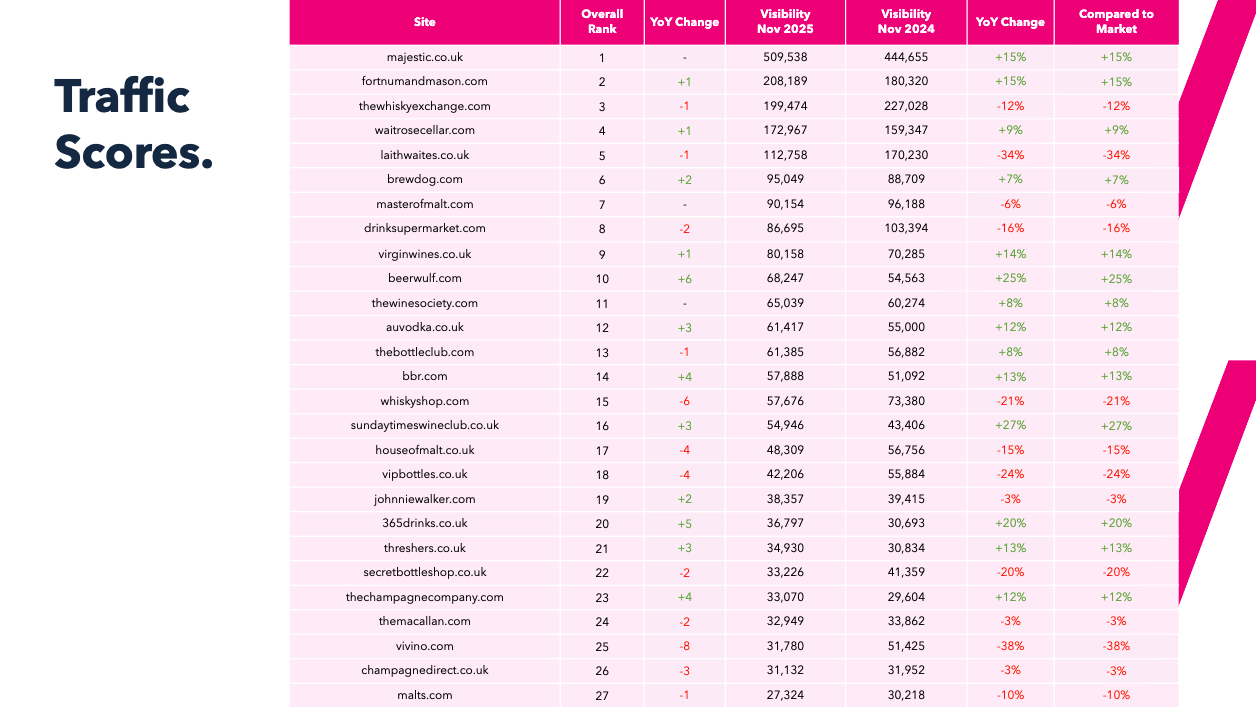
The Salience Index Alcohol 2026 report covers a 12-month view using visibility snapshots from November 2025 vs November 2024. The headline is stark: the sector’s average year-on-year change is 0%. Yet The Alcohol Free Co grew 95% and climbed 19 positions to #29. In a SERP where only 0.63% of searchers click page two, that kind of movement is rare. This piece unpacks why. It blends data from the report with a close read of the site experience, so you can act on it. If you want the full PDF, you can get the free 69-page report here.
One note upfront: the snapshot is taken in November, so some movement is helped by early Christmas demand. The year-on-year comparison controls for much of that, but seasonality still matters.
What we mean by “visibility” (so we’re speaking the same language)
The report’s headline metric is Traffic Score (labelled in-document as “Visibility Nov 2025” and “Visibility Nov 2024”). It’s not your GA4 sessions. It’s an independent estimate built from ranking positions across the top 100, search volumes, and estimated click-through rates. The strength of this metric is comparability. It lets you weigh brands on the same rules and see who is actually gaining share.
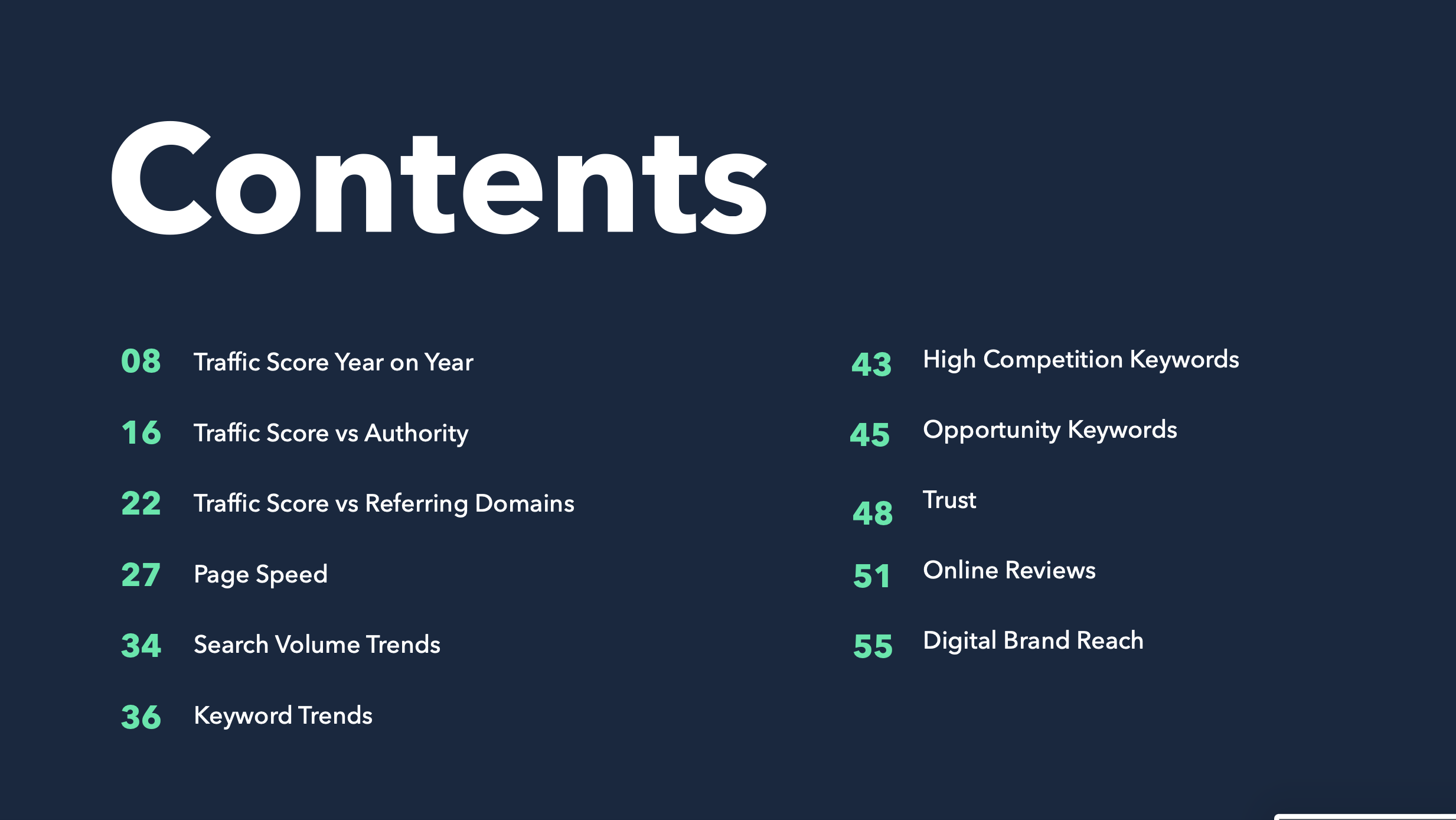
The report tracks 11 areas: traffic score, authority signals, referring domains, page speed, search volume trends, keyword competition and opportunity, trust, reviews, and digital brand reach. That’s the Salience lens: search performance is never “SEO in isolation”. It’s demand, content, tech, UX, trust, and brand working together.
Why we’re spotlighting The Alcohol Free Co (and not the giant at #1)
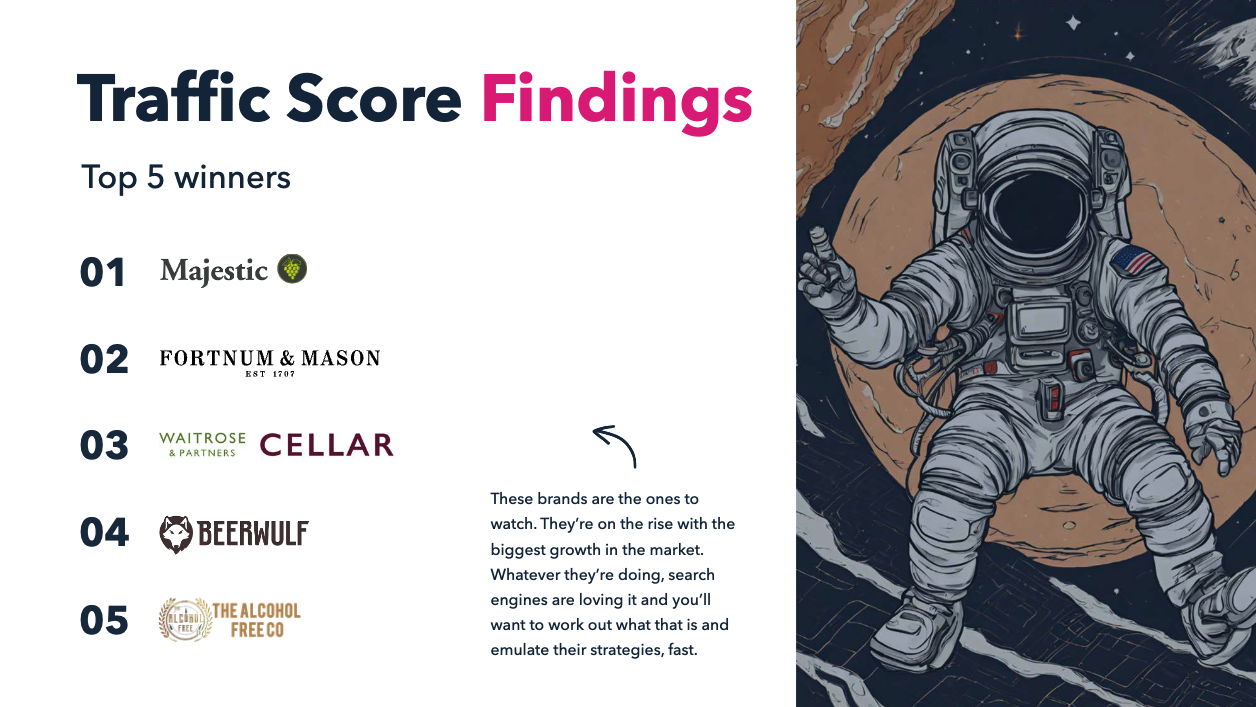
Majestic is #1 on Traffic Score. Fortnum & Mason is #2. Both grew year-on-year. Big brands often rise because they already have demand, links, and scale. The more instructive story is the challenger that sits outside the top 10 with less baked-in demand yet almost doubles visibility in a market that didn’t grow. That’s The Alcohol Free Co.
It also appears in the report’s Emerging Brands table. The brand search term “the alcohol free co” shows search volume of 210 with an interest trend of 98%. Useful momentum, but the bigger story is still non-brand.
The core idea: treat alcohol-free as its own department store
Most alcohol retailers treat no-and-low as a filter on a category page, a tiny sub-range, or a seasonal campaign. The Alcohol Free Co treats it as the whole shop. That choice changes what you can build:
- Many more landing pages that match real searches.
- Filters and content that help people narrow choices fast.
- Room for “help” content to live on commercial pages.
- Faster handoff from curiosity to basket.
When you’re trying to grow in organic search, structure is a weapon.
What they’re doing on-site that lines up with the numbers
We’re not guessing; we’re reading the site like a customer would.
1) The menu doubles as a keyword plan
Instead of a shallow “Beer / Wine / Spirits”, the main navigation builds out:
- Beer types (IPA, pale ale, stout/porter, sour, lager…)
- Dietary needs (gluten-free, vegan)
- Wine types (white, red, rosé, sparkling, mini bottles, mulled wine)
- Spirits framed as substitutes (rum alternatives, tequila alternatives, vodka alternatives, whiskey alternatives)
- Gifting and mixed packs
Each of these supports a logical landing page for queries like:
- “alcohol-free stout”
- “non-alcoholic IPA”
- “alcohol-free tequila alternative”
- “alcohol-free mulled wine”
- “gluten-free alcohol-free beer”
- “alcohol-free gifts under 25”
This is how you build non-brand coverage without thin blog posts. You give Google and users a page that’s clearly about one thing.
2) Category pages help people choose (not only scroll)
On the category pages we checked, filters are practical:
- ABV bands (including 0.0 and low-alcohol ranges)
- Vegan / gluten-free
- Size
- Brand filtering
That reduces choice overload. First-time alcohol-free shoppers worry about whether it’s truly 0.0, whether it tastes sweet, what it replaces, and whether it will arrive in time. Filters don’t answer everything, but they keep people on the page long enough to find a match. That behaviour—more product clicks, fewer bounces—often travels with organic growth.
3) They lean into occasion intent (which spikes at Christmas)
Because the snapshot is November, we paid attention to gifting. They don’t hide gift intent behind a generic “Gifts” tab. They build specific pages like “Gifts Under £25”, each with its own product list and supporting copy. That matters because gift shopping creates a different query pattern: budget-led (“under 25”, “under 50”), urgency-led (“next day”, “last posting date”), and taste-led (“for gin lovers”). You don’t need all of them; you need a structure that gives you a shot at them.
4) Product pages answer the “People Also Ask” set
On a product page we reviewed, content is structured into clear chunks: tasting notes, serving suggestions, food pairings, highlights, and additional info (ABV, size, dietary flags). That helps shoppers decide and gives the page more reasons to match informational queries. If you want growth without a huge blog, let commercial pages carry part of the “help” load.
5) Content stitched into commerce
Posts in an “Alcohol Free Insights” section link into collections and products. We looked at a Christmas collection post that links through to the bundles it mentions. The content has a job beyond “ranking for a keyword”: it routes readers into the buying path.
The numbers behind the story
Here are the headline stats pulled from the report.
| Metric (as shown in report) | The Alcohol Free Co |
|---|---|
| Site overall rank (Traffic Scores table) | 29 |
| Visibility Nov 2025 | 26,104 |
| Visibility Nov 2024 | 13,416 |
| YoY change | +95% |
| Position change | +19 |
| Market average YoY change | 0% |
Analysis — what this reveals about market dynamics
The flat market backdrop makes this growth stand out. When the tide isn’t rising, gains reflect share being taken from rivals, not just category expansion. In zero-sum conditions, intent alignment matters more than raw spend. A site that maps neatly to the way people search can out-execute bigger brands because it wastes fewer impressions and clicks.
Analysis — outward-looking implications
Across alcohol eCommerce, we’re seeing a slow shift from brand-led discovery to mission-led discovery. Shoppers start with constraints (“0.0”, “gluten-free”) or occasions (“gift under £25”) more often than they start with a particular brand. Sites that surface these intents in navigation and filters capitalise. Expect this to intensify as AI-driven SERP features summarise generic options and push users further down the funnel before they click. If you don’t own the long-tail, you’ll compete only on head terms—and those are a knife fight.
Benchmark context: the giants at the top
| Brand | Visibility Nov 2025 | YoY change |
|---|---|---|
| Majestic | 509,538 | +15% |
| Fortnum & Mason | 208,189 | +15% |
Analysis — what this reveals about market dynamics
Scale helps, but it doesn’t guarantee acceleration. The leaders grew, but not at the clip of the challenger. That suggests head terms and brand demand are relatively stable, while growth edges are opening around specialised queries and occasion-based searches. The leaders will always be hard to dislodge for core terms; share is more contestable in the mid-tail where structure and UX win.
Analysis — outward-looking implications
For mid-market players, trying to out-rank category leaders on “gin” or “whisky” is often sunk cost. The opportunity is to expand relevance around needs, constraints, and substitutes (e.g., alcohol-free rum alternatives, vegan-friendly beers, mixed taster packs). This pattern also reflects generational shifts: younger drinkers explore no-and-low and treat “taste + occasion + value” as the unit of decision, not heritage.
Brand demand: small today, moving fast
In the Emerging Brands list, “the alcohol free co” records 210 searches with 98% interest growth. In the overall brand-search ranking, The Alcohol Free Co sits at #48 (bottom of the top 50). That’s ideal for a challenger: visibility gains are not riding brand demand; they’re created by non-brand discovery that later turns into brand search.
Where the fights are: head terms vs opportunity terms
The report splits keyword space into high-competition head terms and under-served opportunities.
High-competition keywords (hard to win quickly)
| Keyword | Monthly search volume | Competitiveness |
|---|---|---|
| whisky | 135,000 | 84 |
| gin | 49,500 | 79 |
| rum | 40,500 | 71 |
Analysis — what this reveals about market dynamics
These terms are locked down by the biggest sites, marketplaces, and retailers with deep authority. Teams lean on paid here because organic gains are slow and expensive. If your strategy hinges on these alone, you’ll pay to stand still.
Analysis — outward-looking implications
Treat head terms as moats, not targets. Your organic strategy should orbit them, picking off adjacent needs where competition is lower and user intent is clearer. That lowers CAC and lifts conversion, because the page can be about something specific rather than a catch-all.
Opportunity keywords (volume with headroom)
| Keyword | Monthly search volume | Competitiveness |
|---|---|---|
| white wine | 10,000 | 4 |
| prosecco | 60,500 | 4 |
| cider | 201,000 | 8 |
Analysis — what this reveals about market dynamics
Plenty of mid-tier queries carry serious volume but aren’t saturated. This is where information architecture and on-page help win. A category that blends strong filters, scannable copy, and internal links to sub-types gives you a real shot.
Analysis — outward-looking implications
Use this list to stress-test your nav. If an “opportunity” keyword lacks a dedicated, helpful landing page, you’re leaving money on the table. Revisit your taxonomy quarterly; retire dead sub-categories and spin up new ones as trends emerge.
Demand doesn’t sit still: trend swing examples
The report’s Search Volume Trends section shows how interest moves for products and content.
| Topic | Monthly search volume | Interest trend |
|---|---|---|
| sloe gin | 27,100 | +93% |
| cider | 201,000 | −23% |
Analysis — what this reveals about market dynamics
Interest ebbs and flows inside categories that look stable from afar. “Sloe gin” is hot right now; “cider” is soft. If your roadmap is set once a year, you’ll ride these waves by accident rather than design.
Analysis — outward-looking implications
Build an iteration loop. Give merchandising and content teams a shared dashboard that highlights rising sub-topics and slipping stalwarts. Spin up seasonal and occasion-led collections ahead of the curve, and cull under-performers quickly. In short: move with demand, not behind it.
Trust: the hidden lever in alcohol eCommerce
Alcohol is a trust purchase. People worry about delivery, packaging, product quality (especially for alcohol-free), and whether the site is legitimate. The report notes that Google aims to prioritise trustworthy, credible brands—eCommerce and YMYL sites suffer the most when trust is thin.
It offers a simple checklist:
- Site-wide trust bar with delivery, returns, and support.
- Testimonials and review widgets on product pages.
- A robust review profile (e.g., Trustpilot) and a tidy Google Business Profile where relevant.
The Alcohol Free Co surfaces reviews on category and content pages, not just the product layer. Smart. We’re not claiming reviews caused the 95% growth, but they do influence clicks and conversion. The report quotes useful review stats:
- 98% pay attention to reviews from the last two weeks.
- 74% say trust in a company increases after reading positive reviews.
- 50% trust online reviews after reading 4–5 reviews.
Analysis — what this reveals about market dynamics
As AI features compress SERPs, brand signals do more work before the click. Strong review recency and volume make your result more clickable, and better post-click conversion feeds the flywheel that supports organic visibility.
Analysis — outward-looking implications
Treat reviews as part of search performance, not a social proof afterthought. Place them where decisions happen—on categories, products, and high-intent guides. Pair them with clear delivery and returns copy. Do the same with helpful FAQs and policy pages that reduce friction.
Speed still matters
A useful reminder from the report: a 1-second delay can lead to a 7% drop in conversions. You can’t afford that in a SERP where page two might as well not exist. Tidy up render-blocking scripts, compress images, and keep third-party widgets on a short leash—especially during peak traffic.
Three things to brief your team next week
-
Treat your menu and category structure like your SEO plan
Ask:
- Do our categories mirror how people search, or how we manage stock?
- Are we building pages for type, use case, and constraint (diet, budget, delivery), not just product families?
- Are we relying on filters that don’t generate indexable landing pages?
-
Make product pages do more of the “help” work
Add structured sections that answer common questions: taste profile, serving, pairings, ingredients and dietary flags, and “what it replaces” (for spirits and alcohol-free). This isn’t about stuffing keywords. It’s about giving pages more reasons to rank and convert.
-
Put trust signals where decisions happen
Treat reviews as a ranking-adjacent signal. Surface them on category pages and product pages. Keep delivery and returns copy clear and close. Don’t bury it in the footer.
Where this leaves the sector (and your roadmap)
You’re competing in SERPs where ads, retail aggregators, and AI features take up more space every quarter. You don’t get many second chances. Only 0.63% of searchers click results on page two.
The Alcohol Free Co shows how to win anyway:
- Build a deep, intent-led category structure.
- Help people choose on category pages.
- Write product pages that answer real questions.
- Stitch content back into commerce.
- Surface trust signals early.
Want to dive deeper? Get the free 69-page report for the full brand rankings, trends, and methodology. If you’d like to understand how we build the kind of content ecosystems described here, learn more about our Content Marketing service. And if you want to see what this looks like in practice, see how we helped a retailer dominate with human-first content.